


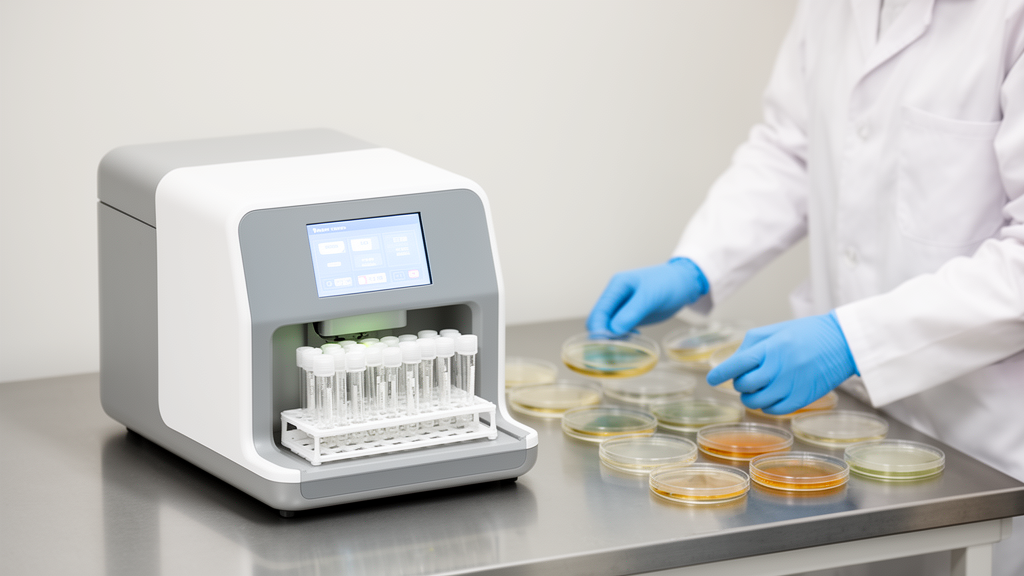
Urine cultures are among the most frequently ordered tests in clinical microbiology, yet the vast majority of them come back negative. Every negative culture represents wasted laboratory time, delayed answers for clinicians, and unnecessary costs for health systems. A new study from Turkey now reports how an automated urine analyzer that combines flow imaging with artificial intelligence could help laboratories cut down on these unnecessary cultures, with results that are promising but far from definitive.
The analyzer under evaluation, known as the MUS-1, uses a technique called flow cytometry to examine urine sediment. Instead of relying solely on chemical dipstick readings, it counts cells and bacteria directly under a microscope. The system then applies artificial intelligence to interpret the resulting images, classifying them as either likely positive or likely negative for urinary tract infection. This approach could allow laboratories to screen out negative cultures before they are set up, saving time and resources.
The study, published in the journal Clinical Chemistry and Laboratory Medicine, evaluated the MUS-1 on urine samples from patients suspected of having urinary tract infections. The researchers compared the analyzer’s results with conventional urine cultures, the gold standard for diagnosis. They found that the MUS-1 could correctly identify a substantial proportion of negative cultures, allowing them to be screened out before setup.
However, the results were far from perfect. The analyzer missed a notable number of positive cultures, meaning that some infections would have gone undetected if the MUS-1 were used as the sole screening tool. The researchers emphasized that the system should be used in combination with conventional cultures, not as a replacement for them.
The study also found that the MUS-1 performed better on urine samples from male patients than on samples from female patients. The researchers suggested that this difference might be related to variations in urine sediment composition between the sexes.
Despite these limitations, the researchers concluded that the MUS-1 represents a promising step forward in the effort to reduce unnecessary urine cultures. They emphasized that further studies are needed to confirm the system’s performance and to determine the best way to integrate it into laboratory workflows.
The study behind these findings was conducted at a tertiary hospital in Türkiye over a roughly two-week enrollment window in early 2024, during which 856 midstream urine specimens were collected from outpatient clinics and intensive care units. Each specimen was transported without delay and processed so that quantitative culture and automated analysis were performed on the same sample within an hour of laboratory arrival, with the MUS-3600 reading completed within ten minutes of collection. This tight timing matters, because delays between collection and analysis can allow bacteria to multiply or cells to degrade in the tube, artificially inflating particle counts and distorting the comparison against culture. After excluding 97 specimens judged contaminated by urethral flora, the final analysis rested on 759 samples from patients aged 18 to 96, split almost evenly between 409 female and 350 male participants, with the overwhelming majority, 96 percent, coming from outpatients.
The culture methodology followed conventional microbiological practice. Urine was plated on chromogenic agar and incubated at 35 to 37 degrees Celsius for 18 to 24 hours, with a threshold of at least 10,000 colony-forming units per milliliter for a single organism or each of up to two potential pathogens defining a positive result. Organisms were identified by MALDI-TOF mass spectrometry and susceptibility testing was carried out on a VITEK 2 Compact system, ensuring that the reference standard was robust and reproducible. Specimens yielding three or more species without a dominant organism were treated as contaminated and removed from the analysis, a standard safeguard against counting mixed urethral flora as infection.
The demographic pattern of the results deserves attention. Women made up nearly three-quarters of culture-positive cases, 72.5 percent, while men accounted for only 27.5 percent, a difference that was highly statistically significant. Median age was also slightly higher among culture-positive patients, 58 versus 54 years. These distributions help explain why the analyzer’s negative predictive value reached 93.9 percent in men but only 82.1 percent in women: when the pretest probability of infection is lower, as it was among the male samples in this cohort, a screening test naturally achieves a higher proportion of correct negative calls. This is a statistical property of predictive values rather than evidence that the instrument itself performs differently by sex, although differences in urine sediment composition between sexes may also contribute.
The particle-level data reveal why morphotype classification adds value. Median bacillus counts were 294 per microliter in culture-positive samples versus zero in culture-negative ones, and total bacteria medians were 1,080 versus 337.5 per microliter, both differences highly significant. Suspected coccus counts, while also statistically different, showed a much less dramatic separation, with medians of 650 versus 328 per microliter. This weaker discrimination likely underlies the poor screening performance of the suspected cocci parameter, which achieved only 44.4 percent sensitivity and 34.5 percent positive predictive value at its derived cutoff of 859 per microliter. Gram-positive organisms and contaminants can both appear as cocci on imaging, making this category intrinsically harder to interpret.
Chemical dipstick results provided complementary signals. Nitrite positivity was rare overall, 5.4 percent of samples, but when present it strongly indicated infection: 39 of 41 nitrite-positive specimens were culture-positive, whereas only 2 of 604 nitrite-negative culture-negative samples were falsely flagged. Leukocyte esterase positivity showed a similar directional pattern, with 64.7 percent of culture-positive samples testing positive compared with 19 percent of culture-negative ones. Neither chemical parameter alone was sufficient for screening, but the concordance between the imaging-based particle counts and the dipstick findings illustrates how multimodal urinalysis data could be combined in future algorithms.
The choice of a 10,000 colony-forming unit per milliliter threshold for positivity is itself consequential. Many laboratories use 100,000 units per milliliter for midstream specimens from symptomatic patients, and lower thresholds increase sensitivity for true infection at the cost of detecting more asymptomatic bacteriuria and low-count contamination. By adopting the stricter cutoff, the investigators classified more samples as positive, which raises the bar for the analyzer’s sensitivity figures. Had a higher threshold been used, some of the low-count positives that the analyzer missed might have been reclassified as negatives, potentially improving apparent screening performance. Readers comparing this study with other evaluations of automated urinalysis should therefore pay close attention to how culture positivity was defined.
The concept of an elimination rate, the proportion of culture-negative samples that the analyzer correctly identifies as negative and thus removes from the culture workload, is central to the economic argument for such systems. With a combined white blood cell and bacilli strategy, 77.2 percent of negative cultures could theoretically be eliminated, and the corresponding negative predictive value of 87.9 percent means roughly one in eight eliminated samples would actually harbor significant growth. Whether that error rate is acceptable depends on clinical context: for a healthy outpatient with uncomplicated symptoms, a 12 percent miss rate may be tolerable if clinicians retain the option to request culture, whereas for immunocompromised or pregnant patients it would likely be unacceptable.
It is also worth noting what the study excluded. Catheterized specimens, pediatric patients, samples with insufficient volume, and specimens with gross hematuria or mucus were all left out, and essentially no outpatients had received antibiotics before culture. Real-world populations include many patients whose antibiotic exposure suppresses bacterial counts, potentially widening the gap between analyzer readings and culture results. The narrow two-week enrollment at a single center likewise limits generalizability, and seasonal variation in circulating uropathogens could shift the balance of gram-positive versus gram-negative organisms, altering the relative value of the bacilli and cocci parameters.
The MUS-3600 itself integrates two modules, an H1600 urine chemistry analyzer and a FUS360 sediment analyzer, using flow-type micro-imaging in which particles are photographed in a flowing stream and classified by artificial intelligence algorithms. This differs from impedance- and fluorescence-based flow cytometry systems that have dominated prior evaluations of automated urine screening, and direct visual classification of bacterial morphotypes is a relatively new capability among commercial platforms. Independent validation in other laboratories, with different patient mixes and different local microbiology, will be needed before such morphotype-based cutoffs can be recommended broadly.
For now, the most defensible reading of the evidence is that the MUS-3600 functions as a rule-out aid rather than a rule-in test. Its negative predictive values, particularly the 93.9 percent figure in male outpatients, suggest it can meaningfully reduce culture volume in selected populations, while its modest sensitivity means positive or equivocal results must still trigger definitive culture. Laboratories considering adoption would need to establish their own cutoffs, monitor miss rates prospectively, and define clear escalation pathways so that no symptomatic patient is denied culture on the basis of a screening result alone.
Subject of Research: Laboratory Medicine
Article Title: Screening performance of the MUS-3600 urine analyzer for urinary tract infection: comparison with urine culture
Article References: Yalçınkaya Kara, Z. M., Genç, L., Odabaşı, M. S., & Aktaş, E. (2026). Screening performance of the MUS-3600 urine analyzer for urinary tract infection: comparison with urine culture. Acta Biochimica Polonica, 73, Article 16555. https://doi.org/10.3389/abp.2026.16555
Image Credits: AI Generated
Keywords: urine culture, flow cytometry, artificial intelligence, laboratory medicine, diagnostics, Screening, performance, MUS-3600, urine, analyzer, urinary, tract
Cite Scienmag News
Kristina Jarvis. (October 17, 2026). Screening performance of the MUS-3600 urine analyzer for urinary tract infection: comparison with urine culture. Scienmag. https://scienmag.com/screening-performance-of-the-mus-3600-urine-analyzer-for-urinary-tract-infection-comparison-with-urine-culture/
Kristina Jarvis. "Screening performance of the MUS-3600 urine analyzer for urinary tract infection: comparison with urine culture." Scienmag, 17 October 2026, https://scienmag.com/screening-performance-of-the-mus-3600-urine-analyzer-for-urinary-tract-infection-comparison-with-urine-culture/. Accessed 17 October 2026.
Kristina Jarvis. "Screening performance of the MUS-3600 urine analyzer for urinary tract infection: comparison with urine culture." Scienmag. October 17, 2026. https://scienmag.com/screening-performance-of-the-mus-3600-urine-analyzer-for-urinary-tract-infection-comparison-with-urine-culture/


