


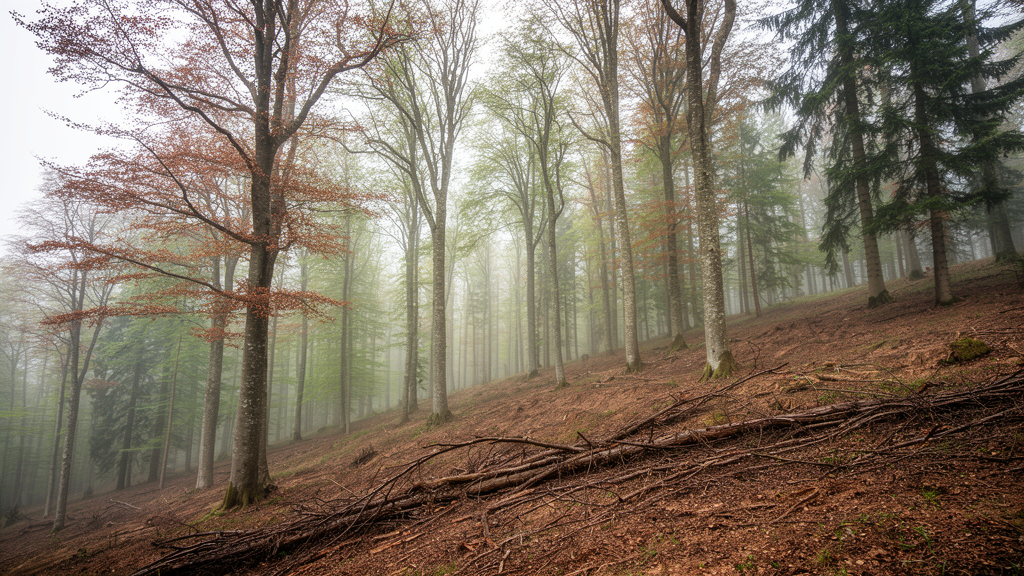
A forest can look perfectly intact from the roadside and still have lost much of its capacity to bounce back from the next drought, storm or fire. That unsettling gap between appearance and function is the central message of a new policy brief published by eLTER, the European research infrastructure dedicated to long-term ecosystem, critical zone and socio-ecological research. The document, titled Forests at Risk: Measuring and Building Resilience Against Extreme Climate Events, argues that resilience must stop being treated as a vague aspiration and instead become an explicit, quantifiable objective of European forest management and policy, one that is measured continuously rather than assessed only after damage has already occurred.
The numbers behind the warning are stark. Across Europe, the rate at which forests are damaged by drought, storms, wildfire and insect outbreaks has more than doubled over the past three decades, and climate-driven damage already costs several billion euros every year. Particularly worrying is the rise of compound events, in which one disturbance sets the stage for another: a severe drought weakens trees, and a subsequent fire or pest outbreak then magnifies the losses and slows recovery even further. These cascading interactions are becoming more common as the climate warms, yet they remain poorly captured by conventional monitoring and assessment systems, which tend to evaluate each disturbance in isolation.
Summer 2026 has made the issue tangible for policymakers and the public alike. Prolonged heat and drought stressed forests across much of the continent, and by late August wildfires had burned more than 630,000 hectares within the European Union, roughly twice the twenty-year average for that point in the season. Giorgio Vacchiano of the University of Milan, author of the policy brief, stresses that resilience is not simply a question of whether a forest is still standing after a disturbance. The real question, he argues, is whether forests can maintain their functions, regenerate and adapt as conditions change, and if those processes are not measured, they cannot be managed.
The stakes extend far beyond the timber economy. Extreme events put biodiversity, rural livelihoods and cultural landscapes at risk, and they raise the likelihood of floods and landslides in vulnerable terrain. Europe’s forests currently absorb around 360 million tonnes of carbon dioxide each year, a service of enormous value to continental climate policy, but that carbon sink is weakening as stands age, harvesting intensifies and disturbances grow more frequent. Without deliberate adaptation, the brief warns, the European Union’s climate targets become progressively harder to meet, because a shrinking forest sink must be compensated by deeper emissions cuts elsewhere in the economy.
One of the brief’s core criticisms is that forest monitoring and reporting still concentrate largely on how much forest exists and how much biomass it holds. Those figures matter, but they reveal little about whether a given stand can resist a shock, recover afterwards or adjust to a changing climate over decades. A plantation of uniform, drought-stressed trees may report impressive standing volume on paper while possessing almost no capacity to regenerate after a fire. The brief therefore calls for a broader suite of resilience indicators covering recovery capacity, regeneration success, structural and functional diversity, landscape connectivity, and the ability of species to adapt in place or shift their ranges as conditions change.
Technology has a crucial role to play in this shift. Satellite observation can supply early-warning signals long before decline becomes visible to a forester walking the ground. A drop in photosynthetic activity detected from orbit, for instance, can indicate that recovery is slowing and that a stand is approaching a critical threshold beyond which degradation accelerates. Remote-sensing time series of this kind are most powerful when paired with long-term field observation and scenario-based models that combine three dimensions of risk simultaneously: the climate hazard itself, the vulnerability of the forest, and its adaptive capacity. Together, these tools allow policymakers and forest managers to test what-if futures and to target intervention where it will deliver the greatest benefit.
The brief also translates analysis into practice, setting out management approaches that can demonstrably strengthen resilience. Among them are Closer-to-Nature and Climate-Smart Forestry, greater diversity of tree species and forest structures, restoration of hydrological function in degraded catchments, and carefully planned assisted migration of suitable species and provenances to areas where the climate is shifting faster than natural dispersal allows. Biodiversity is central throughout this agenda: complementary species and functions help forests absorb uncertainty while continuing to store carbon, regulate water flows and support rural livelihoods. Monocultures, by contrast, may perform well under average conditions but fail catastrophically when an extreme event exceeds their narrow tolerance range.
To move from principles to policy, the authors recommend five directions for action. These include mainstreaming climate-smart planning using resilience indicators and scenario modelling; introducing quantitative resilience targets into national forest, climate, adaptation and nature restoration strategies; investing in long-term observation and research infrastructures such as eLTER; supporting biodiversity-based and closer-to-nature management through payments for ecosystem services and well-designed nature credits; and aligning forest management more closely with natural disturbance regimes so that resilience and carbon uptake are sustained together. At the regional level, the brief points to fire-prevention planning in Tuscany and Lombardy, where climate projections, vegetation dynamics and fire-behaviour models are already being used to prioritise areas for intervention before ignition occurs.
Underpinning the entire argument is the claim that long-term observation is the missing link in European forest policy. Resilience cannot be read off a single measurement or judged only in the aftermath of a disaster; it has to be observed across years and decades. Through its distributed network of long-term research sites and socio-ecological platforms, eLTER tracks tree growth and mortality, soil moisture, carbon pools and water balance over exactly those timescales. Sustained field observation supplies the evidence needed to calibrate models and to test whether management interventions genuinely improve resistance and recovery, while comparable observations from across Europe make it possible to identify which approaches work, under which conditions and with which trade-offs.
Vacchiano summarises the case plainly: long-term observations are what turn resilience from an appealing concept into something that can be tested and improved, allowing scientists to see whether recovery is slowing, whether a forest is approaching a threshold, and whether management is actually increasing its capacity to cope with future extremes. Europe’s forests will keep meeting climate shocks, and the brief’s conclusion is that the continent faces a clear choice between reacting after each damaging event and building, in advance, the capacity to anticipate, absorb, recover and adapt. Whether that choice is made in time may determine not only the fate of Europe’s woodlands but the credibility of its climate commitments.
Subject of Research: Measuring and building the resilience of European forests against extreme climate events
Article Title: Europe's forests are still standing, but many are losing the ability to recover
Article References: Europe's forests are still standing, but many are losing the ability to recover. (n.d.). Original publication
Image Credits: AI Generated
DOI: Not provided
Keywords: forests, climate change, resilience, eLTER, wildfire, drought, carbon sink, biodiversity, forest management, long-term monitoring, remote sensing, policy brief
Cite Scienmag News
Gavin Prescott. (October 9, 2026). Standing but Struggling: Europe’s Forests Are Quietly Losing Their Power to Recover. Scienmag. https://scienmag.com/standing-but-struggling-europes-forests-are-quietly-losing-their-power-to-recover/
Gavin Prescott. "Standing but Struggling: Europe’s Forests Are Quietly Losing Their Power to Recover." Scienmag, 9 October 2026, https://scienmag.com/standing-but-struggling-europes-forests-are-quietly-losing-their-power-to-recover/. Accessed 9 October 2026.
Gavin Prescott. "Standing but Struggling: Europe’s Forests Are Quietly Losing Their Power to Recover." Scienmag. October 9, 2026. https://scienmag.com/standing-but-struggling-europes-forests-are-quietly-losing-their-power-to-recover/


