


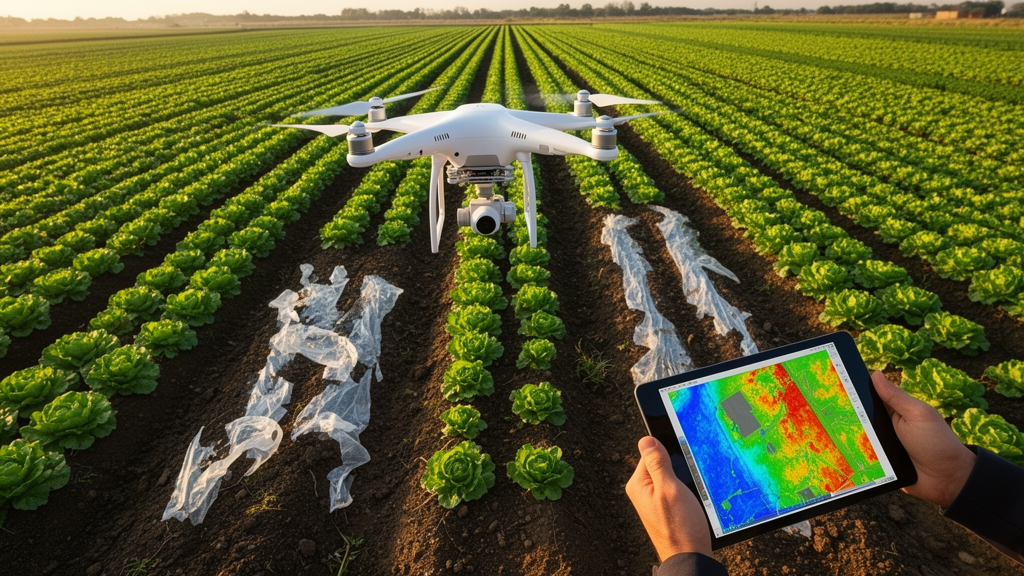
Every year, farmers around the world unroll billions of square metres of thin plastic film over their fields. Mulch films suppress weeds, conserve water, and warm the soil; greenhouse covers extend growing seasons and boost yields. But the same films that make agriculture more productive also shed fragments into the ground, and agricultural soils are now considered one of the largest sinks of plastic debris on the planet, potentially holding more plastic than the ocean surface. Once buried or scattered across a field, these residues are notoriously difficult to track, because the standard method — collecting soil samples and analysing them in the laboratory — is slow, expensive, and impossible to scale across whole landscapes. A new study published in the journal SOIL shows that a faster, bird’s-eye alternative may be within reach: drones equipped with ordinary cameras can spot plastic film residues on cropland, provided researchers understand both the promise and the pitfalls of the technology.
The research, led by Alessandro Fabrizi of the University of Augsburg together with colleagues in Germany and Belgium, set out to answer a deceptively simple question: can optical remote sensing, which has proven effective for spotting floating plastic in oceans and rivers, also work over soil? The team combined laboratory-grade spectroscopy with drone-based imaging to build a foundation for monitoring macroplastic residues — fragments larger than five millimetres — left behind after agricultural plastic film use. Their findings carry practical weight, because these macroplastic fragments are believed to be a major source of secondary microplastics in farmland, slowly breaking down into particles that can alter soil physics, chemistry, and biology.
The first stage of the study took place on a rooftop in Louvain-la-Neuve, Belgium, where the researchers measured the reflectance of eight different low-density polyethylene films — the dominant material in agricultural covers — under natural sunlight. The films came in black, white, and transparent variants, including double-sided black-and-white films measured from both faces, effectively yielding ten film types. Each film was tested in four conditions: pristine, crumpled by hand, dirty from being rolled in soil, and both crumpled and dirty. Two contrasting soils, a silt loam from the Belgian loam belt and a standard sandy loam, served as backgrounds. Using a high-resolution spectroradiometer covering wavelengths from the visible into the short-wave infrared, the team captured 82 samples with five replicate measurements each, building one of the first open-access spectral libraries of agricultural plastic films.
The spectra revealed a striking pattern. White films reflected intensely in the visible range and faded gradually toward longer wavelengths; black films stayed dark and nearly featureless across the entire spectrum; and transparent films largely mimicked the reflectance of the soil beneath them, their signal shaped by thickness and additives. Crucially, the measurements pinpointed absorption features — narrow wavelength regions where plastic absorbs light — at roughly 1215, 1730, 1765, 2312, and 2352 nanometres, all in the short-wave infrared. These features are chemical fingerprints of the polymer itself, and the researchers showed that spectral indexes built around them could unambiguously separate plastic films from soils and crop residues, even when the films were coated with dirt. Notably, crumpling barely changed the films’ reflectance, while soil contamination mainly dampened brightness without erasing the diagnostic absorption features.
Armed with this spectral knowledge, the team moved to the field. On an agricultural plot near Córdoba in southern Spain, they laid out 53 pieces of film — 21 black, 19 transparent, and 13 white — each cut to roughly five by ten centimetres and pinned to the soil with metal spikes whose positions were recorded with centimetre-accurate satellite navigation. A drone flying at just seven metres above ground carried a five-band multispectral camera capturing blue, green, red, red edge, and near-infrared light, producing images with a ground resolution of about half a centimetre per pixel. The researchers then trained a random forest classifier to distinguish plastic pixels from bare soil, shadows, and other objects, testing four different data configurations that traded spectral richness against spatial detail.
The results delivered a surprise that challenges conventional wisdom in remote sensing. All three datasets flown at half-centimetre resolution — full multispectral, plain RGB, and RGB with added band ratios — performed similarly at detecting the known films, while a multispectral dataset degraded to 1.2-centimetre resolution missed many transparent films. In other words, for detecting fragments around five centimetres across, spatial resolution mattered as much as or more than spectral resolution. Because ordinary RGB cameras capture finer detail at a given flight height, or cover larger areas faster at the same detail, the authors conclude that high-resolution colour cameras should be favoured over multispectral sensors for mapping macroplastic film residues with today’s off-the-shelf technology. This is good news for practitioners: cheap, lightweight cameras on consumer drones could become a routine screening tool for farm-level plastic audits.
But the study also exposed sobering limitations. Although the classifier found most of the real films, it dramatically overestimated the total plastic cover — by a factor of roughly 21 to 44, depending on the dataset. The errors followed a colour-coded logic. Black films were confused with shadows cast by soil clods left by recent tillage; white films were confused with brightly reflecting patches of soil; and transparent films blended almost invisibly into the soil background in the visible and near-infrared bands. These confusions are not mere artefacts of a single field. Shadows and variable illumination are inherent to arable land, and transparent films genuinely lack distinguishing colour. The authors suggest practical countermeasures — flying under uniform conditions at high solar elevation, using multi-temporal flights, or building high-resolution surface models — but acknowledge that truly robust detection of transparent and black films will require seeing beyond the visible spectrum.
That is where the study points toward a technological gap with real consequences. The short-wave infrared absorption features that unambiguously identify plastic are found only on expensive hyperspectral instruments, which demand low flight altitudes, long survey times, and heavy data processing — a combination that rules out large-scale monitoring. Yet the researchers demonstrated that even a broadband index spanning the 1715-nanometre absorption region separated plastic from nearly everything else on cropland, with only a handful of rare minerals overlapping. This suggests that a purpose-built miniaturised multispectral camera carrying a few broad bands centred on plastic absorption features, alongside high-resolution visible bands, could deliver unambiguous detection at low cost and low data volume. Such a sensor, the authors argue, would be a milestone for monitoring plastic contamination on land, and could even distinguish polymer types: polyethylene, polypropylene, and PVC share similar features, but PET — the stuff of bottles and litter — absorbs at different wavelengths, potentially allowing managers to separate agricultural residues from dumped waste.
The timing of this work is significant. Regulatory limits on plastic concentrations in soil are beginning to emerge in Europe, and demand for fast, standardised monitoring is likely to follow. Because macroplastic fragments fragment into microplastics over time, reliable mapping of the larger residues would also sharpen risk assessments for soil ecosystems, where experiments have shown that high plastic loads can degrade soil properties and harm plants, even though the thresholds for damage remain poorly quantified. The Augsburg team’s spectral library is openly available, inviting other researchers to develop new indexes and detection algorithms on a shared foundation.
For now, the message to farmers, agronomists, and environmental agencies is pragmatic: a consumer drone with a good colour camera, flown carefully, can already map plastic film residues well enough to identify which fields, films, and management practices generate the most debris — knowledge that is essential for designing sustainable plasticulture. But the study’s deeper legacy may be its blueprint for the next generation of sensors. By showing exactly where plastic betrays itself in the spectrum, and exactly where current cameras fall short, the researchers have drawn a clear target for engineers: build small, affordable instruments that look at farmland not just in the colours we see, but in the infrared fingerprints that plastic cannot hide.
Subject of Research: Optical remote sensing of agricultural plastic film residues in cropland soils
Article Title: Plastic film residues on cropland: monitoring soil contamination through optical remote sensing
Article References: Fabrizi, A., Fiener, P., Van Oost, K., & Wilken, F. (2026). Plastic film residues on cropland: monitoring soil contamination through optical remote sensing. SOIL, 12(1), 715-731. https://doi.org/10.5194/soil-12-715-2026
Image Credits: AI Generated
Keywords: plastic pollution, agricultural soils, remote sensing, drones, UAV, multispectral imaging, hyperspectral, plastic film, mulching, microplastics, spectral library, soil contamination
Cite Scienmag News
Reese Ellison. (October 9, 2026). Drones and Spectral Signatures Reveal Hidden Plastic Pollution on Farmland. Scienmag. https://scienmag.com/drones-and-spectral-signatures-reveal-hidden-plastic-pollution-on-farmland/
Reese Ellison. "Drones and Spectral Signatures Reveal Hidden Plastic Pollution on Farmland." Scienmag, 9 October 2026, https://scienmag.com/drones-and-spectral-signatures-reveal-hidden-plastic-pollution-on-farmland/. Accessed 9 October 2026.
Reese Ellison. "Drones and Spectral Signatures Reveal Hidden Plastic Pollution on Farmland." Scienmag. October 9, 2026. https://scienmag.com/drones-and-spectral-signatures-reveal-hidden-plastic-pollution-on-farmland/


