


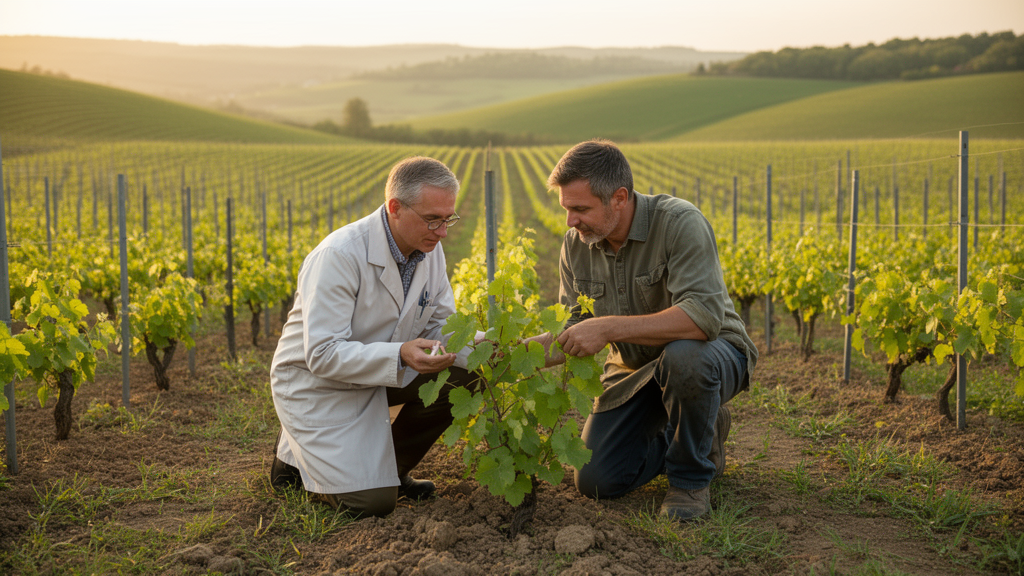
Downy mildew is one of the most destructive diseases in viticulture, and the fungicides used to control it are under increasing pressure from regulation, environmental concerns and the evolution of resistant pathogen strains. One of the most promising alternatives is to plant grapevine cultivars bred for genetic resistance to the disease. Yet resistance genes are not a permanent solution: when a resistant variety is deployed across a landscape, the pathogen can adapt, break through the plant’s defenses and render the variety useless. How growers arrange resistant vines across their vineyards, how quickly they plant them and whether they still apply fungicides can all shape how long that resistance lasts. A new study published in PLOS Sustainability and Transformation shows how these decisions can be made jointly by scientists and the people who actually run a wine business.
The research, led by Marta Zaffaroni and colleagues, was carried out in partnership with a French wine cooperative. Rather than asking growers to react to a finished model, the team used an action-research approach: over four workshops, cooperative managers and a multidisciplinary group of researchers sat together to design deployment strategies that were not only scientifically interesting but genuinely feasible for a real business operating a real landscape. This participatory framing matters, because deployment strategies that look optimal on paper often fail when confronted with practical constraints such as market demands, varietal identity, labor and the patchwork of plots that make up a working vineyard.
Out of those workshops came six candidate strategies for planting resistant cultivars, abbreviated RC in the study. The scenarios shared a common logic: resistant vines would replace old vines on plots more than thirty years old, which are natural candidates for replanting. Within that shared frame, the strategies differed in pace and placement. Some involved planting resistant cultivars on a fixed share of the older plots each year, set at 3.3 percent, producing a gradual rollout over decades. Others concentrated resistant vines in no-treatment zones, areas where fungicide spraying is restricted or impossible because of proximity to watercourses or human dwellings. Some scenarios also imposed a maximum percentage of resistant vines allowed in the vineyard, capping the overall share of the landscape planted with the new varieties.
To evaluate these six strategies, the team turned to the landsepi model, a simulation platform designed to capture how pathogens spread and evolve across agricultural landscapes. Landsepi treats the landscape as a mosaic of fields and tracks both the epidemiological dynamics of disease and the evolutionary dynamics of the pathogen population, including the emergence and establishment of strains capable of overcoming host resistance. The researchers implemented the strategies within the actual landscape of the cooperative, so the simulations reflected the real spatial arrangement of plots rather than an idealized grid. This landscape-scale realism is a key strength, because the spatial distribution of resistant and susceptible hosts strongly influences how quickly a pathogen can adapt.
The assessment rested on four families of criteria. The first was disease control efficacy, meaning how well each strategy kept downy mildew damage below damaging thresholds. The second was resistance durability, essentially how long the resistant cultivars remained effective before virulent pathogen strains became established. The third was the reduction in fungicide use, a central motivation for planting resistant varieties in the first place. The fourth was economic performance, evaluated both for individual vineyards and for the cooperative as a whole. By combining epidemiological, evolutionary and economic indicators, the study captured trade-offs that any single metric would have missed.
When the results were presented back to the cooperative, the managers prioritized one strategy above the rest: planting resistant cultivars in the no-treatment zones. This choice illustrates the value of the participatory process. The no-treatment strategy was not necessarily the top performer on every simulated metric, but it fit the cooperative’s broader practical constraints, including regulatory restrictions on spraying near sensitive areas. Putting resistant vines exactly where fungicides cannot be used converts an agronomic liability into an opportunity, protecting those plots genetically while leaving the rest of the landscape under conventional management.
The exercise also opened two scientific questions that have received little attention in the literature on resistance deployment. The first concerns fungicides: should growers keep spraying, even on and around resistant vines? The simulations showed that fungicide application substantially decreases the risk of resistance breakdown. Fungicides complement the epidemiological control provided by resistant cultivars, and this protective effect is particularly pronounced when the fitness costs of virulence are low, meaning the pathogen pays little penalty for evolving the ability to attack resistant plants. In that situation, reducing the pathogen population through chemical control also shrinks the evolutionary opportunity for resistance-breaking strains to emerge and spread.
The second question concerns speed: is it better to plant resistant cultivars rapidly or gradually? The simulations generally found that the probability of pathogens adapted to resistant cultivars becoming established was lower with gradual deployment than with rapid deployment. Spreading the new varieties over time keeps the landscape mosaic diverse for longer, making it harder for a specialized pathogen strain to find enough compatible hosts. However, the study uncovered a subtler and somewhat counterintuitive pattern: when adaptation did occur, the time to establishment was shorter under gradual strategies once the mean cropping ratio of resistant cultivars reached fifty percent or more. In other words, a slow rollout lowers the odds of breakdown but can accelerate it in the scenarios where breakdown happens anyway, because the resistant share of the landscape keeps climbing over time.
Perhaps the most sobering finding is that these deployment choices, despite their clear individual effects, had only a marginal overall impact on disease control. The reason lies in compensatory processes that partly cancel each other out. Dilution effects, in which resistant hosts interrupt the transmission of the pathogen among susceptible ones, improve epidemiological control as the resistant share grows. At the same time, a growing resistant share raises both the probability that a resistance-breaking strain will appear and the speed at which it establishes once it does. Rapid versus gradual deployment, spraying versus not spraying, each shift the balance between these epidemiological and evolutionary forces, but the net effect on disease levels tends to even out. This does not mean deployment strategy is irrelevant; durability and the timing of breakdown still differ between scenarios, and those differences matter to growers whose livelihoods depend on a variety remaining effective for decades.
Beyond the specific findings for viticulture, the study is a demonstration of what participatory, landscape-scale modeling can achieve. By building the scenarios with the cooperative rather than for it, the researchers ensured that the strategies were implementable, and the cooperative gained a quantitative understanding of the trade-offs behind its replanting decisions. The approach is directly transferable to other crops and other diseases where resistant cultivars are a cornerstone of integrated disease management. As agriculture seeks to reduce its reliance on fungicides, pesticides and other chemical inputs, the lesson from this French wine cooperative is that sustainable disease control is not just a breeding problem or a modeling problem. It is a design problem, best solved when the models of scientists and the knowledge of farmers are combined from the very start.
Subject of Research: Participatory landscape-scale modeling of disease-resistant grapevine cultivar deployment strategies with a wine cooperative
Article Title: Co-designing deployment strategies for disease-resistant cultivars: Insights from a participatory landscape-scale modeling study with a wine cooperative
Article References: Zaffaroni, M., Alonso Ugaglia, A., Miclot, A.-S., Rimbaud, L., Papaïx, J., Rey, J.-F., & Fabre, F. (2026). Co-designing deployment strategies for disease-resistant cultivars: Insights from a participatory landscape-scale modeling study with a wine cooperative. PLOS Sustainability and Transformation, 5(10), e0000286. https://doi.org/10.1371/journal.pstr.0000286
Image Credits: AI Generated
DOI: 10.1371/journal.pstr.0000286
Keywords: grapevine, downy mildew, resistant cultivars, resistance durability, landscape modeling, participatory research, wine cooperative, fungicide reduction, pathogen evolution, sustainable agriculture, landsepi, France
Cite Scienmag News
Courtney Benton. (October 9, 2026). Farmers and Scientists Model the Best Way to Plant Disease-Resistant Grapevines. Scienmag. https://scienmag.com/farmers-and-scientists-model-the-best-way-to-plant-disease-resistant-grapevines/
Courtney Benton. "Farmers and Scientists Model the Best Way to Plant Disease-Resistant Grapevines." Scienmag, 9 October 2026, https://scienmag.com/farmers-and-scientists-model-the-best-way-to-plant-disease-resistant-grapevines/. Accessed 9 October 2026.
Courtney Benton. "Farmers and Scientists Model the Best Way to Plant Disease-Resistant Grapevines." Scienmag. October 9, 2026. https://scienmag.com/farmers-and-scientists-model-the-best-way-to-plant-disease-resistant-grapevines/


