


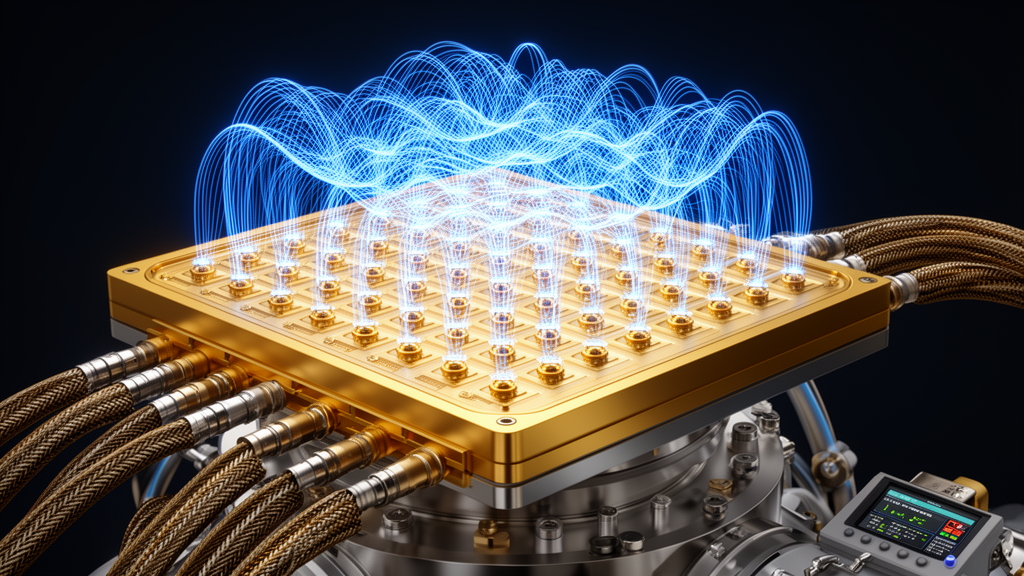
Chaos is one of the most familiar ideas in science. Weather systems, turbulent fluids, cardiac rhythms and even the traffic patterns of city buses all display the hallmark of chaos: infinitesimal changes in initial conditions grow into enormous differences in outcome. Since the pioneering work of Ott, Grebogi and Yorke in 1990, physicists have known that chaos in classical systems can be tamed with carefully designed feedback, nudging a wandering trajectory back toward stability whenever it strays. But a far harder question has lingered for decades: can the same trick work for quantum systems, where chaos scrambles quantum information across an entire many-body wavefunction and where the very act of measurement disturbs what you are trying to control? A large collaboration spanning IBM Quantum, Rutgers University, Iowa State University, the CUNY system, Louisiana State University and the Flatiron Institute has now answered that question in the affirmative, on real quantum hardware, and in doing so has uncovered a sharp phase transition between quantum and classical behavior.
The experiment, published in Nature Physics, was performed on an IBM superconducting quantum processor with up to 100 qubits. The team implemented a quantum version of the Bernoulli map, a textbook example of a classically chaotic dynamical system in which each step of the evolution stretches and folds the space of possibilities, rapidly amplifying any tiny perturbation. On the quantum side, this chaotic evolution has a dramatic consequence: it scrambles quantum information, spreading local information across the entire entangled state of the qubit register in much the same way that a drop of ink diffuses through a churning fluid. Left alone, the quantum state races toward an effectively maximally scrambled, thermal-like configuration that carries no memory of where it began.
To fight back against this scrambling, the researchers used adaptive monitored quantum circuits. The key ingredients are mid-circuit measurements and resets: the processor periodically measures individual qubits while the computation is still running, reads out the result, and then applies conditional feedback operations whose choice depends on what was just measured. Each measurement is a non-unitary operation, meaning it does not simply rotate the quantum state but rather collapses part of it, pruning branches of the wavefunction. The classical control loop then steers the dynamics toward a fixed point of the Bernoulli map, the stable destination that a fully controlled classical trajectory would reach. In this scheme, measurement is not a nuisance to be avoided but the very tool used to impose order.
The fundamental tension of the experiment is beautifully simple to state. The chaotic quantum map, built from entangling gates, works relentlessly to spread information and push the system toward quantum scrambling. The measurement-and-feedback machinery works in the opposite direction, repeatedly collapsing the state back toward a classical fixed point. Which force wins determines the character of the dynamics. When chaos dominates, the qubits end up in a scrambled quantum state that remembers nothing of its origin. When feedback dominates, the system settles into a stable, classically controlled configuration locked to the map’s fixed point. Between these two regimes, the collaboration predicted and then observed a dynamical phase transition, a critical point where the nature of the steady state changes abruptly as the balance of control is tuned.
Phase transitions are usually discussed in equilibrium thermodynamics, where water freezes into ice or a magnet loses its magnetization as temperature changes. But over the past several years, physicists have discovered that entirely analogous sharp transitions occur in the dynamics of open quantum systems. The best studied example is the measurement-induced phase transition, predicted independently in 2018 and 2019 by several groups: in a circuit that combines entangling gates with random measurements, the entanglement properties of the evolving state change qualitatively at a critical measurement rate. Those theoretical predictions were confirmed experimentally in 2022 and 2023 on superconducting and trapped-ion platforms. The new work extends this program in a crucial direction: rather than merely measuring, the circuit uses measurement outcomes to actively control chaotic dynamics, connecting the modern theory of monitored quantum circuits to the classical science of chaos control.
The scale of the experiment is what makes it remarkable. The team applied up to nearly 5,000 entangling gates and nearly 5,000 non-unitary mid-circuit operations on systems of up to 100 qubits, sustaining a measurement-and-feedback protocol over circuit depths that would have been unthinkable on early quantum hardware. Crucially, despite the noise and decoherence that plague any present-day processor, the device produced accurate estimates of universal critical properties, the quantitative fingerprints of the phase transition that do not depend on microscopic details. This shows that mid-circuit measurement, the same primitive that underpins quantum error correction, has matured to the point where it can serve as a genuine instrument of many-body physics rather than just a tool for correcting errors.
Interpreting such an experiment is a formidable theoretical challenge, because the very size of the 100-qubit Hilbert space forbids direct classical simulation of the full state. The collaboration therefore deployed a battery of complementary techniques. Noisy simulations of smaller systems captured the essential physics on sizes that classical computers can handle. Matrix product states, a tensor-network method that efficiently represents the mildly entangled states produced by measurement, extended the accessible system sizes. Finally, mappings onto statistical mechanics models allowed the team to identify the universality class of the transition, connecting the circuit dynamics to well-understood critical phenomena. The agreement between the hardware data and these theoretical tools provides strong evidence that the observed transition is a genuine critical phenomenon rather than an artifact of device noise.
The paper also reports an analysis of the quantum fluctuations of magnetization across the transition, measured through the Kullback-Leibler divergence, an information-theoretic quantity that quantifies how one probability distribution differs from another and whose system-size scaling reveals the critical point. Figures of this scaling, together with maps of the long-time steady state and the dynamical buildup of the transition, constitute the central evidence: as the feedback strength crosses a critical threshold, the distribution of outcomes changes shape in a way characteristic of a continuous phase transition, with fluctuations that grow and then reorganize according to universal critical exponents. In effect, the team has watched a quantum system choose, on the basis of control strength alone, whether to behave like a quantum machine or a classical one.
The implications reach in several directions at once. For quantum computing, the demonstration that adaptive, measurement-conditioned circuits can run thousands of non-unitary operations on a hundred qubits is a milestone for the dynamic circuits that future error-corrected machines will rely on. For fundamental physics, it establishes the first experimental realization of a control-induced phase transition, confirming theoretical predictions from 2023 and 2024 that measurement and feedback can drive entanglement and criticality in chaotic systems. And for the classical science of chaos, it extends a program that began with controlling cardiac arrhythmias and chaotic lasers into a regime where the object being controlled is not a trajectory in phase space but an entangled quantum wavefunction. Chaos, it turns out, can be ordered even at the edge of quantum mechanics, one measurement at a time.
Subject of Research: Control of quantum chaos and a quantum-to-classical dynamical phase transition using adaptive measurement-and-feedback circuits on a superconducting quantum processor
Article Title: Order from chaos with adaptive circuits on quantum hardware
Article References: Pokharel, B., Pan, H., Aziz, K., Govia, L. C. G., Ganeshan, S., Iadecola, T., Wilson, J. H., Jones, B. A., Deshpande, A., Pixley, J. H., & Takita, M. (2026). Order from chaos with adaptive circuits on quantum hardware. Nature Physics. https://doi.org/10.1038/s41567-026-03470-6
Image Credits: AI Generated
DOI: 10.1038/s41567-026-03470-6
Keywords: quantum chaos, quantum computing, superconducting qubits, mid-circuit measurement, feedback control, phase transition, monitored quantum circuits, measurement-induced phase transition, quantum scrambling, Bernoulli map, IBM Quantum, Nature Physics
Cite Scienmag News
Katie Riggs. (October 9, 2026). Taming Quantum Chaos: Feedback Circuits Bring Order on a 100-Qubit Processor. Scienmag. https://scienmag.com/taming-quantum-chaos-feedback-circuits-bring-order-on-a-100-qubit-processor/
Katie Riggs. "Taming Quantum Chaos: Feedback Circuits Bring Order on a 100-Qubit Processor." Scienmag, 9 October 2026, https://scienmag.com/taming-quantum-chaos-feedback-circuits-bring-order-on-a-100-qubit-processor/. Accessed 9 October 2026.
Katie Riggs. "Taming Quantum Chaos: Feedback Circuits Bring Order on a 100-Qubit Processor." Scienmag. October 9, 2026. https://scienmag.com/taming-quantum-chaos-feedback-circuits-bring-order-on-a-100-qubit-processor/


