


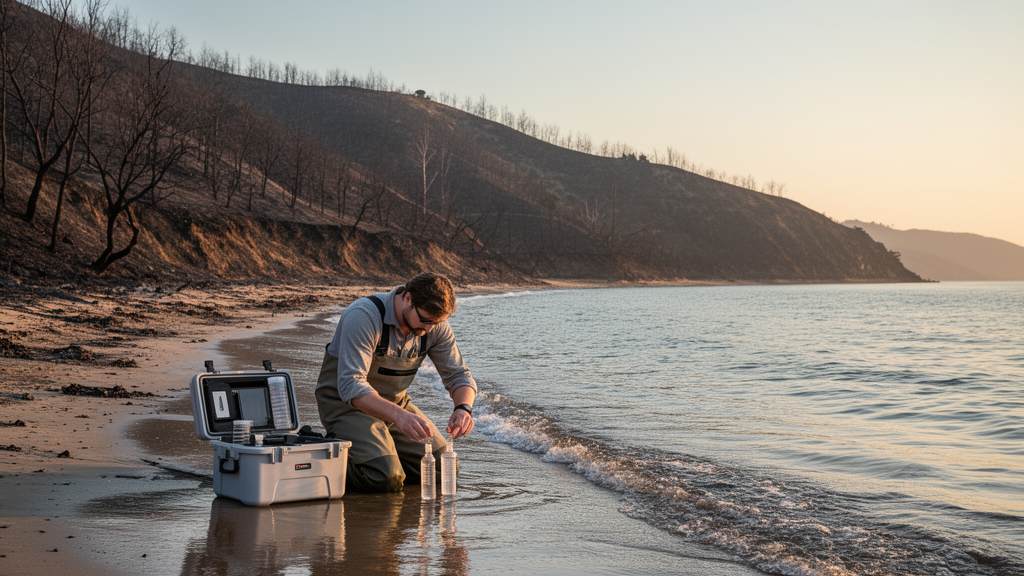
When wildfire sweeps through a coastal watershed in California, the damage is usually measured in acres burned and homes lost. But a new twenty-year investigation suggests the impacts continue to unfold in the water long after the smoke clears, in the form of shifting concentrations of fecal indicator bacteria in the coastal waters that millions of people use for swimming, surfing, and shellfishing. The study, published in PLOS Water, is the first attempt to generalize how post-fire bacterial responses play out across the entire California coast, and its findings point to a surprising divide between urbanized and wildland watersheds.
The research, conducted by Carl Swindle and Jean Carlson, integrates spatiotemporal datasets spanning 2003 to 2023, a period that covers some of the most destructive fire seasons in California’s recorded history. Rather than focusing on a single fire or a handful of monitoring stations, the team assembled monthly records of fecal indicator bacteria concentrations, land cover, precipitation, and burn histories for every watershed that drains into the California Coast. This comprehensive framing allowed the investigators to ask a question that has been difficult to answer at scale: does wildfire systematically alter the bacterial signature of the water reaching the Pacific?
Fecal indicator bacteria are the workhorses of water quality monitoring. The four groups examined in the study—Escherichia coli, total coliforms, fecal coliforms, and Enterococcus—are used by public health agencies worldwide as proxies for the possible presence of harmful pathogens. None of these indicators is necessarily dangerous in itself, but elevated concentrations signal that fecal material from humans, animals, or environmental reservoirs has entered the water system. Because coastal water quality directly affects recreation, aquaculture, and ecosystem health, understanding what drives fluctuations in these bacteria has practical consequences far beyond academic curiosity.
The methodological core of the study lies in how it defines what is normal. For each coastal watershed, the researchers calibrated monthly background concentrations of fecal indicator bacteria during periods without recent fire, establishing a local baseline that accounts for the natural seasonal rhythms of bacterial abundance. Anomalies were then identified relative to these baselines, both during burn periods—defined as intervals when more than ten percent of a watershed had burned within a two-year window—and during non-burn periods. Crucially, the anomalies were normalized by the local baseline concentrations, which means the analysis compares proportional departures from normal rather than raw concentrations that would be dominated by inherently dirty or clean sites.
This normalization matters because bacterial concentrations vary enormously across California’s coastal watersheds, from heavily urbanized drainages around Los Angeles to forested catchments in the northern part of the state. A raw measurement approach might simply rediscover that urban streams carry more bacteria. By measuring how much each watershed’s bacterial levels deviate from its own expectations after fire, the researchers isolated the fire signal from the background noise of geography, season, and land use. The result is a dataset in which the fingerprints of wildfire can be compared across dozens of dissimilar landscapes.
The correlations that emerged are strikingly land-cover dependent. During burn periods, anomalous total coliform concentrations showed a negative correlation with urban land cover fraction and positive correlations with coastal oak woodland, mixed chaparral, and redwood land cover, as well as with monthly precipitation. In other words, the biggest post-fire surges in total coliforms occurred in the least urbanized, most vegetated watersheds, and wet months amplified the effect. Burn-period fecal coliform anomalies, by contrast, exhibited a positive correlation with urban land cover fraction, suggesting a different source and a different mechanism altogether.
The interpretation the authors offer is that these two patterns reflect two distinct post-fire bacterial pathways. The prominent export of total coliform bacteria in watersheds with little urbanization may originate from decaying plant material and soils, which fire leaves destabilized and ready to be flushed into streams by rain. Total coliforms include many species that are native to soils and vegetation rather than fecal sources, so a fire that kills and decomposes vegetation could plausibly seed waterways with these organisms. In urbanized watersheds, the elevated fecal coliform anomalies point instead to humans and animals as the likely sources, with fire-altered hydrology—reduced infiltration, increased runoff, and damaged infrastructure—transporting fecal material to coastal waters more efficiently than before.
Not every correlation survived statistical scrutiny, and the study’s rigor in this respect strengthens its conclusions. When the researchers applied the Benjamini–Hochberg false discovery rate correction, a procedure designed to control the expected proportion of false positives among many simultaneous statistical tests, several relationships held firm. Positive correlations between burn-period total coliform anomalies and both monthly precipitation and coastal oak woodland land cover persisted, as did the negative correlation between total coliform anomalies and urban land cover. For Escherichia coli, positive correlations with mixed chaparral land cover and negative correlations with redwood land cover also survived the correction. These corrected findings represent the most defensible core of the study’s evidence.
The precipitation connection deserves particular attention in a state defined by climatic extremes. California’s fire seasons and its rainy seasons are increasingly colliding, as atmospheric river storms arrive in autumn and winter while fire scars from the previous summer remain fresh. The finding that burn-period total coliform anomalies correlate positively with monthly precipitation implies that the first substantial rains after a fire may deliver pulses of bacteria to the coast, a dynamic familiar from post-fire studies of sediment and nutrient runoff. For water quality managers, this suggests that the highest-risk windows for coastal bacterial contamination may follow the combination of a significant burn and a significant storm, especially in watersheds dominated by oak woodland and chaparral vegetation.
What makes the study a genuine advance is its generality. Previous work on fire and water quality has typically examined individual fires and their immediate downstream effects, producing results that are valuable but hard to extrapolate. By quantifying average bacterial concentrations, land cover, precipitation, and burn histories for every month across all watersheds flowing into the California Coast over two decades, Swindle and Carlson have produced the first effort to generalize post-fire fecal indicator bacteria responses in coastal waters. The patterns they document are not anecdotes from a single disaster but statistical regularities that emerge when many fires, many watersheds, and many seasons are considered together.
The practical implications extend to public health and environmental management. Coastal water quality monitoring in California already triggers beach advisories when indicator bacteria exceed regulatory thresholds, and shellfish harvesting areas can be closed on the same basis. If fire reliably shifts the bacterial baseline of affected watersheds, then post-fire periods may warrant intensified monitoring, particularly in less urbanized catchments where total coliform surges are strongest and in urban drainages where fecal coliform export rises. The authors note that the results may inform future risk assessments, and the land-cover specificity of their findings gives managers a way to prioritize: a burned redwood or oak woodland watershed responds differently than a burned suburban one.
There are also broader scientific questions raised by the work. The proposed mechanism for wildland watersheds—bacterial export from decaying plant material and disturbed soils—connects fire ecology to microbial ecology in a way that could be tested with targeted sampling of burn scars. The urban pathway, involving fecal material from humans and animals, raises questions about how fire damages or overwhelms stormwater and sanitation systems, and whether infrastructure hardening could reduce post-fire bacterial export. And because the study covers a period of accelerating fire activity in California, it provides a baseline against which future, potentially more extreme, fire regimes can be compared.
As climate change lengthens fire seasons and pushes flames into new terrain, the boundary between terrestrial disturbance and coastal water quality is becoming harder to ignore. This twenty-year investigation demonstrates that the connection is measurable, systematic, and shaped by the human geography of the landscape. The waters off California’s coast, it turns out, carry a chemical and microbial memory of the fires that burned upstream—and reading that memory may soon be an essential part of protecting both public health and the coastal ecosystems that depend on clean water.
Subject of Research: Post-wildfire changes in fecal indicator bacteria concentrations in California coastal watersheds
Article Title: Coastal water bacterial responses to wildfires in California: A twenty-year investigation
Article References: Coastal water bacterial responses to wildfires in California: A twenty-year investigation. (n.d.). https://doi.org/10.1371/journal.pwat.0000589
Image Credits: AI Generated
DOI: 10.1371/journal.pwat.0000589
Keywords: wildfire, coastal water quality, fecal indicator bacteria, Escherichia coli, total coliforms, fecal coliforms, Enterococcus, watersheds, land cover, precipitation, California, PLOS Water
Cite Scienmag News
Violet Maxwell. (October 9, 2026). After the Flames: Wildfires Reshape Bacterial Pollution in California’s Coastal Waters. Scienmag. https://scienmag.com/after-the-flames-wildfires-reshape-bacterial-pollution-in-californias-coastal-waters/
Violet Maxwell. "After the Flames: Wildfires Reshape Bacterial Pollution in California’s Coastal Waters." Scienmag, 9 October 2026, https://scienmag.com/after-the-flames-wildfires-reshape-bacterial-pollution-in-californias-coastal-waters/. Accessed 9 October 2026.
Violet Maxwell. "After the Flames: Wildfires Reshape Bacterial Pollution in California’s Coastal Waters." Scienmag. October 9, 2026. https://scienmag.com/after-the-flames-wildfires-reshape-bacterial-pollution-in-californias-coastal-waters/


