

Sunday, October 25, 2026
Science
No Result
View All Result
  • Login
  • HOME
  • SCIENCE NEWS
  • CONTACT US
  • HOME
  • SCIENCE NEWS
  • CONTACT US
No Result
View All Result
Scienmag
No Result
View All Result
Home Science News Agriculture

Stable wheat locus on chromosome 4BS linked to drought tolerance at germination

October 25, 2026
in Agriculture
Alan Morgan
By Alan Morgan Scienmag Editorial Profile - Precision Agriculture
Reading Time: 3 mins read
0
Stable wheat locus on chromosome 4BS linked to drought tolerance at germination

Stable wheat locus on chromosome 4BS linked to drought tolerance at germination

65
SHARES
587
VIEWS
Share on FacebookShare on Twitter
ADVERTISEMENT

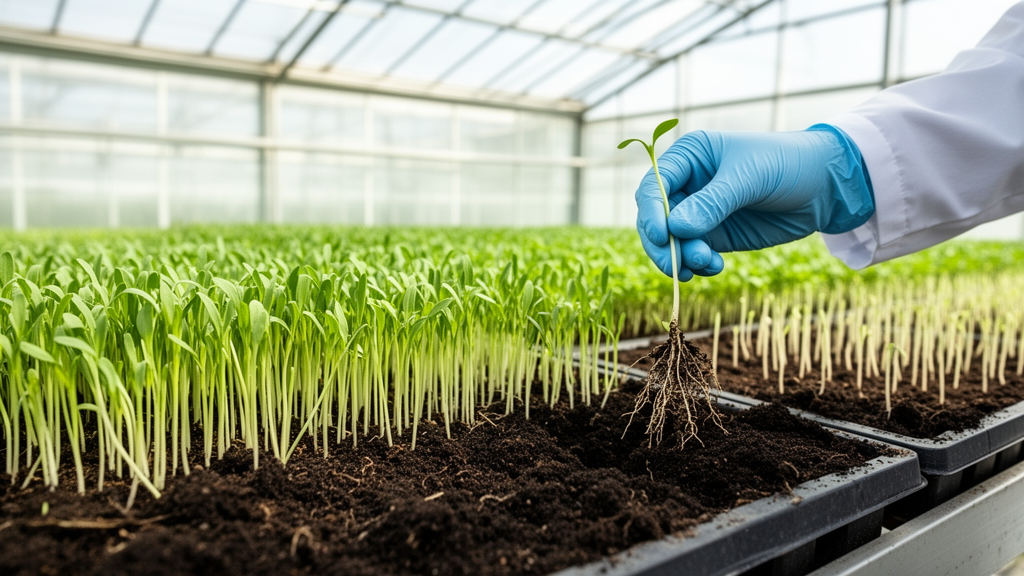
Drought striking at the moment a wheat seed germinates can devastate stands before a crop ever establishes. A study published in Theoretical and Applied Genetics now reports the identification of a stable major locus on wheat chromosome arm 4BS that influences both early shoot growth and the plant's response to drought stress during germination. The work, led by Jiajun Liu, Defu Wang and Qinghong Zhou with colleagues under the senior authorship of Jian Ma, combined quantitative trait locus (QTL) mapping with bulked segregant analysis sequencing and transcriptomics to investigate the genetic basis of this trait.

The team used a recombinant inbred line (RIL) population derived from two parent varieties. Seedlings were grown under both control conditions and drought treatment at the germination stage, and the researchers measured three seedling traits: maximum root length, root number and shoot height. Across these conditions they detected 21 QTLs, the statistical signatures of genomic regions contributing to trait variation.

Among these, three signals—QSH.scwl-CK-4B, QSH.scwl-DT-4B and QRSH.scwl-4B—co-localized to a common region on chromosome arm 4BS, indicating that a single locus exerts pleiotropic effects on both basal shoot growth and the drought-stress response. The most striking result came from QRSH.scwl-4B, which was independently recovered through bulked segregant analysis sequencing, a method that pools the genomes of plants with extreme phenotypes to locate causal regions. Mapping placed the locus within a 2.09 megabase interval on 4BS, and across analyses it explained between 24.32% and 30.89% of the phenotypic variation—a substantial share for a single locus in a complex trait.

By integrating RNA sequencing data with the bulked segregant results and sequencing of the two parental genomes, the researchers identified two putative candidate genes within the interval, TraesCS4B03G0104700 and TraesCS4B03G0102800. KEGG pathway enrichment analysis suggested that TraesCS4B03G0104700 may regulate drought tolerance during germination through jasmonic acid biosynthesis, a plant hormone pathway involved in stress responses. The authors present this as a mechanistic hypothesis supported by enrichment evidence rather than a functionally validated conclusion.

Crucially for breeding programs, the locus appears to carry a favorable trade-off profile. The positive allele of QRSH.scwl-4B increased productive tiller number—the number of grain-bearing heads per plant, a direct yield component—by 13.37%, while showing only limited adverse effects on other yield-related traits. The authors describe QRSH.scwl-4B as a promising locus for improving wheat drought tolerance with potentially minimal negative impact on yield.

The findings represent a foundation for cloning the locus and for improving drought tolerance through molecular breeding, rather than a finished product. The candidate genes remain putative, and the study was conducted in a single RIL population at the germination stage, so the results will need confirmation in other genetic backgrounds and environments. Even so, the convergence of QTL mapping, sequencing-based bulk analysis and transcriptomics on the same 4BS interval, together with the observed benefit to a yield component, marks QRSH.scwl-4B as a notable target for further research.

The authors state that these findings collectively provide a basis for cloning the locus and for improving drought tolerance in wheat through molecular breeding.

Subject of Research: Genetic mapping of a drought-tolerance locus and candidate genes for wheat germination on chromosome 4BS

Article Title: Identification of a stable major locus and candidate genes for drought tolerance during wheat germination

Article References: Liu, J., Wang, D., Zhou, Q., Qin, N., Liu, J., Liu, X., Li, Y., Peng, H., & Ma, J. (2026). Identification of a stable major locus and candidate genes for drought tolerance during wheat germination. Theoretical and Applied Genetics, 139(11), Article 317. https://doi.org/10.1007/s00122-026-05422-3

Image Credits: AI Generated

DOI: 10.1007/s00122-026-05422-3

Keywords: wheat, drought tolerance, germination, QTL mapping, chromosome 4BS, jasmonic acid, candidate genes, bulked segregant analysis, RNA sequencing, productive tiller number, molecular breeding, recombinant inbred lines

Cite Scienmag News

Alan Morgan. (October 25, 2026). Stable wheat locus on chromosome 4BS linked to drought tolerance at germination. Scienmag. https://scienmag.com/stable-wheat-locus-on-chromosome-4bs-linked-to-drought-tolerance-at-germination/


Alan Morgan. "Stable wheat locus on chromosome 4BS linked to drought tolerance at germination." Scienmag, 25 October 2026, https://scienmag.com/stable-wheat-locus-on-chromosome-4bs-linked-to-drought-tolerance-at-germination/. Accessed 25 October 2026.

Alan Morgan. "Stable wheat locus on chromosome 4BS linked to drought tolerance at germination." Scienmag. October 25, 2026. https://scienmag.com/stable-wheat-locus-on-chromosome-4bs-linked-to-drought-tolerance-at-germination/

Tags: bulked segregant analysisbulked segregant analysis in cropscandidate geneschromosome 4BSchromosome 4BS wheat locusdrought toleranceDrought tolerance in wheat germinationdrought-resistant wheat breedingearly-stage wheat stress response geneticsgenetic basis of drought response in wheatgerminationjasmonic acidmolecular breedingpleiotropic effects of wheat lociproductive tiller numberQTL mappingquantitative trait locus mapping in wheatrecombinant inbred linesRNA sequencingstable genetic markers for drought tolerancetranscriptomics in drought stresswheatwheat genetic analysis under drought conditionswheat seedling root and shoot traits
Share26Tweet16
Previous Post

Galaxy Clusters Reveal Hints of Cosmic Anisotropy, but the Universe Refuses to Break Its Symmetry Just Yet

Next Post

Barrel-shaped rolls bring ultra-thin metal foils closer to perfect uniformity

Related Posts

Chloroplast genomes support Petrocodon phylogeny on China’s Guizhou karst plateau
Agriculture

Chloroplast genomes support Petrocodon phylogeny on China’s Guizhou karst plateau

October 25, 2026
How Long You Stew Pork Intestine Decides Its Aroma, Chemistry Reveals
Agriculture

How Long You Stew Pork Intestine Decides Its Aroma, Chemistry Reveals

October 25, 2026
AI Spots Which Pig Is Coughing in Crowded Pens, Even at Night
Agriculture

AI Spots Which Pig Is Coughing in Crowded Pens, Even at Night

October 25, 2026
Extreme rainfall remobilizes mining tailings metals and stresses coastal Restinga plants
Agriculture

Extreme rainfall remobilizes mining tailings metals and stresses coastal Restinga plants

October 25, 2026
Mixing Selection Tools Beats Standard Breeding in Simulated Oat and Wheat Programs
Agriculture

Mixing Selection Tools Beats Standard Breeding in Simulated Oat and Wheat Programs

October 25, 2026
Knockout study links PP2 to phloem defense against viroid and virus
Agriculture

Knockout study links PP2 to phloem defense against viroid and virus

October 25, 2026
Next Post
Barrel-shaped rolls bring ultra-thin metal foils closer to perfect uniformity

Barrel-shaped rolls bring ultra-thin metal foils closer to perfect uniformity

  • Mothers who receive childcare support from maternal grandparents show more optimized

    Mothers who receive childcare support from maternal grandparents show more parental warmth, finds NTU Singapore study

    27656 shares
    Share 11059 Tweet 6912
  • University of Seville Breaks 120-Year-Old Mystery, Revises a Key Einstein Concept

    1061 shares
    Share 424 Tweet 265
  • Bee body mass, pathogens and local climate influence heat tolerance

    682 shares
    Share 273 Tweet 171
  • Researchers record first-ever images and data of a shark experiencing a boat strike

    546 shares
    Share 218 Tweet 137
  • Groundbreaking Clinical Trial Reveals Lubiprostone Enhances Kidney Function

    531 shares
    Share 212 Tweet 133
Science

Embark on a thrilling journey of discovery with Scienmag.com—your ultimate source for cutting-edge breakthroughs. Immerse yourself in a world where curiosity knows no limits and tomorrow’s possibilities become today’s reality!

RECENT NEWS

  • Barrel-shaped rolls bring ultra-thin metal foils closer to perfect uniformity
  • Stable wheat locus on chromosome 4BS linked to drought tolerance at germination
  • Galaxy Clusters Reveal Hints of Cosmic Anisotropy, but the Universe Refuses to Break Its Symmetry Just Yet
  • CT biomarkers assess immunotherapy response and surgical planning in lung cancer

Categories

  • Agriculture
  • Anthropology
  • Archaeology
  • Athmospheric
  • Biology
  • Biotechnology
  • Blog
  • Bussines
  • Cancer
  • Chemistry
  • Climate
  • Earth Science
  • Editorial Policy
  • Marine
  • Mathematics
  • Medicine
  • Pediatry
  • Policy
  • Psychology & Psychiatry
  • Science Education
  • Science News
  • Social Science
  • Space
  • Technology and Engineering

Subscribe to Blog via Email

Enter your email address to subscribe to this blog and receive notifications of new posts by email.

Join 5,151 other subscribers

© 2025 Scienmag - Science Magazine

Welcome Back!

Login to your account below

Forgotten Password?

Retrieve your password

Please enter your username or email address to reset your password.

Log In
No Result
View All Result
  • HOME
  • SCIENCE NEWS
  • CONTACT US

© 2025 Scienmag - Science Magazine

Discover more from Science

Subscribe now to keep reading and get access to the full archive.

Continue reading