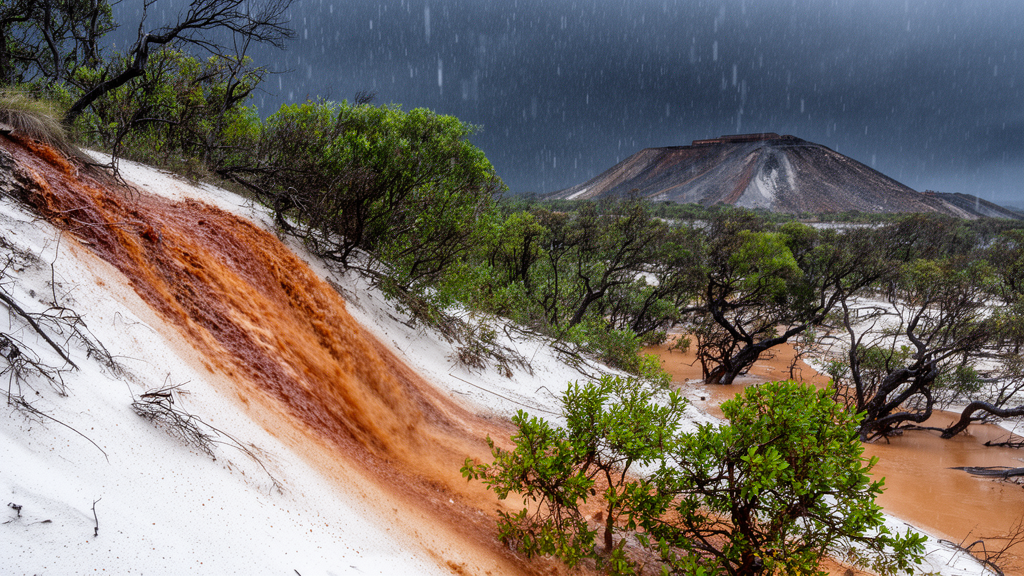
When an intense rainfall pulse struck the coast of Espírito Santo, Brazil, in January 2020, the leaves of beach-dwelling herbs in a protected Restinga ecosystem quickly accumulated higher levels of toxic metals and showed measurable signs of photosynthetic stress, while neighboring tree species barely flinched. That is the central finding of a field study published in Discover Plants, which tracked four native plant species through three phases of the 2020 rainy season inside the Comboios Biological Reserve. The herbaceous plants Ipomoea pes-caprae and Scaevola plumieri responded to the pulse with sharp but temporary declines in photosystem stability and energy-use efficiency, whereas the trees Manilkara salzmannii and Protium heptaphyllum maintained functional stability throughout. The authors argue that this contrast reveals a functional gradient within Restinga vegetation: fast-growing herbs act as rapid diagnostic signals of acute environmental disturbance, while woody species buffer contamination and may underpin long-term contaminant stabilization in these coastal soils.
The study site carries a heavy environmental legacy. In November 2015, the failure of the Fundão Dam released approximately 50 million cubic meters of mining tailings into the Rio Doce basin, contaminating freshwater, estuarine and coastal systems across a vast stretch of southeastern Brazil. The tailings were enriched in iron, manganese, copper, zinc, arsenic, cadmium, chromium and vanadium. Although the disaster occurred years before the measurements reported here, biannual monitoring conducted since 2018 has shown that regional hydrodynamics continue to transport contaminated material toward the coastal sector where the research took place. Recurrent flooding keeps remobilizing and redepositing contaminated sediments along the coastline, which means that even legally protected areas such as the Comboios Biological Reserve function not as pristine reference sites but as receptors of long-distance pollution. This history made the reserve a strategically important location for asking whether chronic and episodic contamination still leave detectable fingerprints in native vegetation.
To capture the response window, the team sampled during three phases of the 2020 rainy season: a pre-peak reference period in January, a pulse period in late January associated with more than 60 millimeters of rainfall per day driven by the extratropical cyclone Kurumi, and a post-peak period in March. During the pulse, the Rio Doce water level rose above its flood quota of 345 centimeters on January 27 and reached 558 centimeters on January 29, providing a high-intensity disturbance suitable for evaluating rainfall-driven resuspension effects. The researchers selected two herbaceous and subshrub species growing on dunes immediately adjacent to the beach line and two tree species located roughly 700 meters inland, sampling ten adult individuals of each species per phase. Fully expanded, sun-exposed leaves were collected for chemical and physiological analysis, and soil samples were taken in triplicate around each sampling point.
The analytical toolkit combined several complementary approaches. Leaf chlorophyll content was estimated non-destructively with a portable SPAD meter, while vegetation condition at the ecosystem scale was tracked through the Normalized Difference Vegetation Index calculated from Landsat 8 satellite imagery at 30-meter resolution. Photosynthetic performance was assessed through chlorophyll a fluorescence using a Handy-PEA fluorometer after 60 minutes of dark adaptation, with JIP-test parameters extracted from the OJIP induction transients. Leaf and soil concentrations of arsenic, cadmium, chromium, vanadium, copper, iron, manganese and zinc were quantified by inductively coupled plasma mass spectrometry and optical emission spectrometry, and bioaccumulation factors were calculated as the ratio between leaf and soil concentrations at the same sampling point. The authors note that these bioaccumulation factors represent shoot-level accumulation only, since they do not account for potential metal storage in roots or stems.
The chemical results showed a pronounced divide between life forms. The highest concentrations of toxic elements appeared in the herbaceous and subshrub species, with foliar arsenic in Scaevola plumieri reaching a mean of 2.27 milligrams per kilogram of dry weight and cadmium reaching 0.19 milligrams per kilogram during the January pulse. Vanadium concentrations spanned more than a tenfold range across species, from 5.43 milligrams per kilogram in Ipomoea pes-caprae down to 0.38 in Protium heptaphyllum, and the highest chromium content measured in the herbaceous plants was almost ten times the average found in the trees. Across all four species, the global average leaf concentrations followed the order chromium, vanadium, arsenic, cadmium. Within the herbaceous group, the precipitation pulse significantly increased arsenic, cadmium and vanadium concentrations, while the March post-impact period brought significant reductions back to levels similar to or below the January baseline.
Bioaccumulation patterns shifted in element-specific ways during the pulse. Zinc bioaccumulation rose most notably in Ipomoea pes-caprae, climbing from 5.66 to 13.44, and in Manilkara salzmannii, from 8.56 to 9.76, both differing significantly from the January reference. In contrast, the lowest bioaccumulation of iron and manganese during the pulse compared with the reference period occurred in the herbs and in M. salzmannii, with both herbaceous species showing a significant reduction in iron translocation to shoots. Scaevola plumieri recorded the highest mean zinc values across the three periods, peaking at 54.01, roughly ten times its iron value, while copper bioaccumulation was most pronounced in M. salzmannii, reaching 46.1. The authors emphasize that no clear hyperaccumulator emerged among the four species; instead, each displayed distinct but comparable accumulation strategies shaped by element type and environmental conditions, with zinc and manganese showing the highest bioaccumulation overall, likely reflecting their high mobility and efficient translocation.
The chlorophyll fluorescence data revealed where the stress landed inside the photosynthetic apparatus. Double-normalized OJIP transients showed clear positive L-band and K-band amplitudes in both herbaceous species during the pulse, signatures the authors interpret as reduced connectivity between photosystem II units and impairment of the oxygen-evolving complex, the manganese and calcium-containing protein cluster that splits water during photosynthesis. The pulse significantly reduced oxygen-evolving complex activity in both herbs, and the performance index PIABS, an integrated measure of photosystem II vitality, fell by 74 percent in Ipomoea pes-caprae during the pulse. Energy dissipation per reaction center increased by approximately 148 percent in I. pes-caprae and about 69 percent in S. plumieri, a pattern the authors describe as a protective response that sheds excess excitation energy as heat. Statistically, foliar arsenic showed a significant negative correlation with oxygen-evolving complex activity, with a coefficient of minus 0.700, while shoot manganese accumulation correlated only weakly with that activity, at 0.310.
The tree species told a different story. Manilkara salzmannii showed no significant variation in PIABS or in most JIP-test parameters during the pulse, and its K-band amplitudes were negative relative to the reference, which the authors link to enhanced oxygen-evolving complex efficiency and greater tolerance. Protium heptaphyllum remained stable during the pulse, with significant changes appearing only in March. The pigment and satellite indices mirrored this divide: chlorophyll index readings shifted significantly in the herbs, with I. pes-caprae declining from 39.34 to 34.57 by March, while neither tree species showed significant variation. NDVI values decreased during the pulse in both physiognomies, then recovered from roughly 0.3 to 0.6 in the herbaceous vegetation and from 0.3 to 0.8 in the trees by March. Notably, the sharp NDVI drop in the trees was not accompanied by corresponding SPAD changes, leading the authors to suggest that the satellite index may also reflect structural and nutritional factors beyond chlorophyll content alone.
The authors are careful about what these temporal patterns can and cannot establish. Sediment resuspension was not directly measured during the study, and the observed alignment between the rainfall peak, rising foliar metal concentrations and physiological changes supports a strong association within a mechanistic framework in which intense rainfall enhances metal remobilization and short-term bioavailability, rather than a direct measurement of that process. Because different individuals were sampled during each rainfall phase, temporal differences were evaluated separately for each species, and bioaccumulation factors reflect only leaf-level accumulation. Soil context also mattered: organic matter content was greatest under the tree species, where it can act as a reducing agent for the toxic fraction of metals and promote immobilization, while the sandy, organic-poor soils of the herbaceous zone offer less buffering. The authors suggest that bioavailability, rather than total concentration, drove the contrasting uptake patterns observed for zinc and iron.
The practical implications reach beyond fundamental plant physiology. The rapid, reversible responses detected in the herbaceous halophytes support their use as low-cost, non-destructive early-warning indicators of contamination pulses following extreme weather events, an appealing prospect for routine monitoring in protected areas downstream of contaminated watersheds. Meanwhile, the physiological stability of the trees, particularly Manilkara salzmannii, which accumulated substantial copper yet showed minimal impact on its photosynthetic apparatus, points toward a role in restoration programs aimed at soil stabilization and long-term contaminant immobilization. The authors conclude that integrating chlorophyll fluorescence measurements with metal accumulation metrics proved effective for detecting short-term environmental disturbances and for evaluating species-specific adaptive strategies, and they call for routine monitoring of metal dynamics during high-precipitation periods as climate instability increases the frequency of the rainfall extremes that drive this resuspension pathway.
Subject of Research: Rainfall-driven metal resuspension and photosynthetic stress responses in coastal Restinga vegetation
Article Title: Rainfall-driven metal resuspension triggers photosynthetic stress in Restinga vegetation
Article References: Broetto, S. G., Oliveira, G. C., de Oliveira Silva Junior, R., da Silva Penha, J., Soares, P. B., Pereira, O. J., & Silva, D. M. (2026). Rainfall-driven metal resuspension triggers photosynthetic stress in Restinga vegetation. Discover Plants, 3(1), Article 488. https://doi.org/10.1007/s44372-026-00984-4
Image Credits: AI Generated
DOI: 10.1007/s44372-026-00984-4
Keywords: Restinga, heavy metals, chlorophyll fluorescence, Rio Doce, Fundão dam collapse, mining tailings, bioaccumulation, photosynthesis, PSII, coastal ecosystems, bioindicators, phytostabilization
Cite Scienmag News
Alan Morgan. (October 25, 2026). Extreme rainfall remobilizes mining tailings metals and stresses coastal Restinga plants. Scienmag. https://scienmag.com/extreme-rainfall-remobilizes-mining-tailings-metals-and-stresses-coastal-restinga-plants/
Alan Morgan. "Extreme rainfall remobilizes mining tailings metals and stresses coastal Restinga plants." Scienmag, 25 October 2026, https://scienmag.com/extreme-rainfall-remobilizes-mining-tailings-metals-and-stresses-coastal-restinga-plants/. Accessed 25 October 2026.
Alan Morgan. "Extreme rainfall remobilizes mining tailings metals and stresses coastal Restinga plants." Scienmag. October 25, 2026. https://scienmag.com/extreme-rainfall-remobilizes-mining-tailings-metals-and-stresses-coastal-restinga-plants/