


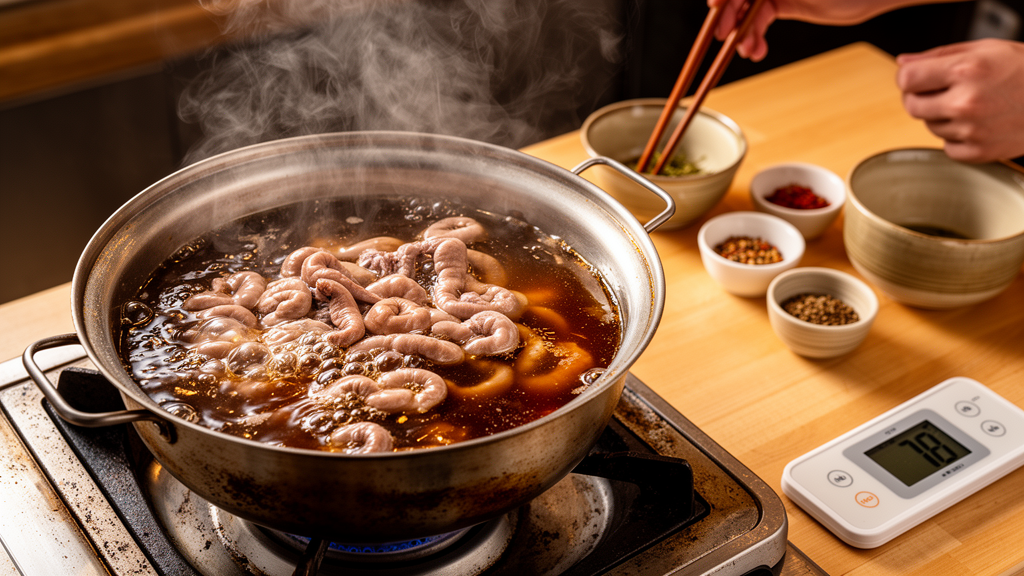
The Chinese culinary maxim that “the more stewed, the more fragrant” has now been put to a rigorous chemical test. In a new study, researchers tracked spiced brine-stewed pork intestine — a delicacy known as chitterlings or chitlins — minute by minute through the braising process, combining four complementary volatile-analysis platforms with precursor profiling, texture measurements and trained sensory panels. Their flavor-omics investigation shows that aroma development in this complex system is not the product of any single reaction but of three concurrent processes: endogenous lipid oxidation, amino acid-related thermal reactions including Maillard and Strecker pathways, and the migration and transformation of spice-derived volatiles from the brine into the tissue. Crucially, the study identifies a practical processing window: overall sensory acceptability peaked at 60 to 70 minutes of stewing, when aroma development and textural softening reached their most favorable balance.
The experimental design was deliberately comprehensive. Fresh pork large intestines from a commercial supplier in Shandong, China, were cleaned with baking soda, white vinegar, soybean oil and starch, trimmed of excess fat, blanched for three minutes with scallion, ginger and cooking wine, then immersed in a spiced brine containing green onion, ginger, allspice, cinnamon, star anise, clove, cumin, Sichuan pepper, licorice and nutmeg, together with salt, rock sugar, monosodium glutamate, ethyl maltol, soy sauces and other seasonings. Independent batches were stewed for 20, 30, 40, 50, 60 and 70 minutes, with blanched but unstewed intestines serving as the 0-minute control. Samples were vacuum-sealed, rapidly frozen and stored at minus 80 degrees Celsius until analysis, ensuring that the chemical snapshots reflected each stewing time rather than post-processing drift.
Volatile analysis by headspace solid-phase microextraction gas chromatography-mass spectrometry identified 44 volatile compounds spanning aldehydes, ketones, alcohols and esters. The contrast between raw and stewed samples was stark: unstewed intestines contained just 18 volatile compounds at a total concentration of about 198.56 micrograms per liter, whereas stewed samples held 24 to 30 compounds, with total volatile concentration peaking at 60 minutes at 13,948.69 micrograms per liter. Aldehydes such as 3-furfural, 5-methyl-2-furfural and 5-hydroxymethylfurfural, and alcohols including 4-methyl-5-thiazoleethanol and 1-octen-3-ol, rose significantly during stewing, while toluene, indole, ethyl acetate and 2-pentylfuran declined. Notably, seven compounds — among them octanal, indole and ethyl acetate — were detected exclusively in the raw sample, and trace indole disappeared after stewing even as methylindole isomers emerged at later stages.
Exogenous compounds told their own story. Ethyl maltol, added directly to the brine, was absent from raw samples but appeared rapidly after 20 minutes and reached its maximum at 60 minutes, its trajectory reflecting migration between brine and tissue, partitioning into lipid and protein matrices, volatilization losses and thermal transformation. Eugenol and anethole, neither present before stewing, appeared only afterward, confirming their spice origin. Hierarchical clustering showed the raw sample clearly separated from all stewed samples, with the 20-, 30- and 40-minute samples grouping together, the 50- and 70-minute samples forming another subgroup, and the 60-minute sample occupying a distinct branch. Interestingly, compounds with entirely different chemical origins — furfural derivatives alongside indole- and phenol-related compounds, terpenoids alongside lipid oxidation and Maillard products — clustered by similar temporal trajectories rather than shared formation pathways, underscoring the synchronized evolution of endogenous and exogenous chemistry.
Gas chromatography-ion mobility spectrometry corroborated this staging. During the first 20 minutes, signal intensity rose for 1-hydroxy-2-propanone, two forms of 2-furaldehyde, two forms of benzaldehyde and ethanol; at 30 to 40 minutes most of these signals faded while ethyl 2-hydroxypropanoate grew; new signals emerged at 50 minutes; and 60 minutes marked the peak enrichment of terpenes, eugenol, 1-octen-3-ol and benzaldehyde, before signals weakened significantly at 70 minutes. To separate genuine aroma contributors from the broader volatile background, the team calculated estimated odor activity values, using semi-quantitative concentrations and literature odor thresholds, and interpreted these as approximate indicators rather than absolute measures of odor intensity, since thresholds were largely determined in water rather than in the fatty intestine matrix.
That filtering proved decisive. Eighteen compounds exceeded an estimated odor activity value of 1, their number rising from 6 in raw samples to 13 with stewing. Two dominated overwhelmingly: ethyl maltol, with values ranging from about 872 to 2,045, and eugenol, from about 2,146 to 3,809 — several thousand times above threshold. 3-Methylindole, a compound with a characteristic unpleasant odor, showed elevated values between 30 and 50 minutes. Gas chromatography-olfactometry-mass spectrometry, in which six trained assessors sniffed the GC effluent and recorded odor events on a three-point intensity scale, confirmed 11 aroma-active compounds carrying grassy, honey, sweet and floral notes, with concentrations peaking at 30 minutes and declining by 70 minutes. Ethyl maltol maintained high aroma intensity throughout, cementing its role as a core contributor to the stewed product’s characteristic aroma.
The precursor side of the ledger revealed an asymmetry with important mechanistic implications. Twelve free fatty acids were identified, dominated by butyric, palmitic, stearic, oleic and linoleic acids; total fatty acid content rose then fell, peaking at 40 minutes, with saturated and monounsaturated fractions peaking then and polyunsaturated fractions at 30 minutes. Sixteen free amino acids were quantified, with glutamic acid the most abundant, accumulating significantly to a peak of 106.50 milligrams per 100 grams at 60 minutes before declining sharply. Correlation analysis then showed that aroma-active compounds correlated broadly with free amino acids but only sparingly with free fatty acids, suggesting lipid precursors matter for specific volatiles rather than across the board. Eugenol and ethyl maltol both correlated positively with multiple amino acids including arginine, glutamic acid, leucine and methionine — but because both compounds originate from the brine rather than the tissue, the authors caution these correlations more likely reflect concurrent changes in spice release, matrix distribution and amino acid variation than direct precursor-to-product conversion.
Texture followed a dramatic arc of its own. Hardness of raw intestine was lowest at about 177 grams, spiked to a peak of 845.11 grams at 20 minutes — consistent with protein denaturation and aggregation temporarily tightening the tissue — then fell continuously to 336.70 grams at 50 minutes as protein structures broke down and connective tissue softened and dissolved, with a slight rebound to 420.40 grams at 70 minutes. Gumminess and chewiness traced the same pattern, peaking at 20 minutes and bottoming out at 50 minutes, while springiness dropped below 1.0 after 30 minutes and cohesiveness stabilized around 0.69 after 30 minutes. The authors note that the time needed to reach desirable texture here was shorter than in previous studies, likely reflecting differences in preprocessing, heating method and formulation, and they acknowledge that the proposed structural mechanisms still require validation by microstructural characterization.
Sensory evaluation by ten trained assessors tied the chemistry together. Raw intestines scored a dismal 2.94 out of 10 overall; after 20 minutes the score leapt to 7.56, with chewing scoring highest at that stage; scores stabilized between 7.98 and 8.02 from 30 to 50 minutes; and quality peaked at 60 to 70 minutes with overall scores of 8.64 and 8.60, driven by marked improvements in smell and overall acceptability. The panel data also revealed perceptual interactions: 3-methylindole and p-cresol, which carry unpleasant odors, showed strong responses early in stewing when acceptability was lowest, yet overall acceptability rose even while their estimated odor activity values remained high, suggesting that accumulating pleasant aroma compounds may mask or suppress the off-notes within the evolving aroma matrix.
The study’s authors are careful about the limits of their evidence. Because volatile concentrations were semi-quantitatively estimated and thresholds were mostly water-based, the estimated odor activity values serve as screening tools, not definitive potency measures. The relative contributions of amino acid-related thermal reactions, lipid oxidation and spice-derived volatile transformation could not be quantitatively separated from the present data, and the textural mechanisms await molecular-level structural confirmation. Even so, the work delivers something traditional braised-intestine production has lacked: a chemically grounded processing window. Stewing for 60 to 70 minutes, the data indicate, achieved the highest overall sensory acceptability, coinciding with peak total volatile accumulation and ethyl maltol levels while the tissue softened past its early-stage protein-toughening phase — a rare case where folk wisdom, sensory science and analytical chemistry converge on the same number.
Subject of Research: Evolution of aroma-active compounds and precursor-aroma relationships in spiced brine-stewed pork intestine during stewing
Article Title: Evolution of aroma-active compounds and precursor-aroma relationships in spiced brine-stewed pork intestine during stewing
Article References: Li, M., Qu, X., Wang, H., Yang, X., Cheng, C., Ni, L., Zheng, Q., Wang, Z., Zhang, D., Zhang, Z., & Zhang, C. (2026). Evolution of aroma-active compounds and precursor-aroma relationships in spiced brine-stewed pork intestine during stewing. Journal of Agriculture and Food Research, Article 103374. https://doi.org/10.1016/j.jafr.2026.103374
Image Credits: AI Generated
DOI: 10.1016/j.jafr.2026.103374
Keywords: pork intestine, spiced brine stewing, aroma-active compounds, flavor precursors, free amino acids, free fatty acids, GC-MS, GC-olfactometry, texture profile analysis, sensory evaluation, Maillard reaction, lipid oxidation
Cite Scienmag News
Bethany Barker. (October 25, 2026). How Long You Stew Pork Intestine Decides Its Aroma, Chemistry Reveals. Scienmag. https://scienmag.com/how-long-you-stew-pork-intestine-decides-its-aroma-chemistry-reveals/
Bethany Barker. "How Long You Stew Pork Intestine Decides Its Aroma, Chemistry Reveals." Scienmag, 25 October 2026, https://scienmag.com/how-long-you-stew-pork-intestine-decides-its-aroma-chemistry-reveals/. Accessed 25 October 2026.
Bethany Barker. "How Long You Stew Pork Intestine Decides Its Aroma, Chemistry Reveals." Scienmag. October 25, 2026. https://scienmag.com/how-long-you-stew-pork-intestine-decides-its-aroma-chemistry-reveals/


