


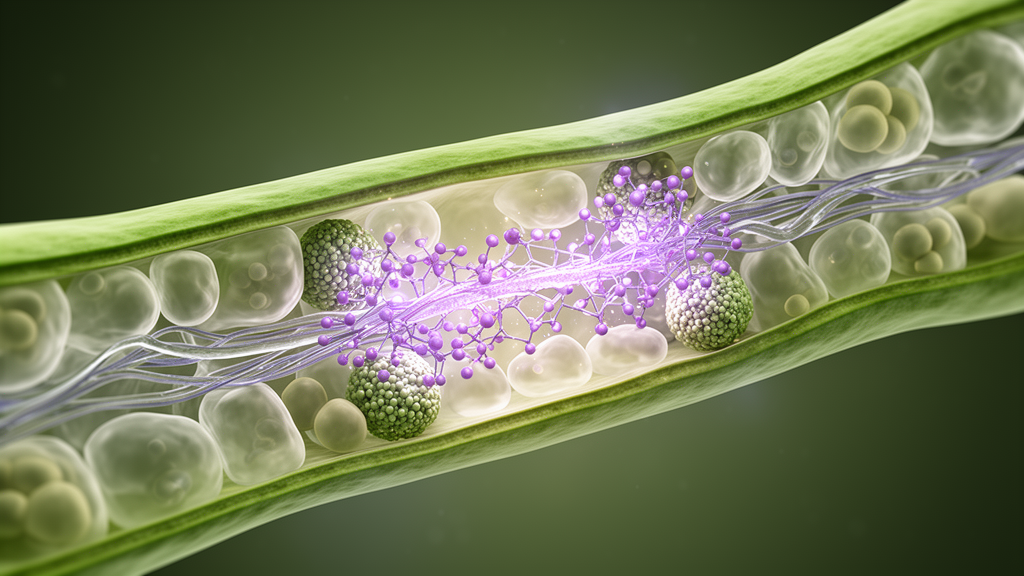
Plant knockout and protoplast experiments indicate that phloem protein 2, or PP2, helps restrict apple scar skin viroid and cucumber mosaic virus through phloem-associated defense rather than by directly inhibiting viroid replication. Plants lacking the Arabidopsis PP2 homolog AtPP2-A1 developed more severe disease, accumulated more of each pathogen, and expressed less of the phloem defense marker PDF1.2 than wild-type plants.
The research focused on PP2, a major phloem protein already associated with the transport of nutrients, RNA, and defense-related material. Although these functions were known, the molecular basis of PP2’s RNA-binding activity and its contribution to antiviral defense remained poorly understood. The study therefore examined the protein’s RNA-binding regions and tested the consequences of disrupting PP2-dependent defense.
Investigators divided cucumber PP2, CsPP2, into four RNA-binding domains and analyzed their interactions with apple scar skin viroid RNA. The experiments identified interactions involving both the C-terminal region of the protein and its conventionally predicted RNA-binding domain. These results characterize PP2 as an unconventional RNA-binding protein because its RNA association was not confined to the single domain initially predicted by sequence-based analysis.
To test PP2’s defensive function, the researchers used T-DNA knockout mutants of AtPP2-A1, described as the closest homolog of CsPP2. Compared with wild-type plants, the mutants showed greater disease severity and higher accumulation of apple scar skin viroid. They also had reduced expression of PDF1.2, a gene used as a marker of phloem defense, linking loss of PP2 with impairment of a defense response in this tissue.
The knockout phenotype contrasted with the movement of RNA through the plant. PP2 was therefore assigned a principal role in phloem-based defense rather than in broadly preventing the long-distance movement of RNA. The reported evidence does not establish every molecular step connecting PP2 to pathogen restriction, but it directly links the absence of the protein with weaker defense-marker expression, increased disease severity, and greater pathogen accumulation.
Protoplast experiments provided a more specific test of whether PP2 influences the replication of apple scar skin viroid itself. In that system, PP2 did not affect viroid replication. This result distinguishes the protein’s effect on whole-plant defense from a direct suppression of replication within individual cells: the supported mechanism is restriction through phloem-associated defense, not an observed inhibitory effect on viroid replication.
The same AtPP2-A1 mutants were also more susceptible to cucumber mosaic virus. They exhibited enhanced disease symptoms and increased viral accumulation relative to wild-type plants. Thus, loss of PP2 weakened resistance to both a viroid and a virus in the tested plant system. The experiments establish PP2’s contribution to phloem-based defense against both pathogens, although they do not determine whether the two responses arise from one shared downstream mechanism or distinct mechanisms that produce similar plant-level outcomes.
Taken together, the findings connect PP2’s unusual RNA-binding behavior with a measurable defensive function. PP2 binds viroid RNA through its C terminus as well as its conventionally predicted RNA-binding domain, and its loss is associated with reduced PDF1.2 expression, more severe disease, and increased accumulation of apple scar skin viroid and cucumber mosaic virus. The study demonstrates that PP2 contributes to phloem-based defense in the examined knockout and protoplast systems; it does not show that PP2 directly blocks cucumber mosaic virus replication or establish effects in commercial crop varieties.
Subject of Research: PP2-mediated phloem defense against apple scar skin viroid and cucumber mosaic virus
Article Title: Phloem protein 2 (PP2) regulates phloem-based defense against apple scar skin viroid and cucumber mosaic virus
Article References: Chaudhary, S., Rai, G., Awasthi, P., Kumar, S., Tamang, A., Singh, G., Dhir, S., Bairwa, M. C., Purohit, R., & Hallan, V. (2026). Phloem protein 2 (PP2) regulates phloem-based defense against apple scar skin viroid and cucumber mosaic virus. BMC Plant Biology. https://doi.org/10.1186/s12870-026-09451-4
Image Credits: AI Generated
DOI: 10.1186/s12870-026-09451-4
Keywords: PP2, phloem defense, plant immunity, RNA-binding protein, apple scar skin viroid, cucumber mosaic virus, plant knockout, viroid replication, pathogen accumulation, plant molecular biology, Phloem, protein
Cite Scienmag News
Kristina Jarvis. (October 25, 2026). Knockout study links PP2 to phloem defense against viroid and virus. Scienmag. https://scienmag.com/knockout-study-links-pp2-to-phloem-defense-against-viroid-and-virus/
Kristina Jarvis. "Knockout study links PP2 to phloem defense against viroid and virus." Scienmag, 25 October 2026, https://scienmag.com/knockout-study-links-pp2-to-phloem-defense-against-viroid-and-virus/. Accessed 25 October 2026.
Kristina Jarvis. "Knockout study links PP2 to phloem defense against viroid and virus." Scienmag. October 25, 2026. https://scienmag.com/knockout-study-links-pp2-to-phloem-defense-against-viroid-and-virus/


