


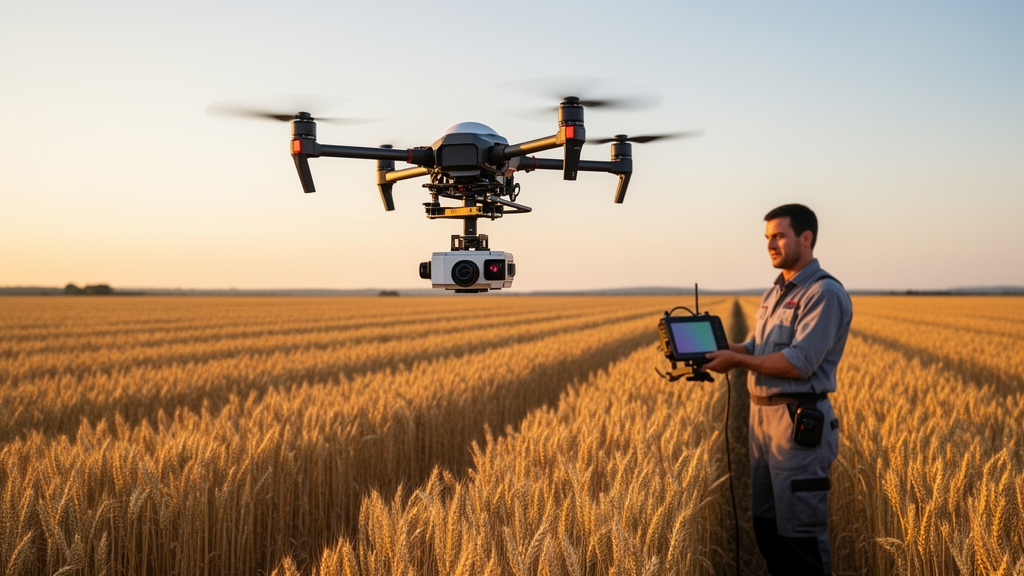
A drone flying over experimental wheat plots in Maharashtra, India, has proven to be a markedly better yield forecaster than the handheld crop sensor long favored by field researchers. In a field study conducted during the 2023–24 growing season at Mahatma Phule Krishi Vidyapeeth (MPKV), Rahuri, researchers compared vegetation indices derived from an unmanned aerial vehicle (UAV) carrying a MicaSense Altum-PT multispectral sensor against measurements taken with a GreenSeeker handheld sensor. Across 13 bread wheat genotypes grown under both timely and late sowing conditions, the UAV-derived indices showed consistently stronger correlations with biological yield, grain yield and thousand-grain weight, while the handheld NDVI readings were weaker and less consistent across growth stages and sowing environments. The findings, published in Discover Plants, point to drone-based multispectral imaging as a robust, scalable phenotyping tool for breeding programs seeking high-yielding, heat-tolerant wheat varieties.
The motivation behind the study lies in a quiet crisis for Indian wheat. The country cultivates more than 31 million hectares of wheat and produces over 110 million tonnes annually, ranking second globally after China, yet national average yield slipped from 3.48 tonnes per hectare in 2016–17 to 3.41 tonnes per hectare in 2021–22 as rising temperatures during grain filling took their toll. Terminal heat stress, which strikes as the crop approaches maturity in semi-arid regions, compresses the grain-filling period and erodes both grain weight and yield. Accurate, early prediction of how different genotypes will perform under such stress is therefore central to both crop management and breeding. Vegetation indices—mathematical combinations of reflectance measured in two or more wavelength bands—offer a non-destructive window into canopy greenness, chlorophyll content, biomass and stress responses, and the question of which sensor platform and which index best capture those signals drove the experimental design.
The team, led by Vaibhav Malunjkar, Sunil Kadam and Pawan Kulwal, grew six advanced breeding lines and seven released varieties at the Climate Smart Research Block of the CAAST-CSAWM facility. Two sowing dates were used deliberately: the timely-sown trial went into the ground on November 24, 2023, while the late-sown trial was planted on December 30, 2023, so that its flowering would coincide with elevated temperatures. Each genotype was sown in four 1.5-meter rows with two replications, and all agronomic operations—fertilization at 120:60:40 kg N:P:K per hectare, irrigation at critical stages, and uniform weed and pest management—were applied identically across plots so that differences in spectral response and yield could be attributed to genotype and sowing environment rather than management variation.
Aerial data were collected with a hexacopter flying at a constant 25 meters above the canopy at 3.5 meters per second, carrying the Altum-PT sensor, which records blue, green, red, red-edge, near-infrared, panchromatic and thermal bands. Two flights were made: on January 16, 2024, corresponding to 52 days after sowing (DAS) for the timely-sown crop and 16 DAS for the late-sown crop, and on February 12, 2024, corresponding to 79 and 43 DAS respectively. These dates captured the booting or late-vegetative stage and the anthesis stage in the timely-sown trial, and the early-vegetative and heading stages in the late-sown trial. Radiometric calibration used reflectance panels imaged before and after each flight, and ground control points recorded with handheld GPS ensured accurate georeferencing. The 2,443 and 2,471 raw images from the two dates were processed in Pix4D Mapper into orthomosaics at roughly one-centimeter resolution, with a mean reprojection error of just 0.165 pixels.
From these reflectance maps the team calculated four indices: the Normalized Difference Vegetation Index (NDVI), which contrasts near-infrared and red reflectance to gauge canopy vigor; the Green NDVI (GNDVI), which substitutes the green band and is more sensitive to chlorophyll concentration and nitrogen status; the Normalized Difference Red-edge Index (NDRE), which uses the red-edge band and detects subtle chlorophyll and canopy-structure variation, especially in dense canopies where NDVI can saturate; and the Simple Ratio (SR), the ratio of near-infrared to red reflectance, a sensitive indicator of leaf area and biomass accumulation. On the same dates, NDVI was recorded on the ground with the GreenSeeker, held 30 centimeters above the canopy, with both platforms operated between 10 a.m. and noon under clear skies to minimize illumination differences.
The yield data told a familiar story of heat stress. Average biological yield was 8.97 tonnes per hectare under timely sowing and 9.58 tonnes per hectare under late sowing, but grain yield fell from 4.46 to 3.40 tonnes per hectare when sowing was delayed, and thousand-grain weight dropped sharply from 40.58 grams to 29.38 grams. In other words, late-sown wheat accumulated slightly more total biomass but partitioned far less of it into grain, a consequence of elevated temperatures during heading, anthesis and grain filling that accelerate development, shorten the grain-filling window and reduce assimilate translocation to the developing grains. Only three varieties—Phule Samadhan, HI 1605 and MACS 6222—yielded more under late sowing than under timely sowing, and the advanced breeding lines generally outperformed the released varieties in both environments.
The spectral maps mirrored these physiological differences. Under timely sowing, NDVI and GNDVI values frequently exceeded 0.80 and SR values surpassed 10, reflecting dense, uniform canopies, whereas late-sown plots showed lower vegetation density and reduced uniformity early on, with NDVI values as low as 0.34–0.57 at the first observation before most genotypes recovered to 0.79–0.90 by the second. Analysis of variance revealed significant genotype-by-genotype differences for every index under both sowing conditions, and principal component analysis of standardized index values captured 92.2 percent of the total variance on the first principal component alone, cleanly separating timely- and late-sown plots and clustering high-vigor genotypes—Phule Samadhan, MACS 2496 and GS 4042—apart from stress-susceptible lines such as Trimbak and NIAW 34. Heatmap visualization reinforced the same pattern, distinguishing genotypes that maintained higher NDVI, GNDVI and SR values across growth stages from those whose reflectance collapsed under late-sown stress.
The head-to-head sensor comparison favored the drone. UAV-derived indices correlated significantly with biological yield, grain yield and thousand-grain weight, with GNDVI and SR emerging as the strongest predictors of biological and grain yield, particularly at the anthesis stage, while early-stage indices better predicted thousand-grain weight. GreenSeeker NDVI correlations were weaker and less consistent. The authors attribute this gap to measurement geometry: the UAV integrates reflectance from thousands of pixels across an entire plot from a nadir view, averaging out localized irregularities in plant population, tillering and soil background, whereas the GreenSeeker takes point-based readings along rows at a fixed height, making it more vulnerable to row spacing, plant gaps and soil reflectance. Differences in calibration, sun angle, wind-induced canopy movement and transient shading add further noise to ground readings. The two platforms showed similar overall trends and identified comparable genotype rankings, but the authors conclude they should be treated as complementary rather than interchangeable tools.
The timing of image acquisition proved as important as the choice of index. Correlations between vegetation indices and yield traits were strongest during the second observation window, aligned with anthesis and early grain filling, when the canopy reaches maximum leaf area, chlorophyll content and photosynthetic activity and spectral signals most closely track biomass production and assimilate accumulation. Conversely, indices captured at the peak vegetative to booting stage were better predictors of thousand-grain weight, consistent with earlier reports that early canopy vigor reflects the assimilate capacity that ultimately determines grain size. The consistent performance of Phule Samadhan, MACS 2496 and GS 4042 across both sowing environments suggests genuine canopy maintenance and resilience to terminal stress, corroborated by their superior yield performance, and demonstrates that UAV spectral phenotyping can discriminate stress-tolerant genotypes non-destructively and at high throughput.
The authors are candid about the study’s limits. The work spanned a single growing season and two sowing conditions, so inter-annual climatic variability remains untested, and yield estimation relied on linear correlations rather than the machine-learning or hybrid regression approaches—partial least squares regression, random forests, deep neural models—that could sharpen predictive accuracy. Scaling to operational farmer fields will require automated image calibration, RTK-enabled georeferencing and standardized processing pipelines, and the team notes that more frequent observations and temporal indicators such as cumulative index values could further improve prediction. Even so, the study makes a clear case that drone-mounted multispectral imaging, with careful attention to phenological timing and index selection, offers breeding programs a rapid, scalable route to screening large numbers of genotypes for stress tolerance and yield potential—and, in the longer term, a foundation for site-specific nutrient and irrigation management when coupled with soil and weather data.
Subject of Research: UAV multispectral versus handheld vegetation indices for predicting wheat grain yield under timely and late sowing
Article Title: Predicting grain yield in wheat using UAV multispectral and ground based vegetation indices
Article References: Malunjkar, V., Kadam, S., & Kulwal, P. (2026). Predicting grain yield in wheat using UAV multispectral and ground based vegetation indices. Discover Plants, 3(1), Article 486. https://doi.org/10.1007/s44372-026-00974-6
Image Credits: AI Generated
DOI: 10.1007/s44372-026-00974-6
Keywords: wheat, UAV phenotyping, multispectral imaging, vegetation indices, NDVI, GNDVI, NDRE, grain yield prediction, heat stress, GreenSeeker, precision agriculture, plant breeding
Cite Scienmag News
Alan Morgan. (October 25, 2026). Drone-mounted multispectral sensors outpredict handheld NDVI for wheat yield. Scienmag. https://scienmag.com/drone-mounted-multispectral-sensors-outpredict-handheld-ndvi-for-wheat-yield/
Alan Morgan. "Drone-mounted multispectral sensors outpredict handheld NDVI for wheat yield." Scienmag, 25 October 2026, https://scienmag.com/drone-mounted-multispectral-sensors-outpredict-handheld-ndvi-for-wheat-yield/. Accessed 25 October 2026.
Alan Morgan. "Drone-mounted multispectral sensors outpredict handheld NDVI for wheat yield." Scienmag. October 25, 2026. https://scienmag.com/drone-mounted-multispectral-sensors-outpredict-handheld-ndvi-for-wheat-yield/


