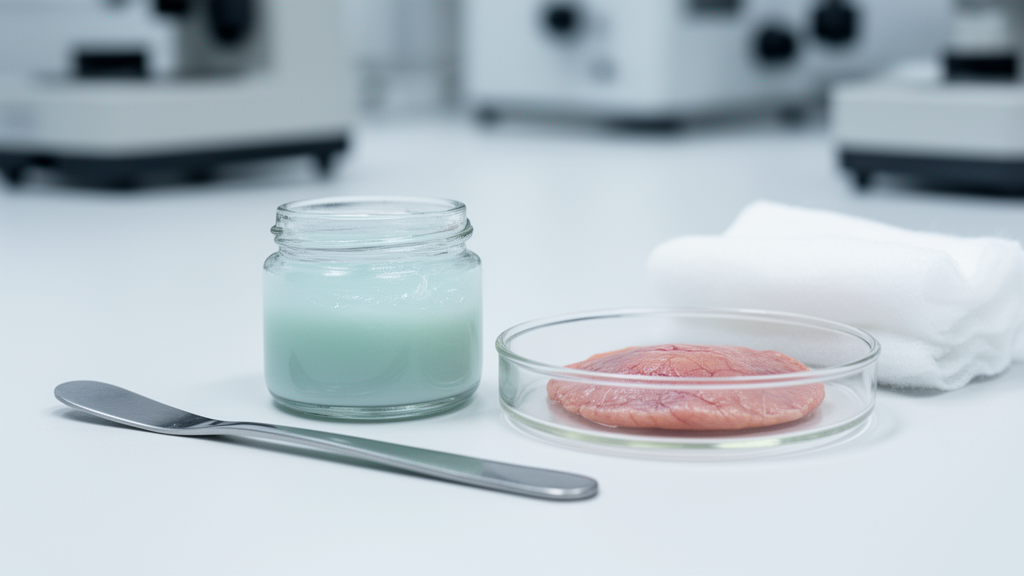
A simple ointment made from petroleum jelly and copper-doped bioactive glass has shown striking regenerative effects in animal models of metabolic syndrome, one of the most challenging environments for wound healing. Researchers at Northwestern University synthesized copper-containing bioactive glass particles through a sol-gel process, folded them into a petroleum jelly matrix at 25 percent by weight, and applied the resulting ointment to full-thickness skin wounds in diabetic mice and in Ossabaw pigs with metabolic syndrome. Treated wounds closed dramatically faster than controls, regenerated thicker epidermal and dermal layers, regrew hair follicles, formed less scar tissue, and developed denser networks of new blood vessels. The findings position the formulation as a candidate for clinical translation in a patient population whose wounds heal poorly under standard care.
Metabolic syndrome, a cluster of conditions that includes central obesity, dyslipidemia, hypertension, and insulin resistance, creates a hostile landscape for tissue repair. Chronic low-grade inflammation and impaired microcirculation disrupt every phase of healing, from hemostasis and inflammation through proliferation and remodeling. Skin injuries in affected patients therefore close slowly, become infected more readily, and regenerate poorly. The Northwestern team designed their ointment to attack these deficits simultaneously. Bioactive glasses are known to release therapeutic ions such as silicon, calcium, and phosphorus that stimulate cell proliferation, promote neovascularization, and support new tissue matrix formation. Copper, doped into the glass network, adds angiogenic signaling, antibacterial activity, and modulation of cellular pathways vital for wound closure, making it a particularly attractive ion for wounds compromised by metabolic disease.
The researchers prepared three glass compositions containing 0, 1, and 3 weight percent copper oxide using an acid-catalyzed sol-gel method, mixing tetraethyl orthosilicate, triethyl phosphate, calcium nitrate, and copper oxide before gelling, drying at 60 degrees Celsius, and calcining at 600 degrees. Scanning electron microscopy revealed irregularly shaped particles with rough surfaces, typical of sol-gel-derived bioactive glasses, with most primary particles in the 5 to 20 micrometer range regardless of copper content. Energy-dispersive X-ray spectroscopy confirmed uniform elemental distributions of silicon, calcium, phosphorus, and copper, with measured copper signals of 1.09 and 3.02 percent in the doped powders. X-ray diffraction showed the 0 and 1 percent compositions to be fully amorphous, while the 3 percent glass displayed weak crystalline reflections assigned to tenorite, indicating that a small amount of copper oxide precipitated at the highest loading while the surrounding glass network remained amorphous.
Before formulating the ointment, the team tested cytotoxicity by exposing human dermal fibroblasts to glass extracts and serial dilutions, finding that all formulations maintained cell viability above 80 percent even at the highest concentration. They then blended 25 percent glass powder with 75 percent melted petroleum jelly at 80 degrees Celsius to produce ointments designated PBGCu0, PBGCu1, and PBGCu3. Inductively coupled plasma mass spectrometry tracked copper ion release from the ointments over 12 days in phosphate-buffered saline, revealing a gradual, sustained increase in Cu2+ delivery rather than an initial burst. The 3 percent copper ointment released ions at higher rates than the 1 percent formulation, demonstrating that the petroleum jelly matrix can serve as a vehicle for prolonged copper delivery, an advantage over many copper-loaded dressings and nanoparticle systems that exhaust their payload within hours to a couple of days.
Laboratory tests confirmed the ointments are biocompatible and bioactive. Human dermal fibroblasts and human umbilical vein endothelial cells cultured with all three ointments showed viability comparable to controls, with live/dead staining revealing no cytotoxicity or morphological changes. Against Staphylococcus aureus, a common pathogen in chronic wounds, all formulations achieved killing ratios above 80 percent, while the copper-containing ointments exceeded 99 percent bacterial killing, a highly significant effect. Even the copper-free glass ointment inhibited bacterial growth, likely through calcium ion release. In scratch assays, the 1 and 3 percent copper ointments accelerated fibroblast migration, reducing wound area by 25 and 37 percent respectively compared with tissue culture polystyrene, and the 3 percent formulation outperformed the copper-free ointment by 24 percent. In endothelial tubulogenesis assays on Matrigel, the 3 percent ointment increased tubule nodes, junctions, and meshes by 66, 64, and 70 percent compared with saline, signaling enhanced angiogenic capacity.
The in vivo debut came in db/db mice, a widely used model of diabetes and metabolic syndrome with blood glucose levels consistently above 400 milligrams per deciliter. Each animal received a splinted 6-millimeter full-thickness excisional wound on the back, with silicon rubber splints preventing skin contraction so that true tissue regeneration could be measured. Five groups of five mice were treated every three days with the ointments, petroleum jelly alone, or saline. By day 9, wounds treated with the 3 percent copper ointment showed a 61.5 percent reduction in wound area, compared with 32.5 percent for saline and 36.0 percent for petroleum jelly alone. By day 18, the 3 percent copper wounds were completely closed while saline-treated wounds still had 30 percent of their area open, a difference the authors reported as highly significant.
Histology at day 27 revealed that the benefits extended well beyond closure speed. The epidermal layer of 3 percent copper-treated wounds was 44 micrometers thicker than in saline-treated wounds. Dermal regeneration was even more dramatic, with treated wounds showing approximately 438.9 micrometers and 210.0 micrometers greater dermal thickness than saline and copper-free ointment wounds respectively. Hair follicle regeneration was markedly enhanced, and scar formation was sharply reduced: scar length in the 3 percent copper group was 95 percent shorter than in saline-treated wounds, 88 percent shorter than petroleum jelly alone, and 90 percent shorter than the copper-free ointment. Because excessive scarring compromises skin integrity, the combination of accelerated closure, reduced scarring, and appendage regrowth suggests the ointment promotes genuinely functional tissue reconstruction rather than simple gap filling.
To establish translational relevance, the team moved to Ossabaw pigs with metabolic syndrome, a large-animal model that recapitulates key human features including elevated body fat ratio, total cholesterol, and triglyceride concentrations. Three pigs each received eight square full-thickness wounds measuring 3 by 3 by 2 centimeters, randomly assigned to the 3 percent copper ointment, copper-free ointment, petroleum jelly, or saline, with weekly treatments for three weeks. The 3 percent copper formulation produced the most rapid closure in every animal. In the first week, wound volume fell by 77.1 percent in the first pig, 39.4 percent in the second, and 47.4 percent in the third, compared with far smaller reductions under saline. By week 2, wound area reductions reached 81.6, 60.9, and 90.6 percent in the three pigs respectively, consistently outperforming all controls. Histology at week 7 showed epithelial layers 98.8 micrometers thicker than saline-treated wounds, dermal thickness greater by roughly 2.45 and 2.56 millimeters compared with saline and petroleum jelly, and blood vessel density increased by 51.7, 47.3, and 42.6 percent relative to saline, petroleum jelly, and the copper-free ointment.
The authors argue that sustained copper delivery from the bioactive glass, carried in a clinically established petroleum jelly matrix, distinguishes their approach from prior copper-containing hydrogels, nanoparticle systems, and wound dressings that typically exhibit burst release and transient antibacterial effects. Petroleum jelly maintains the moist wound environment essential for cell migration and re-epithelialization, acts as an occlusive barrier against water loss and contamination, and is already familiar from commercial products such as Aquaphor and Vaseline, keeping manufacturing simple and inexpensive. Copper is thought to act through pro-angiogenic pathways including HIF-1α/VEGF signaling, alongside modulation of inflammation and stimulation of fibroblast proliferation and collagen deposition. The team acknowledges open questions: future work should incorporate immunohistochemical markers such as CD31 and α-SMA to probe angiogenesis mechanistically, examine macrophage polarization, and establish the long-term pharmacokinetics, tissue distribution, and systemic clearance of copper after repeated topical application. No apparent local adverse effects emerged in either species, but chronic wound safety, optimal dosing, and comparative trials against clinically used topical formulations remain to be addressed before the ointment can advance toward patients whose metabolic conditions make healing so difficult.
Subject of Research: A copper-doped bioactive glass ointment for impaired wound healing in metabolic syndrome
Article Title: A pro-regenerative petroleum jelly-based, copper-doped bioactive glass ointment for impaired wound healing in metabolic syndrome
Article References: Wang, H., Tong, O., Ibrahim, Y., Aslam, M., Liu, Y., Duan, C., Luo, R., Guo, A., Kim, M., Vinokour, E., Kang, A., Jakka, P., Jiang, B., & Ameer, G. A. (2026). A pro-regenerative petroleum jelly-based, copper-doped bioactive glass ointment for impaired wound healing in metabolic syndrome. Materials Today Bio, 41, Article 103769. https://doi.org/10.1016/j.mtbio.2026.103769
Image Credits: AI Generated
DOI: 10.1016/j.mtbio.2026.103769
Keywords: bioactive glass, copper ions, wound healing, metabolic syndrome, petroleum jelly, angiogenesis, antibacterial, db/db mice, Ossabaw pigs, tissue regeneration, scar reduction, drug delivery
Cite Scienmag News
Denise Maddox. (October 25, 2026). Copper-Doped Bioactive Glass Ointment Speeds Wound Healing in Metabolic Syndrome. Scienmag. https://scienmag.com/copper-doped-bioactive-glass-ointment-speeds-wound-healing-in-metabolic-syndrome/
Denise Maddox. "Copper-Doped Bioactive Glass Ointment Speeds Wound Healing in Metabolic Syndrome." Scienmag, 25 October 2026, https://scienmag.com/copper-doped-bioactive-glass-ointment-speeds-wound-healing-in-metabolic-syndrome/. Accessed 25 October 2026.
Denise Maddox. "Copper-Doped Bioactive Glass Ointment Speeds Wound Healing in Metabolic Syndrome." Scienmag. October 25, 2026. https://scienmag.com/copper-doped-bioactive-glass-ointment-speeds-wound-healing-in-metabolic-syndrome/