


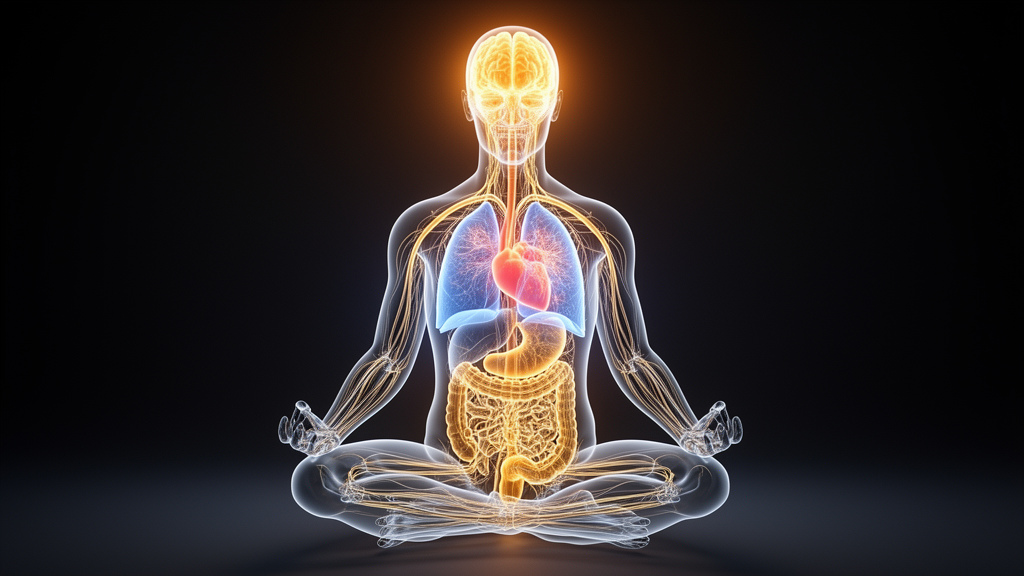
The brain has long been cast as the sole seat of thought, but a sweeping synthesis of research from psychophysiology, neuroscience, transplant surgery, public health and environmental engineering argues otherwise. According to the review, visceral organs—the heart, lungs, stomach, intestines, liver, kidneys and even the bladder—exert measurable influence over memory, willed action, consciousness and social cognition, the very capacities considered hallmarks of the human mind. Peripheral receptors continuously track heart rate, breathing depth, gastric contractions and other bodily signals, relaying them through the vagus nerve and spinal pathways to the brainstem, the thalamus and the cerebral cortex. For decades, cognitive neuroscientists treated this stream of bodily information as noise to be filtered out. The past ten years of landmark studies, the authors contend, have overturned that assumption, showing that interoception—the perception of the body’s internal state—reaches far beyond homeostatic reflexes into the highest levels of cognition.
The evidence base is methodologically diverse. At the periphery, electrocardiography gauges cardiac activity, electrogastrography records stomach contractions, ingestible pills track gut acidity, temperature and pressure, and wearable sensors capture respiratory rate and exhaled gases. At the central level, electroencephalography and magnetoencephalography reveal neural signatures such as heartbeat-evoked responses and respiratory-related evoked potentials, while functional magnetic resonance imaging identifies brain networks that track gastric and respiratory rhythms. Behavioral tests and questionnaires assess interoception itself, which the review treats as a three-part construct: interoceptive accuracy, the objective ability to detect heartbeats or breaths; interoceptive sensibility, the self-reported attention paid to bodily signals; and interoceptive awareness, the match between the two. Across these measures, the authors organize visceral influence into three pathways: a first-order route in which organ activity directly tunes neural processing, a second-order route in which one organ affects another that then shapes cognition, and a third-order route in which visceral activity alters the general state of brain or body.
The heart emerges as a particularly powerful modulator of memory. Baroreceptor signals time-locked to systole, the phase when the heart contracts, appear to engage noradrenergic pathways involved in memory. Participants with lower interoceptive accuracy were worse at recalling words presented at systole than at diastole, while those who counted their heartbeats more precisely were less susceptible to this interference. Higher cardiac accuracy, systole-timed feedback and cardiovascular arousal were also linked to better learning of fearful stimuli, and fear memories encoded at systole produced stronger skin conductance responses. Heart rate and skin conductance recorded during a virtual threat correlated with how aroused participants later recalled the experience, suggesting emotional memories preserve physiological patterns of arousal at encoding. Hippocampus-dependent logical memory and verbal learning, meanwhile, improve as a function of cardiac accuracy, pointing to shared neural substrates between interoception and memory.
Cardiac signals also track consciousness and the sense of self. Heartbeat-evoked responses preceding a faint visual grating predicted whether observers consciously saw it, while stimuli presented in sync with heartbeats were detected less easily and activated the insular cortex more weakly—a cardio-visual suppression effect that disappears after lesions of the anterior insula. In disorders of consciousness, phase shifts of the cardiac cycle, heart-rate variability and heartbeat-evoked responses help distinguish patients in a minimally conscious state from those in a vegetative state, even without overt behavior. Brain activity time-locked to heartbeats likewise covaries with self-related thought: spontaneous self-focus correlated with heartbeat-evoked responses from the ventral precuneus and ventromedial prefrontal cortex, and intracranial recordings linked thoughts about oneself as a subject to responses from the right anterior insula. When virtual bodies or rubber hands flash in sync with a person’s heartbeat, people are more likely to feel them as their own, an effect stronger in those with higher interoceptive accuracy.
Willed action and decision-making show cardiac fingerprints as well. People who count heartbeats more accurately display stronger intentional binding, the perceived compression of time between an action and its outcome, and this binding intensifies during systole. Better interoception is associated with lower non-planning impulsiveness, less risky bodily behavior, better response inhibition and, conversely, a decreased willingness to initiate voluntary movements during systole. Poor interoception, by contrast, accompanies more impulsive behavior, and patients with Tourette’s syndrome show hints of less accurate heartbeat tracking alongside heightened, noisier bodily sensations tied to their premonitory urges. The heart even reaches economic life: in a study of high-frequency financial traders, those better at counting heartbeats earned larger profits and were more likely to survive in the market. Suicide attempters performed worse on a heartbeat tapping task and showed reduced insular activity when attending to cardiac sensations, a pattern the authors link to interoceptive numbing and extreme risk-taking.
Social cognition, too, bends with the cardiac cycle. At systole, when cardiac afferent signaling and threat perception peak, White participants in one study were more likely to misidentify tools as weapons after seeing Black faces and to shoot unarmed Black targets in a simulation—effects absent at diastole. Faces presented in sync with systole were judged less trustworthy, and people with better interoception showed a stronger tendency to project their own emotional state onto others. Listening to one’s own heartbeat during the ultimatum game increased both the sense of unfairness and the likelihood of making unfair offers, while social pain was reduced at systole. The relationship runs both ways: anticipating speech appears to raise interoceptive accuracy, whereas social exclusion makes people worse at perceiving their heartbeats, possibly a defense that shifts attention away from distressing self-awareness.
Respiration, the review finds, is an equally surprising mediator of mental operations. Nasal airflow entrains activity in the amygdala, hippocampus and piriform cortex, with oscillatory power peaking around inhalation, and both memory encoding and retrieval appear more accurate at inhalation than exhalation. Breathing phase also modulates conscious perception: respiration shapes posterior alpha-band oscillations and the likelihood that near-threshold targets are detected. In immersive virtual reality, silhouettes flashing in sync with breathing induced illusory self-identification, an effect disrupted by experimentally induced dyspnoea but not by mechanically delivered breaths. In the ’embreathment’ illusion, avatars breathing in phase with participants were embodied more strongly than out-of-phase ones, and breathing influenced the sense of ownership almost as much as the avatar’s appearance. Voluntary action follows the breath as well: people are far more likely to spontaneously press a button during late exhalation than during inhalation, perhaps because exhalation reduces competition between motor commands for breathing and for movement.
Respiratory health carries cognitive consequences. People who recovered from COVID-19 showed deficits in attention, working memory and problem solving that scaled with the level of medical assistance received for respiratory symptoms—in the worst cases exceeding deficits caused by stroke. Sleep-disordered breathing carries a 26 percent increased risk of cognitive impairment, and lung transplant, while improving respiration, is associated with executive and verbal memory deficits. Air quality matters too: in a controlled study, office workers’ higher-order decision-making scores improved by 61 percent in a low-volatile-organic-compound environment and by 101 percent when low VOC levels were combined with high outdoor ventilation, while rising carbon dioxide concentrations reduced performance linearly by up to 50 percent. A twelve-month longitudinal study found employees in buildings with higher particulate matter and poorer ventilation performed worse on Stroop and arithmetic tasks.
The gut contributes its own signals. Gastric interoceptive accuracy, measured by a water-load test, correlates with hippocampus-dependent logical memory, and combining electroencephalography with electrogastrography revealed that the brain’s spontaneous alpha rhythm fluctuates in coupling with the phase of gastric slow waves—coupling that weakens as body image grows more negative. Using wireless ingestible pills, the researchers found that bodily self-consciousness in virtual reality scaled with gut activity: a more acidic stomach, a more basic intestine or higher temperatures accompanied a better sense of self-location and less disembodiment. Stomach acidity also tracked emotion, with higher acidity predicting stronger disgust and fear after emotional video clips. Beyond the gut, up to half of liver transplant recipients show postoperative cognitive dysfunction, chronic kidney disease impairs cognition through cerebrovascular and dialysis-related effects, ovarian hormones such as estradiol shape hippocampal and prefrontal memory circuits, and excessive heat slows cognitive speed and working memory in young adults.
To unify these findings, the authors propose a ‘deep embodiment’ paradigm, rejecting both brain reductionism—the view that mental activity is entirely due to neural and glial cells—and ‘shallow’ embodiment theories focused only on the outer body. Across organs, cyclical visceral signals appear to anchor cognition to the self: systole and inhalation promote a more self-centered mode of thinking, with more egocentric social behavior, reduced social pain and stronger action attribution, while diastole and exhalation favor a nonself-centered mode. The authors call this balance a cognitive homeostasis, and they acknowledge limits: the science of interoceptive influence on higher cognition remains young, most evidence is correlational, standard heartbeat-counting tests face methodological criticism, and explicit and implicit interoception are rarely measured in the same study. Future directions include multi-organ recordings, causal manipulations through exercise, fasting, pharmacology or vagus stimulation, and artificial-intelligence digital twins of the heart and lungs that could predict how people think and behave in a given bodily state. The mind, on this view, is not merely embodied but deeply embodied—it pulses with the heartbeat, pangs with the gut and flows with the breath.
Subject of Research: The influence of visceral organ activity and interoception on higher cognitive functions
Article Title: The Mind From Within: Visceral Roots of Human Cognition
Article References: Monti, A., & Aglioti, S. M. (2026). The Mind From Within: Visceral Roots of Human Cognition. Advanced Science, 13(59), Article e24184. https://doi.org/10.1002/advs.202524184
Image Credits: AI Generated
Keywords: interoception, heartbeat-evoked responses, cardiac cycle, respiration, gut-brain axis, memory, consciousness, social cognition, deep embodiment, willed action, organ transplantation, air quality
Cite Scienmag News
Cassandra Pierce. (October 25, 2026). Your Heart, Lungs and Gut Help Shape Memory, Consciousness and Decisions. Scienmag. https://scienmag.com/your-heart-lungs-and-gut-help-shape-memory-consciousness-and-decisions/
Cassandra Pierce. "Your Heart, Lungs and Gut Help Shape Memory, Consciousness and Decisions." Scienmag, 25 October 2026, https://scienmag.com/your-heart-lungs-and-gut-help-shape-memory-consciousness-and-decisions/. Accessed 25 October 2026.
Cassandra Pierce. "Your Heart, Lungs and Gut Help Shape Memory, Consciousness and Decisions." Scienmag. October 25, 2026. https://scienmag.com/your-heart-lungs-and-gut-help-shape-memory-consciousness-and-decisions/


