


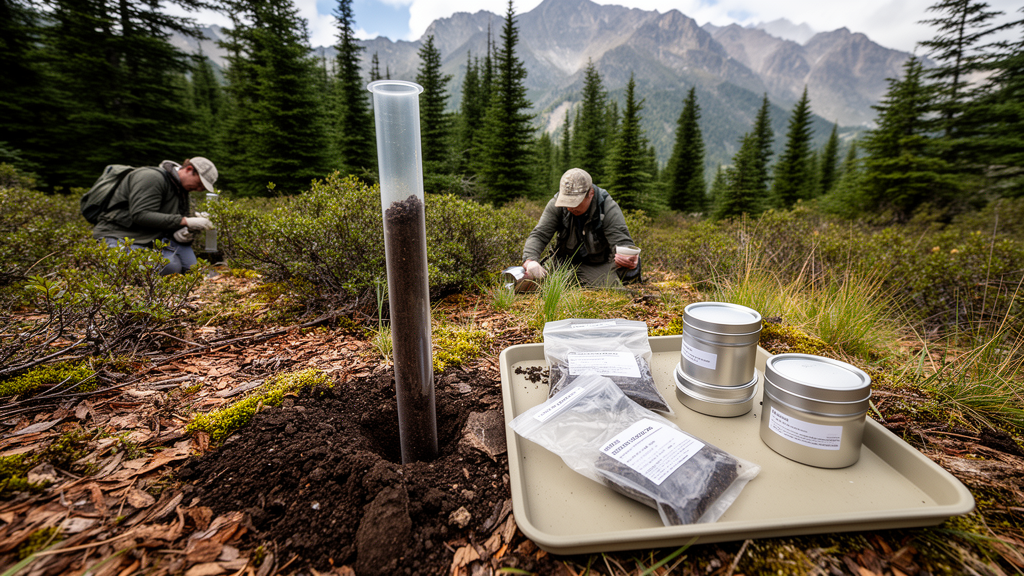
Soil nitrogen and phosphorus changed along different nonlinear paths across alpine forests on the southeastern Tibetan Plateau, according to a field study of 28 sampling sites spanning 769 to 3,767 metres above sea level. Soil nitrogen increased with altitude, reached a peak at approximately 2,800 metres and then declined at higher elevations. Total phosphorus and available phosphorus followed the opposite pattern, demonstrating that the two nutrients did not vary synchronously along the gradient.
The researchers analyzed soil nitrogen content, total phosphorus, available phosphorus and their stoichiometric ratios across the sampled elevation range. Their analysis found that the soil nitrogen-to-phosphorus ratio also followed a unimodal curve. It increased toward approximately 2,800 metres, where the maximum measured value was 11.8 ± 1.86, before decreasing farther upslope.
The reversal reflects the contrasting elevational trajectories of nitrogen and phosphorus rather than a proportional response of the two elements. Soil temperature was associated with a nonlinear decrease in the nitrogen-to-phosphorus ratio. This relationship was reported as part of the study’s analysis of potential environmental controls, but the findings do not establish temperature as the sole cause of the observed nutrient patterns.
The study also drew on literature assembled at a global scale. That comparison showed that the nitrogen-to-phosphorus ratio of temperate evergreen coniferous forests was significantly higher than that of tropical and alpine plant functional types. The southeastern Tibetan Plateau measurements therefore provide local observations that can be considered alongside broader variation in plant functional types, although the reported comparison does not by itself identify the factors responsible for the local elevational pattern.
The results offer an empirical reference for nutrient dynamics in montane ecosystems and for assessing potential changes under future climate conditions. Instead, the two elements reached contrasting turning points, and their stoichiometric balance was strongest near 2,800 metres. Because the supplied findings do not provide site-level nutrient values, sampling dates or analytical methods for every location, the study supports a regional description of asynchronous change rather than a precise prediction for individual sites.
Subject of Research: Elevational variation in soil nitrogen and phosphorus across southeastern Tibetan Plateau alpine forests
Article Title: The asynchronous changes of soil nitrogen and phosphorus along the altitude gradient in the southeastern Tibetan Plateau
Article References: Cui, Y., Xu-Ri, Li, F., Qu, S., Shama, R., Zhang, L., & Liang, E. (2026). The asynchronous changes of soil nitrogen and phosphorus along the altitude gradient in the southeastern Tibetan Plateau. BMC Plant Biology. https://doi.org/10.1186/s12870-026-09804-z
Image Credits: AI Generated
DOI: 10.1186/s12870-026-09804-z
Keywords: soil nitrogen, soil phosphorus, elevational gradient, southeastern Tibetan Plateau, alpine forests, nutrient stoichiometry, soil temperature, montane ecosystems, asynchronous, changes, soil, nitrogen
Cite Scienmag News
Alan Morgan. (October 25, 2026). Southeastern Tibetan Plateau forest survey finds asynchronous soil nutrient changes. Scienmag. https://scienmag.com/southeastern-tibetan-plateau-forest-survey-finds-asynchronous-soil-nutrient-changes/
Alan Morgan. "Southeastern Tibetan Plateau forest survey finds asynchronous soil nutrient changes." Scienmag, 25 October 2026, https://scienmag.com/southeastern-tibetan-plateau-forest-survey-finds-asynchronous-soil-nutrient-changes/. Accessed 25 October 2026.
Alan Morgan. "Southeastern Tibetan Plateau forest survey finds asynchronous soil nutrient changes." Scienmag. October 25, 2026. https://scienmag.com/southeastern-tibetan-plateau-forest-survey-finds-asynchronous-soil-nutrient-changes/


