


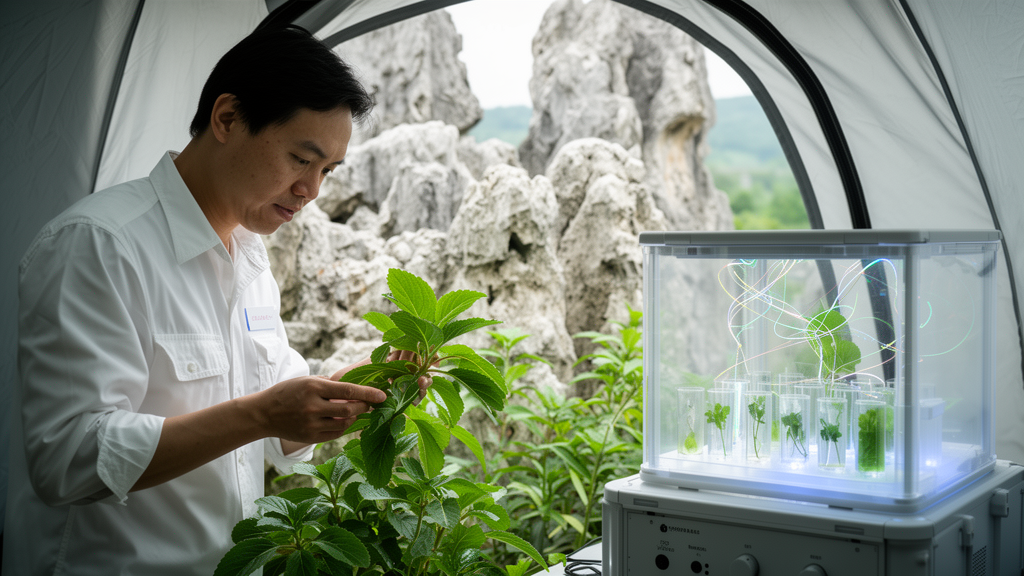
A comparative analysis of 19 complete chloroplast genomes from Petrocodon species on China’s Guizhou karst plateau found a highly conserved genomic structure across the sampled plants, while identifying three geographically associated evolutionary clades. The study newly assembled 13 plastomes and re-annotated six publicly available sequences to examine relationships within the Gesneriaceae genus, where taxonomic revisions and convergent evolution have complicated classification. The distribution of the clades was consistent with the hypothesis that isolation in karst habitats may contribute to speciation, although the analysis did not establish the causes or timing of diversification.
The newly assembled chloroplast genomes ranged from 152,378 to 153,621 base pairs. All 19 sampled plastomes displayed the typical quadripartite structure and contained 131–132 functional genes, indicating substantial conservation in overall genome organization despite differences among species. They also exhibited pronounced A/T bias, meaning that adenine and thymine were more frequent than the alternative bases. Preferred codons, measured by relative synonymous codon usage above 1, generally terminated in A or U. The authors interpreted this composition primarily as a reflection of ancestral neutral mutational pressures and noted that its possible metabolic advantage in nitrogen-poor habitats remains an incidental hypothesis rather than an established function.
Sliding-window analysis detected 12 highly variable regions that could serve as candidate molecular markers for identifying species and studying evolutionary relationships. The ycf1 region and the ndhF–rpl32 interval had the highest nucleotide diversity and were therefore the most informative candidates within this sample. Selection analyses found strong purifying selection across most of the plastomes, consistent with the conservation of their overall structure. In contrast, ndhK and atpF showed elevated evolutionary rates, which the researchers interpreted as relaxed purifying selection. They also suggested that the pattern could be consistent with photoprotective optimization under environmental extremes, but the genomic analysis alone does not demonstrate such a functional effect.
Phylogenomic analysis strongly supported the monophyly of the sampled Petrocodon taxa, meaning that the included species formed a single evolutionary group in the reconstructed tree. Three clades were recovered, each associated with a distinct geographic area, and Clade I exhibited clear geographical endemism. Relationships within Clade III were more complex: topological conflicts, extremely short branch lengths and the non-monophyletic placement of varieties among closely related species suggested a history consistent with rapid diversification. The backbone phylogeny broadly agreed with the observed geographic clades, supporting—but not proving—the hypothesis that karst habitat isolation contributes to speciation among the sampled taxa.
Morphological convergence remains a major obstacle to classification in Petrocodon, whose species have undergone repeated taxonomic revisions. The whole-plastome analysis also placed former genera, including Calcareoboea and Tengia, within the sampled Petrocodon lineage, adding molecular support for the unified treatment of these taxa. The study’s scope was limited to 19 species and the use of chloroplast genomes, so its results do not reconstruct the full evolutionary history of the genus or establish a universal cause of plant radiation on the Guizhou plateau. Nevertheless, the conserved plastome architecture, three-clade structure and variable candidate markers provide resources for improving the identification and phylogenetic study of Petrocodon and for informing conservation work on the region’s karst biodiversity.
Subject of Research: Comparative chloroplast genomics and phylogeny of Petrocodon species from China’s Guizhou karst plateau
Article Title: Comparative and phylogenomic analyses of 19 Petrocodon (Gesneriaceae) species from the Guizhou karst plateau, China, featuring 13 newly assembled chloroplast genomes
Article References: Niu, Z., Yang, S., Gu, J., Li, M., Bai, X., & Wen, F. (2026). Comparative and phylogenomic analyses of 19 Petrocodon (Gesneriaceae) species from the Guizhou karst plateau, China, featuring 13 newly assembled chloroplast genomes. BMC Plant Biology, 26(1), Article 1738. https://doi.org/10.1186/s12870-026-09891-y
Image Credits: AI Generated
DOI: 10.1186/s12870-026-09891-y
Keywords: Petrocodon, chloroplast genomes, plant phylogenomics, Guizhou karst plateau, species radiation, convergent evolution, molecular markers, Gesneriaceae, purifying selection, Comparative, phylogenomic, analyses
Cite Scienmag News
Gavin Prescott. (October 25, 2026). Chloroplast genomes support Petrocodon phylogeny on China’s Guizhou karst plateau. Scienmag. https://scienmag.com/chloroplast-genomes-support-petrocodon-phylogeny-on-chinas-guizhou-karst-plateau/
Gavin Prescott. "Chloroplast genomes support Petrocodon phylogeny on China’s Guizhou karst plateau." Scienmag, 25 October 2026, https://scienmag.com/chloroplast-genomes-support-petrocodon-phylogeny-on-chinas-guizhou-karst-plateau/. Accessed 25 October 2026.
Gavin Prescott. "Chloroplast genomes support Petrocodon phylogeny on China’s Guizhou karst plateau." Scienmag. October 25, 2026. https://scienmag.com/chloroplast-genomes-support-petrocodon-phylogeny-on-chinas-guizhou-karst-plateau/


