


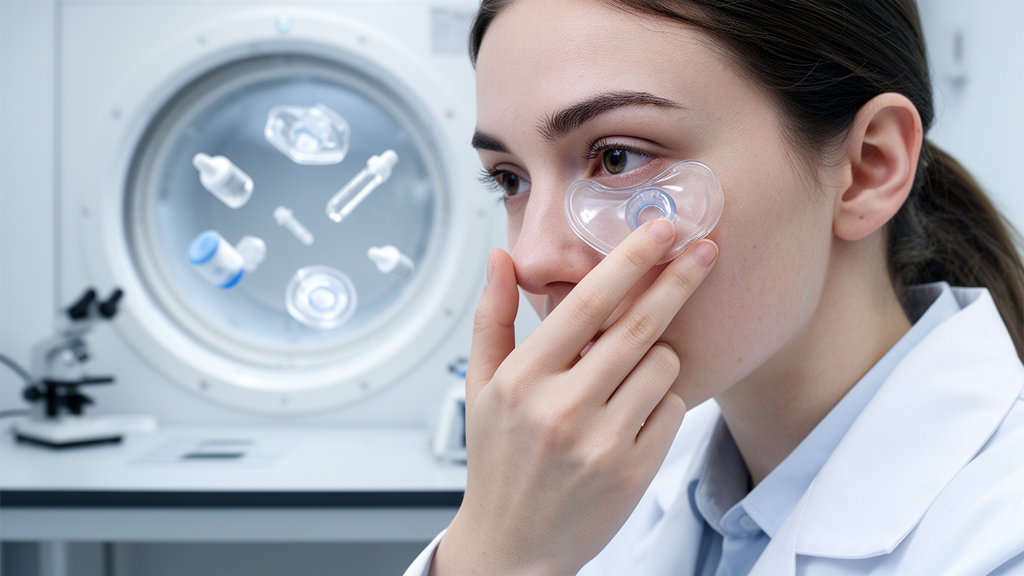
A research team from the Korea Advanced Institute of Science and Technology (KAIST) and Seoul National University Bundang Hospital has developed a flexible, wearable patch designed to deliver eyedrops without relying on gravity. The device uses pressure generated by a chemical reaction inside the patch to move medication through a microchannel toward the eye, offering a possible route for self-administering eye drops during long-duration space missions. The need for such technology arises from the limited gravity environment encountered in space.
KAIST’s news release notes that microgravity shifts body fluids toward the head and can alter the structure of the eyes and visual function. Conventional eye-drop application on Earth depends on liquid falling from a container under gravity, so that method cannot be transferred directly to space. The researchers sought an alternative that would not require an external pump, electrical drive or direct assistance from medical personnel.
The patch combines liquid-carrying microchannels with a chemical reaction chamber in a single flexible structure. When a user presses the actuation area, liquid in the reaction chamber reacts and generates gas pressure, which pushes the eye-drop formulation along the microchannel and onto the eye. The specified reaction occurs when ascorbic acid, or vitamin C, contacts sodium bicarbonate, the main component of baking soda, in water, producing carbon dioxide gas.
Because this pressure originates within the device, the medication can move without depending on the orientation of gravity. A filter positioned between the reaction chamber and the eye-drop chamber permits gas to pass while blocking liquid. This separation keeps the chemical reactants apart from the medication while allowing the generated pressure to act on the formulation.
The design is intended to function in environments where complex equipment is limited. Its ability to deliver liquid without gravity could also make the platform useful on Earth for people who have difficulty positioning an eye-drop container accurately because of hand tremors or other physical limitations, including some patients with Parkinson’s disease. In laboratory evaluations, the research team reported that the patch released eye drops consistently even when the direction of gravity was changed.
An on-body evaluation with human participants on Earth also found that the device delivered the drug at a level similar to that produced by conventional eye-drop application. These findings support the mechanical principle of gravity-independent delivery, but they do not yet demonstrate performance during an actual spaceflight or in the microgravity environment experienced by astronauts. Professor Ki-Hun Jeong of KAIST’s Department of Bio and Brain Engineering led the research team, while Professor Se Joon Woo of Seoul National University Bundang Hospital led the collaborating clinical team.
The researchers described the device as a wearable platform capable of delivering medication without complex additional equipment. They said they expect the approach to expand its use in space medicine and other settings, although the supplied results remain limited to experiments under different gravity directions and an on-body test conducted on Earth; further verification in an actual space environment is still required. Jaehun Jeon, a doctoral student in KAIST’s Department of Bio and Brain Engineering, was the first author.
The peer-reviewed study, titled “Wearable self-instillation microfluidic eyedrop patch for space medicine,” was published online on October 7, 2026, in Sensors and Actuators B: Chemical . The work presents a potential personal drug-delivery technology for astronauts and as a possible aid for people with motor difficulties, but its space application remains a prospect rather than an operationally validated capability.
Subject of Research: A wearable microfluidic patch for gravity-independent eyedrop delivery in space medicine
Article Title: KAIST develops gravity-independent wearable eyedrop patch for use in space
Article References: KAIST develops gravity-independent wearable eyedrop patch for use in space. Original publication (Bibliographic details unavailable.)
Image Credits: AI Generated
DOI: Not provided
Keywords: space medicine, eyedrop delivery, wearable patch, microgravity, microfluidics, drug delivery, chemical actuation, human evaluation, KAIST, develops, gravity-independent, wearable
Cite Scienmag News
Ophelia Keating. (October 25, 2026). Research report: KAIST develops gravity-independent wearable eyedrop patch for use in space. Scienmag. https://scienmag.com/research-report-kaist-develops-gravity-independent-wearable-eyedrop-patch-for-use-in-space/
Ophelia Keating. "Research report: KAIST develops gravity-independent wearable eyedrop patch for use in space." Scienmag, 25 October 2026, https://scienmag.com/research-report-kaist-develops-gravity-independent-wearable-eyedrop-patch-for-use-in-space/. Accessed 25 October 2026.
Ophelia Keating. "Research report: KAIST develops gravity-independent wearable eyedrop patch for use in space." Scienmag. October 25, 2026. https://scienmag.com/research-report-kaist-develops-gravity-independent-wearable-eyedrop-patch-for-use-in-space/


