


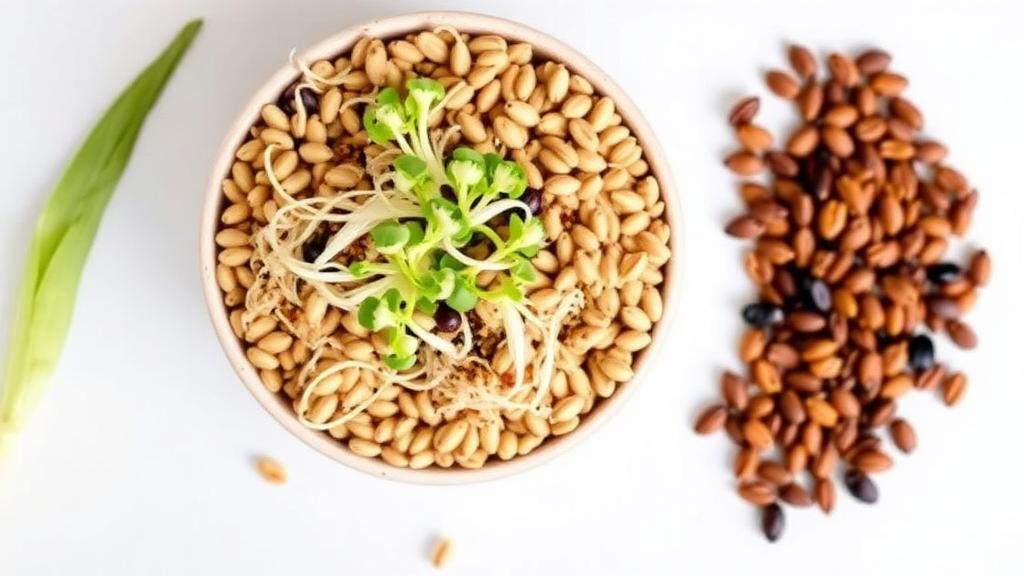
A humble seed, given nothing more than water, warmth, and a couple of days, can transform itself into one of the most nutritionally potent ingredients in the modern food industry. That is the central conclusion of a comprehensive new review published in Food Science and Biotechnology, which synthesizes five years of research on the germination of Andean grains, including quinoa, cañihua, kiwicha (amaranth), and tarwi, the Andean lupine. The review, authored by Lesly Edith Yata-Franco and Laumer Tocto-Yajahuanca of the Universidad Nacional Autónoma Altoandina de Tarma in Peru, compiles evidence from 2020 through 2025 and maps out exactly what happens, chemically and structurally, when these ancient seeds are allowed to sprout. The answer, according to the accumulated data, is that germination acts as a biological upgrade: proteins rise, antinutrients fall, antioxidants multiply, and the grains become easier to digest and easier to work with in the factory.
The timing of this synthesis could hardly be better. Quinoa has already made the leap from Andean staple to global supermarket shelf, but its lesser-known relatives, cañihua (Chenopodium pallidicaule), kiwicha (Amaranthus caudatus), and tarwi (Lupinus mutabilis), remain underutilized crops with remarkable nutritional credentials. All of these crops were domesticated thousands of years ago in the high-altitude environments of the Andes, where they evolved to tolerate frost, drought, intense ultraviolet radiation, and poor soils. As the global food system searches for climate-resilient, protein-rich alternatives to conventional cereals, these ancestral seeds are attracting renewed scientific and commercial attention. Germination, the review argues, is the key processing step that unlocks their full potential.
The technical core of the review concerns what happens during the critical window of 24 to 72 hours at temperatures between 20 and 25 degrees Celsius, the conditions most commonly reported across the recent literature. When a seed imbibes water, it reactivates its metabolic machinery. Dormant enzymes, particularly proteases, amylases, and phytases, spring into action. Proteases break down stored proteins into free amino acids and peptides, which is why germinated grains consistently show increases in protein content and, crucially, in the availability of essential amino acids such as lysine, an amino acid in which most cereals are deficient. Multi-omics studies cited in the review have traced the molecular pathways behind lysine accumulation in quinoa sprouts, offering breeders and processors a roadmap for maximizing this trait.
One of the most striking findings across the reviewed studies involves gamma-aminobutyric acid, or GABA, a non-protein amino acid that has become a sought-after ingredient in functional foods for its purported calming and neuroprotective effects. Germination reliably elevates GABA levels in quinoa, and transcriptome analyses have revealed the molecular mechanism: sprouting upregulates the genes of the GABA shunt, a metabolic pathway that converts glutamate into GABA. Stress treatments applied before or during germination, such as ultrasound, appear to push this accumulation even further, essentially tricking the seed into producing more of the compound as a defensive response. For food manufacturers, this means a simple, non-chemical bioprocess can yield a naturally GABA-enriched flour or beverage base.
The antioxidant story is equally compelling. Germinated Andean grains show consistent increases in phenolic compounds, flavonoids, and overall antioxidant activity compared with their raw counterparts. The mechanism is straightforward biochemistry: as the seed mobilizes its reserves to build a new plant, it activates the phenylpropanoid pathway, the metabolic route responsible for synthesizing phenolic acids and flavonoids. These compounds serve the sprouting seed as chemical armor against pathogens and oxidative stress, and they pass directly into the human diet when the sprouts are consumed. Studies on quinoa sprouts cultivated in Peru have even documented gastroprotective effects associated with this enriched phytochemical profile, hinting at health benefits that extend well beyond basic nutrition.
Just as important as what germination adds is what it removes. Raw Andean grains, like most seeds, contain antinutritional factors that limit mineral absorption and digestibility. Phytates bind iron and zinc in the digestive tract, saponins give quinoa its characteristic bitterness, and protease inhibitors interfere with protein digestion. Germination systematically dismantles these barriers. Phytases degrade phytate, releasing the bound minerals; saponin levels decline as the seed metabolizes these glycosides; and studies in animal models have suggested that germinated quinoa can improve iron status, with anti-anemic effects observed in rats fed germinated quinoa-based diets. The result is a grain whose iron, zinc, folate, and fatty acids are not merely present but actually bioavailable.
Beyond nutrition, the review highlights changes in techno-functional properties, the characteristics that determine how a flour behaves in a bakery, an extruder, or a beverage line. Germination modifies quinoa starch structure, altering its pasting behavior and digestibility, and it changes protein conformation in ways that improve solubility, emulsifying capacity, and foaming. Germinated quinoa flour has been incorporated into wheat doughs and gluten-free formulations with measurable effects on rheology, and pasta supplemented with germinated quinoa shows improved starch digestibility profiles. In extrusion applications, sprouted pseudocereals have produced snacks with better nutritional and physicochemical characteristics, while germinated lupin sprouts have emerged as a novel ingredient for extruded products with modified matrix structure.
The food applications documented in the review read like a preview of the next generation of functional products. Researchers have developed optimized beverages from sprouted quinoa varieties, probiotic desserts based on sprouted quinoa milk, and quinoa-enriched breads in which sprouting serves as a pre-processing step that improves both taste and astringency profiles. Smart pasta formulations combining sprouted quinoa and kiwicha, functional muffins using germinated Andean pseudocereal flours as partial wheat replacers, and noodles fortified with germinating quinoa flour that modulate blood glucose responses all illustrate the breadth of the pipeline. Even 3D printing has entered the picture, with cereal-legume gels formulated from germinated flours demonstrating the compatibility of these ingredients with emerging food manufacturing technologies.
The review is candid about the gaps that remain. Optimal germination protocols differ among species, varieties, and even growing altitudes, and comparative studies on the less-studied grains, particularly cañihua and tarwi, lag far behind the quinoa literature. The authors also point to an emerging frontier: the combination of germination with novel processing technologies. Ultrasound-assisted germination has already been shown to accelerate the process and enhance mineral content and bioactive compounds in quinoa, while cold plasma, high-pressure treatment, ozone, and magnetic field pretreatments have each demonstrated the ability to modulate germination outcomes, from phenolic biosynthesis to gel rheology. Selenium and zinc fortification during germination, borrowed from work on germinated brown rice, represents another promising strategy for producing mineral-enriched functional ingredients.
What emerges from this synthesis is a picture of germination not as a folk technique but as a precise, tunable bioprocess sitting at the intersection of plant physiology, food chemistry, and industrial engineering. The same enzymatic cascade that allows a seed to grow can be steered, through temperature, time, hydration, and physical stimuli, to deliver a specific nutritional or functional outcome. For the Andean grains, crops that fed Inca civilizations at 4,000 meters and are now being positioned as answers to global food security challenges, germination may be the bridge between ancestral knowledge and industrial food science. The review’s authors make clear that the next phase of research must focus on optimization, standardization, and scale-up, but the direction is set: the sprouted seed, ancient and unassuming, is becoming one of the most scientifically validated functional ingredients of the coming decade.
Subject of Research: Effects of germination on the nutritional composition, bioactive compounds, and food applications of Andean grains
Article Title: Germination of Andean grains: a review of the impacts on nutritional composition, bioactive compounds, functional properties and food applications
Article References: Yata-Franco, L. E., & Tocto-Yajahuanca, L. (2026). Germination of Andean grains: a review of the impacts on nutritional composition, bioactive compounds, functional properties and food applications. Food Science and Biotechnology. https://doi.org/10.1007/s10068-026-02325-3
Image Credits: AI Generated
DOI: 10.1007/s10068-026-02325-3
Keywords: Andean grains, quinoa, germination, GABA, antioxidants, bioactive compounds, antinutrients, tarwi, kiwicha, cañihua, functional foods, food science
Cite Scienmag News
Daisy Hatcher. (October 11, 2026). Sprouting Ancient Andean Grains Supercharges Their Nutrition, Review Finds. Scienmag. https://scienmag.com/sprouting-ancient-andean-grains-supercharges-their-nutrition-review-finds/
Daisy Hatcher. "Sprouting Ancient Andean Grains Supercharges Their Nutrition, Review Finds." Scienmag, 11 October 2026, https://scienmag.com/sprouting-ancient-andean-grains-supercharges-their-nutrition-review-finds/. Accessed 11 October 2026.
Daisy Hatcher. "Sprouting Ancient Andean Grains Supercharges Their Nutrition, Review Finds." Scienmag. October 11, 2026. https://scienmag.com/sprouting-ancient-andean-grains-supercharges-their-nutrition-review-finds/


