

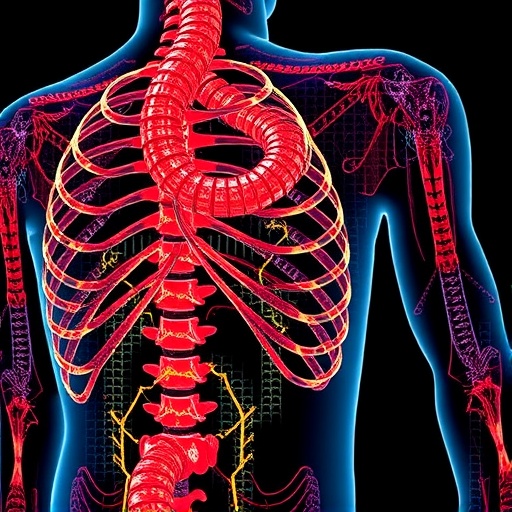
For decades, bones and muscles have been studied as separate mechanical actors in the body’s choreography—one providing rigid structure, the other generating force. But a new study blows that view apart, revealing that these tissues are locked in a constant, elaborate molecular conversation that shapes health, repair, and disease. Using a cutting-edge technique called spatial transcriptomics, researchers have now eavesdropped on the cellular chatter where femur meets muscle in a young male mouse, generating the first high-resolution map of bone–muscle communication networks in their natural setting.
The work, led by Professor Hong-Wen Deng at Tulane University’s Center for Biomedical Informatics and Genomics, tackles a long-standing blind spot in biology. Traditional gene-sequencing methods can list which genes are active in a tissue, but they typically grind samples to a pulp, destroying any information about where exactly signals originate and travel. Spatial transcriptomics sidesteps that by snapping molecular data onto intact tissue slices, preserving geography. “Our goal was to move beyond simply identifying which genes are present and instead understand how cells communicate within their native tissue environment,” Deng explained. “By preserving spatial information, we were able to uncover communication networks that would be difficult to detect using conventional sequencing approaches alone.”
The team profiled 2,660 microscale spots across a mouse femur and its adjacent skeletal muscle, then deployed advanced computational tools to reconstruct cellular neighborhoods. What emerged was not a simple two-party line but a dense, multicellular internet. Osteoblasts and skeletal muscle cells were the obvious participants, but the network also teemed with endothelial cells, various immune cells, and stem-cell populations, all exchanging signals in spatially organized patterns. Altogether, thirteen major signaling pathways surfaced as the principal drivers of tissue coordination, many hinging on extracellular matrix proteins and growth factors that convey information about structural integrity and metabolic demand.
Among the most striking findings was the identification of specific ligand-receptor pairs acting as molecular messengers across cell types. Collagen-associated signaling was particularly prominent between osteoblasts and muscle cells, as if the very scaffolding of bone were whispering instructions to muscle fibers. Thrombospondin-mediated pathways recruited immune cells into the dialogue, likely tuning inflammation-sensitive remodeling, while vascular endothelial growth factor (VEGF)-driven axes knitted vascular function into the musculoskeletal unit. Laboratory imaging then confirmed that several predicted protein partners physically co-localize within the tissue, bolstering the computational predictions with visual proof.
The researchers did not stop at one animal or one dataset. They validated their key pathways against independent mouse and human transcriptomic data, discovering that certain communication mechanisms appear conserved across species. This evolutionary echo suggests that the molecular grammar of bone–muscle crosstalk might be fundamental enough to inform human medicine. Disorders such as osteoporosis, sarcopenia, and metabolic syndromes often involve simultaneous deterioration of both tissues, and a unified understanding of their signaling logic could point to common therapeutic targets that address multiple conditions at once.
Beyond immediate biomedical implications, the study provides a high-definition reference atlas for the field. Scientists investigating injury, aging, or degenerative disease can now overlay their own data onto this map to pinpoint where communication breaks down. “Understanding these cellular communication pathways gives us a framework for studying what goes wrong in musculoskeletal disorders,” Deng said. “In the future, this knowledge may help guide the development of targeted interventions that restore healthy communication between tissues.”
The technical achievement also underscores a broader revolution in biology. Spatial omics technologies are beginning to show that virtually no tissue functions in isolation. The bone–muscle interface studied here exemplifies a principle that likely extends to ligament–bone junctions, tendon–muscle attachments, and even organ-to-organ endocrine loops. By revealing how multiple cell types orchestrate their activity through spatially encoded networks, the research sets a new standard for examining physiological integration.
Looking ahead, the Tulane team plans to apply the same approach to aged and diseased mouse models, probing how the conversation degrades over a lifetime. If successful, such studies could illuminate the molecular roots of frailty and disability, ultimately guiding the development of precision diagnostics and regenerative therapies. For now, the message is clear: bones and muscles do not merely coexist; they are in constant, eloquent negotiation, and understanding that dialogue may hold the key to preserving mobility and vitality well into old age.
Subject of Research: Animal tissue samples (mouse femur and adjacent skeletal muscle)
Article Title: Decoding cellular communication networks and signaling pathways in bone, skeletal muscle, and bone-muscle crosstalk through spatial transcriptomics in a young male mouse
News Publication Date: 19 May 2026
Web References: 10.1038/s41413-026-00520-w
References: Bone Research, Volume 14, 19 May 2026
Image Credits: Professor Hong-Wen Deng, Tulane University, USA
Keywords: spatial transcriptomics, bone–muscle crosstalk, cell communication, signaling pathways, osteoblasts, skeletal muscle, ligand-receptor pairs, musculoskeletal disorders, extracellular matrix, VEGF


