


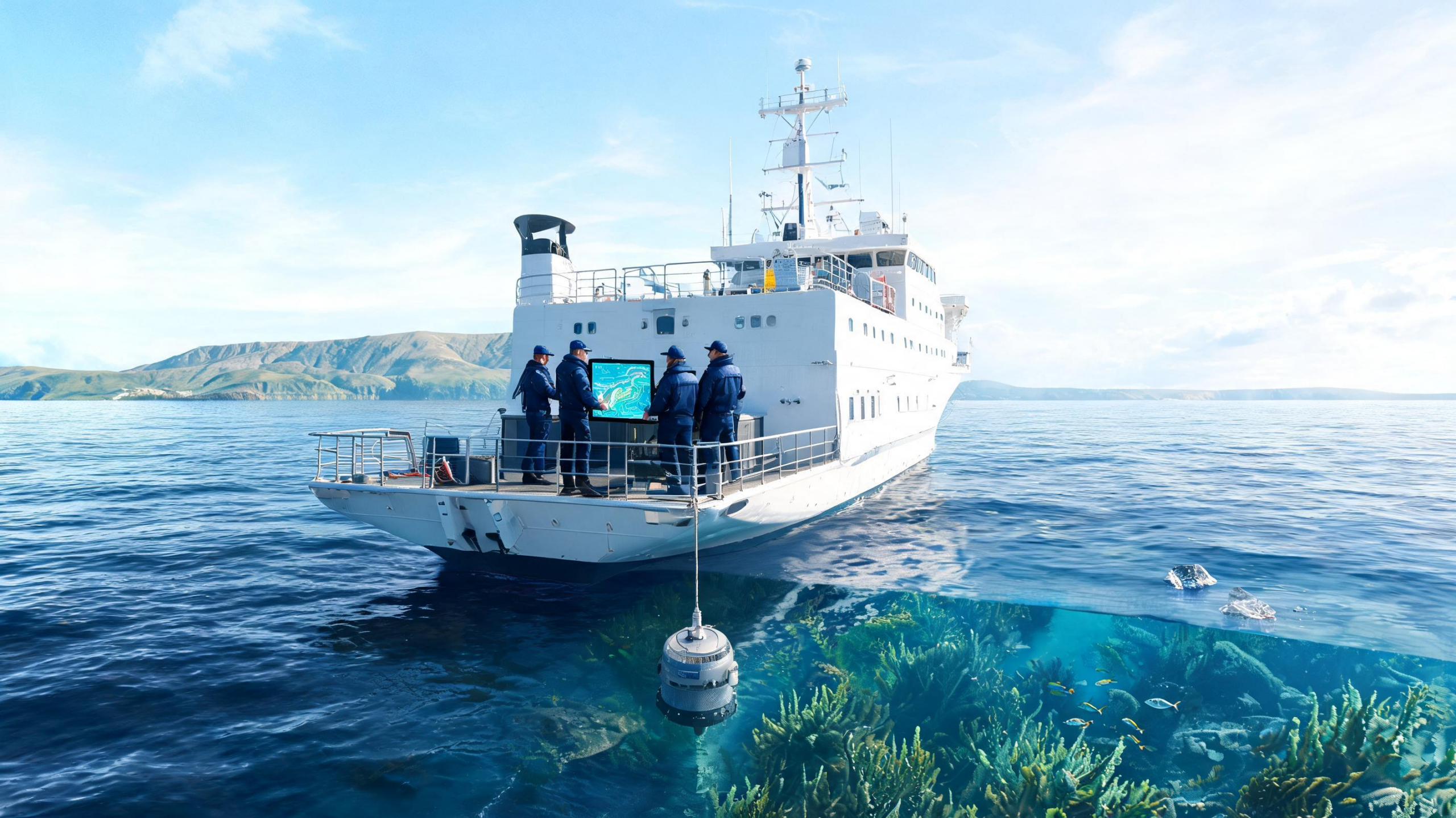
A major gathering of marine scientists in Argentina has brought together research on ocean circulation, biodiversity, pollution, fisheries, technology and climate change, revealing how tightly connected the region’s marine challenges have become. The XII National Marine Sciences Conferences and XX Oceanography Colloquium, held in Puerto Madryn, Chubut Province, from 1 to 5 December 2025, attracted about 684 researchers, students and professionals from Argentina and neighboring countries. The meeting’s theme, “Oceans: A Sea of Opportunities for Our Future,” reflected an increasingly practical ambition: to understand marine systems well enough to support conservation, sustainable resource use and informed public policy. A report describing the event presents the conference not as a single discovery, but as a snapshot of a rapidly expanding scientific agenda for the Southwest Atlantic.
The event grew from Argentina’s long-running Oceanography Week, established in the late 1970s, and became the National Marine Sciences Conferences in 1989 as researchers sought a broader forum spanning physical oceanography, marine biology and related disciplines. Since 2003, the triennial meeting has rotated among Argentine coastal cities; in 2025, it returned to Puerto Madryn after nearly two decades. The organizing effort involved researchers from several CONICET institutes and three higher-education institutions, creating a national network that linked oceanographers with biologists, technologists, social scientists, managers and representatives of economic sectors. For the first time, the scientific community was invited to propose thematic sessions, allowing emerging priorities to help shape the program rather than relying solely on a fixed institutional structure.
The resulting program included 37 thematic scientific sessions, 12 keynote lectures, 10 workshops, eight roundtables, a discussion panel and six training courses. In total, participants delivered 592 presentations: 294 ten-minute oral talks on site and 298 three-minute virtual speed talks. Replacing conventional printed posters with online presentations was intended to reduce material waste and the meeting’s carbon footprint while broadening participation. About 88 percent of attendees participated in person despite difficult economic conditions, and students made up more than half of the audience. Researchers came from across Argentina and from Uruguay, Chile, the United States, Mexico, Spain, the United Kingdom, Poland and Australia, giving the meeting a regional base with international reach.
Many of the scientific themes converged on the idea that ocean ecosystems cannot be understood through isolated disciplines. Sessions on physical, chemical and biological oceanography combined satellite observations, numerical models and measurements collected in the sea to investigate ocean structure, metabolism and variability. Marine microbiology and plankton research focused on organisms that drive food webs and regulate the movement of carbon and nutrients. One keynote examined the “viral engine” concept, in which viruses infecting marine phytoplankton influence microbial mortality and the recycling of matter. Another described the nitroplast, a nitrogen-fixing organelle associated with the marine microorganism UCYN-A and the alga Braarudosphaera bigelowii, highlighting an evolutionary development with implications for understanding nitrogen cycling in the ocean.
Climate change emerged as a force operating across scales, from the physiology of individual organisms to the circulation of the continental shelf. Presentations considered how phytoplankton, invertebrates and vertebrates respond biochemically and physiologically to environmental stress, and how those responses may affect ecosystem health, fisheries and aquaculture. Research on biodiversity addressed intertidal habitats, deep-sea ecosystems, ecological networks, trophic relationships, functional traits and biological invasions. A keynote drawing on the BioTIME database discussed rapid compositional turnover in marine communities linked to climate change, even where overall species richness appears comparatively stable. That distinction matters: an ecosystem can retain a similar number of species while the identities and ecological roles of those species change, potentially altering resilience and ecosystem functioning.
Regional circulation was another central concern. A keynote on the Southwest Atlantic shelf used observations and high-resolution climate modelling to examine how changes associated with the Southern Annular Mode and future emissions scenarios could modify circulation and exchanges between the deep ocean and the Patagonian continental shelf. Storm waves and surges on the Argentine shelf and in the Río de la Plata were studied through numerical simulations combined with observations, improving understanding of how extreme events are generated, propagated and connected across oceanic and coastal environments. Such physical processes affect the transport of heat, sediments, nutrients and pollutants, and they help determine where organisms can live and how human activities are exposed to marine hazards.
Human pressures formed a second major thread. Marine pollution sessions examined biological indicators, anthropogenic particles, persistent organic pollutants and the ecological consequences of contamination. Roundtables on microplastics considered evidence from multiple coastal and marine environmental matrices, as well as possible ecological, economic, health and cultural effects. A workshop explored phycoremediation, using algae or other photosynthetic organisms as a nature-based approach for treating nutrient- and organic-rich wastewater from urban, industrial and fisheries activities. Other discussions addressed marine biological invasions, with emphasis on shipping as a vector, early detection and coordinated prevention between Argentina and Chile. These topics point toward management strategies that combine monitoring, ecological research and action before damage becomes difficult to reverse.
Fisheries, aquaculture and the blue economy were discussed as socio-ecological systems rather than merely sources of production. Contributions examined sustainability and governance in industrial fisheries, as well as the social and regulatory challenges facing artisanal and recreational fisheries in coastal communities. Sessions on San Jorge Gulf and Península Valdés considered pathways toward formalization, while a roundtable on the South Atlantic’s adjacent area linked fisheries and conservation with geopolitics and international relations. Marine spatial planning, ecosystem-based management and coastal governance were also examined through case studies including “Blue Holes,” water-filled vertical openings in carbonate rock with distinctive morphologies, ecologies and water chemistry. These discussions emphasized that scientific evidence must be connected with institutions, local knowledge and decision-making if ocean policies are to work in practice.
Technology and capacity building rounded out the meeting’s forward-looking agenda. Researchers presented work involving marine genomics, biotechnology, hydroacoustics, scientific diving, remote sensing, spatial analysis and numerical modelling. Workshops addressed sustained marine observation in the Argentine Sea and Antarctica, identifying scientific, technological and institutional gaps that limit knowledge of ocean change. Training courses covered aquatic sampling, ultrasound techniques in octopus and flounder, QGIS and R for spatial data analysis, scientific illustration and academic English. A new code of conduct, developed by a working group on inclusion, diversity, equity, accessibility and language, established standards for a safer and more collaborative environment. The next National Marine Sciences Conference and Oceanography Colloquium is scheduled for December 2027 in Mar del Plata, where organizers plan to continue building the regional networks needed to study and protect a changing ocean.
The meeting report is valuable as a map of research capacity as well as a record of presentations. Its breadth shows that Southwest Atlantic marine science is increasingly organized around linked systems: circulation influences the delivery and retention of nutrients; nutrient availability shapes plankton communities; plankton supports food webs; and biological activity feeds back into carbon and nutrient transformations. Connecting these processes requires observations collected at different temporal and spatial scales, together with models and laboratory measurements that can be compared rather than developed in isolation.
This integration is particularly important on continental shelves, where land, atmosphere, open ocean and seabed interact over relatively short distances. Estuaries and coastal waters receive material from rivers and human activities, while tides, storms and shelf circulation redistribute it. The same transport pathways can move nutrients that sustain productivity, sediments that alter habitats, and contaminants or introduced organisms that create ecological risks. Treating these as separate issues can obscure their common physical drivers. The conference’s combination of coastal science, oceanography, pollution research and management therefore provides a framework for asking how one intervention or environmental change may produce several consequences at once.
Biological measurements add another layer of interpretation. Species counts alone may not reveal whether ecosystem functions are being maintained, because organisms with different traits can replace one another while total richness changes little. Studies of physiology, trophic relationships, ecological networks and genomics can help identify which changes affect energy transfer, reproductive success, stress tolerance or vulnerability to disturbance. These approaches also make it possible to connect individual responses with consequences for fisheries, aquaculture and conservation. In this context, biodiversity monitoring is not simply an inventory exercise; it can serve as an early indication of altered ecosystem processes.
The emphasis on observation infrastructure has practical significance because many marine questions cannot be answered by occasional expeditions. Sustained measurements allow researchers to distinguish long-term trends from seasonal cycles, unusual storms or short-lived biological events. Combining ship-based sampling with remote sensing, hydroacoustics, autonomous or fixed observations, and numerical analysis can extend coverage across places that are difficult or expensive to visit regularly. The report’s attention to scientific, technological and institutional gaps suggests that continuity, data comparability and coordination are as important as acquiring individual instruments. Without those foundations, evidence about change may remain fragmented even when many studies are being conducted.
Knowledge production was also presented as a social process. The inclusion of local and traditional knowledge, participatory research and co-production can help identify questions that matter to coastal communities and reveal changes that are not captured by standardized surveys. It can also improve the feasibility and legitimacy of management measures, especially where conservation objectives intersect with fishing, tourism, shipping or other uses. The code of conduct and training activities complement this scientific agenda by supporting the conditions needed for collaboration across career stages, institutions and national boundaries. Taken together, the meeting portrays regional ocean science as both an analytical enterprise and a long-term public infrastructure for responding to environmental change.
Subject of Research: Marine science research and collaboration in the Southwest Atlantic Ocean
Article Title: Recent advances in Southwest Atlantic Ocean Marine Sciences: outcomes from the XII National Marine Sciences Conferences and XX Oceanography Colloquium
Article References: Barbieri, E. S., Argüelles, M. B., Torres, A. I., & Giarratano, E. (2026). Recent advances in Southwest Atlantic Ocean Marine Sciences: outcomes from the XII National Marine Sciences Conferences and XX Oceanography Colloquium. Ocean Microbiology, 2(1), Article 4. https://doi.org/10.1186/s44375-026-00010-8
Image Credits: AI Generated
DOI: 10.1186/s44375-026-00010-8
Keywords: Southwest Atlantic, marine science, oceanography, climate change, marine biodiversity, fisheries, marine pollution, ocean governance, Recent, advances, Southwest, Atlantic
Cite Scienmag News
Violet Maxwell. (August 28, 2026). Southwest Atlantic Marine Scientists Map Ocean Challenges and Opportunities. Scienmag. https://scienmag.com/southwest-atlantic-marine-scientists-map-ocean-challenges-and-opportunities/
Violet Maxwell. "Southwest Atlantic Marine Scientists Map Ocean Challenges and Opportunities." Scienmag, 28 August 2026, https://scienmag.com/southwest-atlantic-marine-scientists-map-ocean-challenges-and-opportunities/. Accessed 4 October 2026.
Violet Maxwell. "Southwest Atlantic Marine Scientists Map Ocean Challenges and Opportunities." Scienmag. August 28, 2026. https://scienmag.com/southwest-atlantic-marine-scientists-map-ocean-challenges-and-opportunities/


