


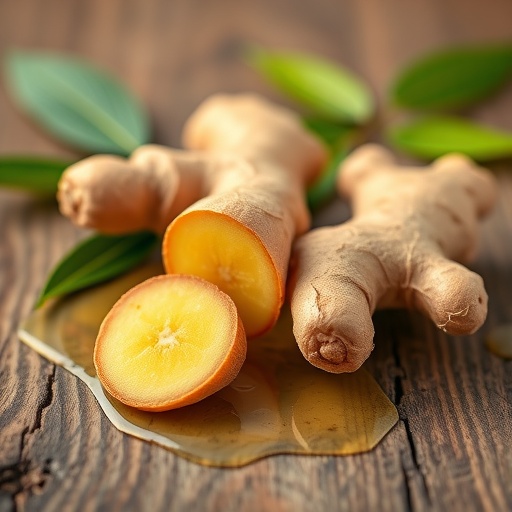
A ginger extract rich in two of the plant’s best-known bioactive molecules has shown antioxidant, anti-inflammatory and anti-parasitic activity in a battery of laboratory tests, while producing a similar level of toxicity in human foreskin fibroblast cells. The findings come from a study of Zingiber officinale rhizomes native to northern Nigeria, in which researchers identified 23 chemical constituents and found that zingerone and 6-gingerol were the dominant compounds. The work offers a detailed chemical and biological profile of a regional ginger variety, but its results remain limited to test-tube and cell-based experiments rather than clinical evidence in people.
Ginger has been used in traditional medicine for centuries, and its biological effects are often attributed to phenolic compounds concentrated in the rhizome. These molecules can participate in oxidation-reduction reactions, interact with cellular membranes and influence biochemical pathways associated with inflammation. However, the composition of ginger is not fixed. Climate, soil, cultivation conditions, plant variety, harvest timing and extraction method can all change the relative abundance of its constituents. The researchers therefore set out to examine both what was present in the Nigerian ginger extract and whether that chemical mixture could neutralize free radicals, protect membranes from inflammatory damage, inhibit a foodborne parasite or harm mammalian cells.
To prepare the sample, the ginger rhizome was first defatted and then subjected to sequential extraction with ethyl acetate. Defatting removes nonpolar materials such as fats and oils, while ethyl acetate is capable of dissolving a broad range of moderately polar plant metabolites, including several phenolic compounds. The resulting extract was analyzed using gas chromatography–mass spectrometry, or GC-MS. In this technique, compounds are separated as they pass through a chromatographic column and are then identified by the characteristic pattern of ions produced when they are fragmented in a mass spectrometer. The method does not simply provide a visual impression of the extract: it generates a chemical fingerprint that can be used to estimate the relative proportion of detectable constituents.
The analysis identified 23 compounds, with zingerone accounting for 19.01 percent of the extract and 6-gingerol for 8.11 percent. Zingerone is an aromatic ketone formed in ginger-related chemistry and is associated with the plant’s sweet, warm sensory profile. 6-Gingerol, by contrast, is one of the characteristic pungent phenolic compounds in fresh ginger. Both molecules contain chemical features capable of interacting with reactive species, although their biological effects depend on concentration, molecular environment and metabolism. Finding them as the major constituents provides a plausible chemical basis for the activities measured in the study, while also underscoring why ginger from different regions may not behave identically in laboratory assays.
The extract’s antioxidant capacity was assessed with two standard radical-scavenging tests, DPPH and ABTS. DPPH, short for 2,2-diphenyl-1-picrylhydrazyl, is a stable purple radical that becomes less intensely colored when it accepts an electron or hydrogen atom from an antioxidant. ABTS, or 2,2′-azino-bis(3-ethylbenzothiazoline-6-sulfonic acid), generates a colored radical cation that can likewise be reduced by antioxidant molecules. In both assays, the researchers reported the concentration required to reduce the measured activity by 50 percent, known as the IC50. Lower values generally indicate stronger activity under the conditions of the experiment. The ginger extract produced IC50 values of 30.26 ± 0.52 micrograms per milliliter in the DPPH test and 35.65 ± 1.34 micrograms per milliliter in the ABTS test.
These experiments model one chemical aspect of oxidative stress: the ability of a mixture to react with certain reactive molecules outside living cells. Oxidative stress in an organism is more complicated. Reactive oxygen and nitrogen species are generated during normal metabolism and immune responses, and they are controlled by enzymes, transport systems and antioxidant networks inside particular tissues. A substance that performs well in a colorimetric assay may be poorly absorbed, rapidly metabolized or unable to reach the relevant biological target. The results therefore indicate antioxidant potential rather than proving that eating ginger or taking a ginger preparation will prevent oxidative damage or treat an oxidative-stress-related disease.
The investigators also examined anti-inflammatory activity using a red blood cell membrane stabilization assay. The method is based on the observation that red blood cell membranes share some structural characteristics with lysosomal membranes, which contain enzymes capable of damaging cellular components when released during inflammation. Under stressful conditions, red blood cells can rupture, or hemolyze. If a test substance helps stabilize the membrane, it may reduce hemolysis in the assay and be interpreted as having anti-inflammatory potential. The ethyl acetate extract produced an IC50 of 16.56 ± 6.54 micrograms per milliliter, indicating activity in this model. That result may reflect interactions between the extract’s phenolic constituents and lipid or protein components of the membrane, although the assay cannot identify the precise molecular pathway involved.
One of the study’s most attention-grabbing findings was activity against Toxoplasma gondii, a widespread parasite and foodborne pathogen. T. gondii is an intracellular protozoan whose life cycle includes rapidly multiplying forms capable of invading host cells. Infection is often asymptomatic, but it can cause serious disease in people with weakened immune systems and can threaten fetal development when infection occurs during pregnancy. The researchers report that the ginger extract exhibited anti-parasitic action against the organism in vitro. The source material does not establish how the extract acted, whether it affected parasite invasion or replication, or which compound was responsible. Nor does an in-vitro effect demonstrate that the extract can reach an effective and safe concentration in an infected person.
The study additionally measured cytotoxicity in human foreskin fibroblast cells, connective-tissue cells commonly used in laboratory toxicology and cell biology. The extract showed similar cytotoxicity toward these cells, a result the researchers considered alongside its anti-parasitic activity. This comparison is important because a compound that kills parasites but is equally damaging to mammalian cells may have a narrow or unusable therapeutic window. Conversely, a lack of substantial toxicity in one cell type would not guarantee safety throughout the body: liver cells, immune cells, intestinal tissues and reproductive cells can respond differently, and whole-organism toxicity involves absorption, distribution, metabolism and excretion. The reported fibroblast result is therefore an initial safety signal, not a toxicological clearance.
The researchers describe their work as the first single study to combine chemical characterization with antioxidant, anti-inflammatory, anti-Toxoplasma gondii and cytotoxicity testing for ginger native to northern Nigeria. They conclude that the findings support traditional uses of ginger and suggest possible value in research on inflammatory and oxidative-stress-related conditions. That conclusion is best understood as a rationale for further investigation rather than a medical endorsement. The experiments used a chemically selected extract and standardized laboratory assays, not a randomized clinical trial of ginger consumption. Future work would need to determine how the extract’s constituents interact, whether zingerone or 6-gingerol drive the observed effects, how the compounds are absorbed and metabolized, and whether anti-parasitic activity can be separated from toxicity in relevant animal and human models. For now, the study’s strongest contribution is a precise snapshot of how chemistry, geography and biological testing converge in one ginger variety.
Cite Scienmag News
Ophelia Keating. (August 28, 2026). Ginger Extract’s Chemical Profile Reveals Antioxidant, Anti-Inflammatory, Antiparasitic and Cytotoxic Effects. Scienmag. https://scienmag.com/ginger-extracts-chemical-profile-reveals-antioxidant-anti-inflammatory-antiparasitic-and-cytotoxic-effects/
Ophelia Keating. "Ginger Extract’s Chemical Profile Reveals Antioxidant, Anti-Inflammatory, Antiparasitic and Cytotoxic Effects." Scienmag, 28 August 2026, https://scienmag.com/ginger-extracts-chemical-profile-reveals-antioxidant-anti-inflammatory-antiparasitic-and-cytotoxic-effects/. Accessed 10 September 2026.
Ophelia Keating. "Ginger Extract’s Chemical Profile Reveals Antioxidant, Anti-Inflammatory, Antiparasitic and Cytotoxic Effects." Scienmag. August 28, 2026. https://scienmag.com/ginger-extracts-chemical-profile-reveals-antioxidant-anti-inflammatory-antiparasitic-and-cytotoxic-effects/


