


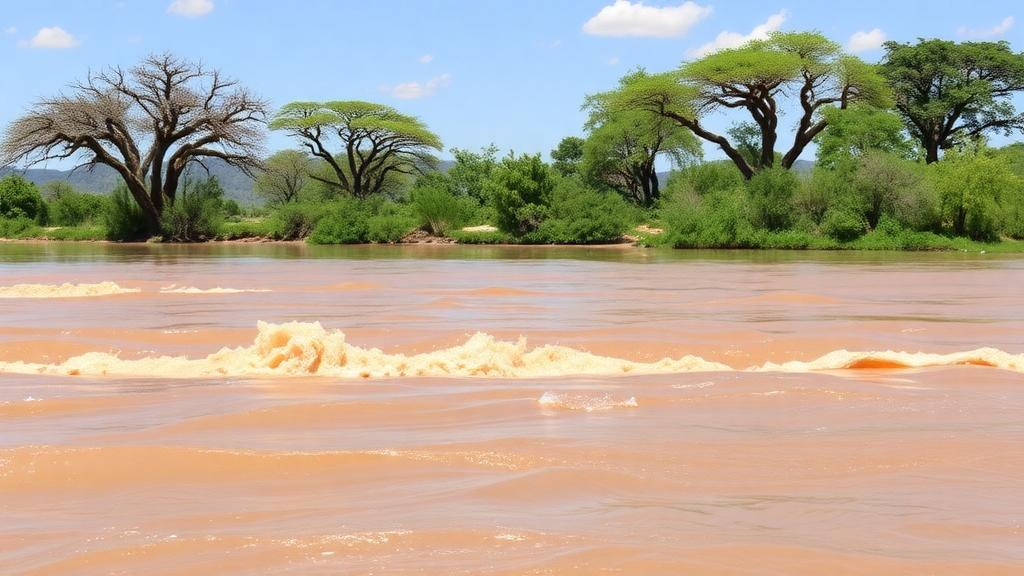
South Africa’s Limpopo River Basin, home to more than 18 million people and the scene of some of the country’s most devastating floods, is heading toward a hydrological future defined by violent swings between extremes. A new study published in Theoretical and Applied Climatology projects that peak river flows in the basin could surge by more than 50 percent above historical levels by the end of the century, even as the river’s overall annual discharge trends downward. The research, led by Tumelo Mohomi of the University of Limpopo together with colleagues at Lomonosov Moscow State University, the University of South Africa and other institutions, marks the first application in Africa of the INM RAS-MSU Terrestrial Model, known as TerM, driven by the latest generation of CMIP6 climate projections from the ISIMIP database.
The team simulated river flow in the basin from 2020 to 2100 under two Shared Socioeconomic Pathways: SSP1-2.6, a low-emission scenario consistent with strong climate mitigation, and SSP5-8.5, a high-emission trajectory in which fossil fuel use continues largely unchecked. Atmospheric forcing came from a five-model ensemble of CMIP6 global climate models at daily resolution, covering variables from precipitation and temperature to humidity, wind speed and radiation. The researchers compared two future windows, a near future spanning 2020 to 2055 and a far future from 2065 to 2100, against a historical baseline running from 1979 to 2014, with floods defined as streamflow exceeding the 95th percentile.
The choice of model matters. TerM, developed at the Marchuk Institute of Numerical Mathematics of the Russian Academy of Sciences and Lomonosov Moscow State University, simulates the exchange of water and energy between the land surface and the atmosphere and forms the land component of the INMCM Earth System Model. Before running future scenarios, the team calibrated the model’s runoff parameters against observed discharge at a gauge on the Limpopo River, optimising soil infiltration capacity, which governs how rainfall is partitioned between surface runoff and infiltration, and maximum groundwater discharge, which controls baseflow during dry periods. The calibration prioritised a near-zero bias in total water volume, a deliberate trade-off that sacrifices some day-to-day timing accuracy in favour of eliminating systematic volume errors that would otherwise distort century-long water balance assessments.
The projections paint a picture of a basin caught between intensifying atmospheric demand and erratic rainfall. Incoming shortwave radiation is projected to rise across the basin, by around 3 watts per square metre per month in the near future and by 4 to 6 watts per square metre in the far-future interior of Gauteng and Limpopo Provinces, likely reflecting declining cloud cover and the eastward expansion of semi-arid conditions from the Kalahari. Temperatures climb along an east-to-west gradient, from 1.6 to 2.5 degrees Celsius in the near future to more than 3.7 degrees Celsius in the far future, with some stations projected to warm by 5.5 degrees Celsius. Relative humidity falls in step, and soil water content declines across all scenarios, from modest near-future deficits to losses exceeding 7 millimetres per month in far-future coastal and southern zones.
Underlying these shifts is a familiar piece of thermodynamics: the Clausius-Clapeyron relationship, which dictates that warmer air holds more water vapour. As temperatures rise, evaporative demand intensifies even during wet periods, so gains in rainfall are largely offset by losses to evaporation. The study projects that terrestrial water storage will decline across the basin by up to 4 millimetres per month, with the steepest deficits concentrated near the river mouth in Mozambique, where surface water evaporation is expected to increase by 0.5 to 0.8 millimetres per month. Groundwater runoff, after a brief near-future increase of up to 0.5 millimetres per month, falls substantially in the far future, with declines reaching 2.5 millimetres per month along the coast. The result is a basin transitioning toward water limitation, where the atmosphere’s thirst outpaces natural replenishment.
The streamflow projections are where the study’s most striking finding emerges. While the long-term annual trend in streamflow is downward and statistically insignificant between 2020 and 2100, individual years tell a very different story. Under the high-emission scenario, peak monthly flows at the river mouth frequently exceed 4,000 cubic metres per second, compared with historical baseline peaks of about 2,500 cubic metres per second, an increase of more than 50 percent. Extreme years cluster around 2030, 2041, 2052, 2073 and 2091. At interior gauges, discharge is projected to exceed 900 cubic metres per second during high-emission years such as 2068 and 2079. Yet the same simulations show synchronised collapses between 2092 and 2094, and again around 2034, when flow at all interior stations falls below 150 cubic metres per second. The authors describe this as hydro-climatic whiplash: a regime in which unprecedented floods and severe droughts alternate with little respite.
The seasonal rhythm of the river is also expected to shift. Peak flows will continue to arrive during the austral summer, concentrated in January and February, when convective rainfall, tropical cyclones landfalling from the Mozambique Channel and the El Niño-Southern Oscillation all conspire to deliver the basin’s heaviest downpours. The 95th-percentile analysis suggests February high flows at the river mouth could reach 4,800 cubic metres per second in the far future under high emissions, with increases of up to 2,250 cubic metres per second relative to the baseline. But the shoulder seasons contract. Pronounced decreases are projected during spring, from September to November, with September rainfall and evaporation under SSP5-8.5 falling by more than 26 percent in the far future. Low-flow months such as August, September and October are projected to see the river dwindle toward zero flow at all monitoring stations, effectively lengthening the dry season.
The urgency of these projections is underscored by recent history. The basin has long been a flood hotspot, recording 48 significant floods between 1980 and 2012, and historical disasters in 1955, 1967, 1972, 1975, 1977, 1981 and 2000 were repeatedly linked to tropical cyclone rainfall pushing the river past bank-full capacity. The pattern has continued into the present decade: flooding along the Phalala River in January 2025 inundated 352 houses and more than 100 educational facilities in Limpopo Province, and in early January 2026 the Nsami and Dap Naude dams exceeded their design capacities by more than 120 percent, causing losses of roughly 4 billion rand, about 247 million US dollars, and the deaths of 17 people. The study’s finding that summer flood peaks will intensify suggests such events may become more frequent and severe, while the projected spring declines threaten the rain-fed agriculture on which much of the basin’s population depends.
Statistically, the picture is nuanced. Using the Modified Mann-Kendall test, which corrects for the serial correlation that plagues hydrological time series in semi-arid climates, the researchers found that long-term downward trends in streamflow, rainfall, evaporation and runoff remain statistically insignificant through most of the century, particularly under the low-emission scenario. But under high emissions, the far future brings significance: models including GFDL and MPI project highly significant streamflow declines, and station A7H008 records the largest projected decrease of 7.87 cubic metres per second per year. The authors interpret this shift from insignificance to significance as a potential tipping point in the basin’s water balance toward the century’s end, with high interannual variability masking a steadily tightening water budget until the trend breaks through the statistical noise.
The study is not without acknowledged limitations. The coarse 0.5-degree resolution of the global ISIMIP forcing data limits the model’s ability to capture station-scale dynamics, yielding a Nash-Sutcliffe efficiency of only about 0.1 at the calibration gauge, compared with 0.60 when the model is driven by high-resolution ERA5 reanalysis. The researchers argue that for centennial-scale projections of monthly means and percentile trends, preserving mass balance matters more than reproducing daily variance, and they express high confidence in the direction and relative magnitude of the projected shifts. What the work delivers, for the first time in the African context, is a physically grounded, process-based account of how one of southern Africa’s most vulnerable transboundary basins will absorb the shock of a warming climate. The authors hope the evidence base will strengthen climate adaptation policies, from flood mitigation infrastructure to water resource planning, before the projected whiplash between flood and drought becomes the basin’s new normal.
Subject of Research: Projected hydrological changes and riverflow extremes in the Limpopo River Basin under CMIP6 climate scenarios
Article Title: Projections of hydrological changes and riverflow extremes using TerM land surface model in the Limpopo River Basin, South Africa
Article References: Mohomi, T., Stepanenko, V., Medvedev, A., Dhau, I., Bopape, M.-J., & Chikoore, H. (2026). Projections of hydrological changes and riverflow extremes using TerM land surface model in the Limpopo River Basin, South Africa. Theoretical and Applied Climatology, 157(10), Article 654. https://doi.org/10.1007/s00704-026-06579-z
Image Credits: AI Generated
DOI: 10.1007/s00704-026-06579-z
Keywords: Limpopo River Basin, TerM land surface model, CMIP6, ISIMIP, streamflow projections, flooding, drought, climate change, SSP scenarios, hydrological extremes, South Africa, water resources
Cite Scienmag News
Violet Maxwell. (October 4, 2026). Limpopo River Faces Whiplash Future of 50% Bigger Floods and Deepening Droughts. Scienmag. https://scienmag.com/limpopo-river-faces-whiplash-future-of-50-bigger-floods-and-deepening-droughts/
Violet Maxwell. "Limpopo River Faces Whiplash Future of 50% Bigger Floods and Deepening Droughts." Scienmag, 4 October 2026, https://scienmag.com/limpopo-river-faces-whiplash-future-of-50-bigger-floods-and-deepening-droughts/. Accessed 17 October 2026.
Violet Maxwell. "Limpopo River Faces Whiplash Future of 50% Bigger Floods and Deepening Droughts." Scienmag. October 4, 2026. https://scienmag.com/limpopo-river-faces-whiplash-future-of-50-bigger-floods-and-deepening-droughts/


