


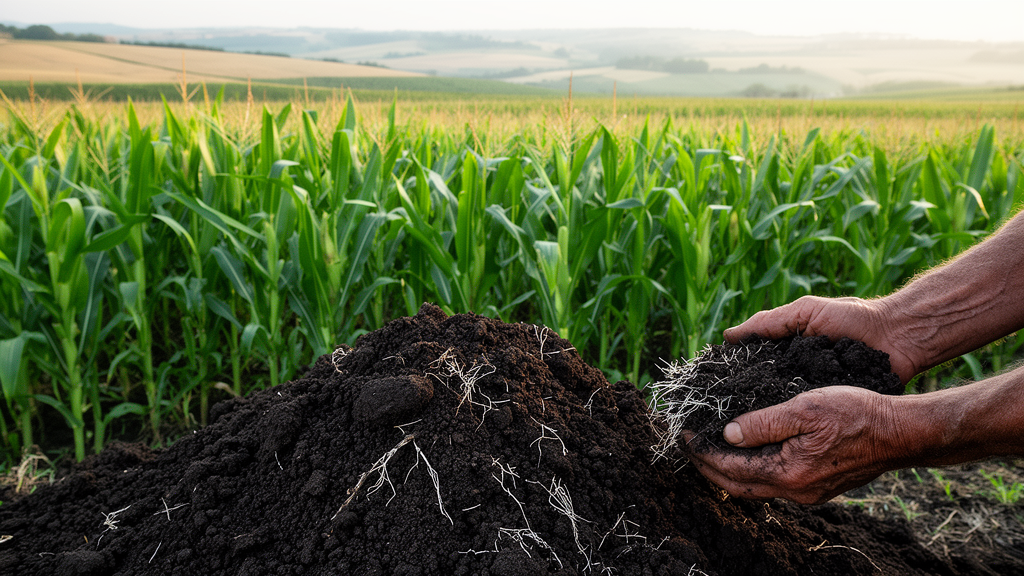
In the maize fields of the North China Plain, a quiet surplus has been building for years. Farmers applying phosphorus fertilizer at rates far beyond what their crops actually use have been banking a non-renewable nutrient in their soil — and a new modeling study suggests that this stored phosphorus, known as legacy P, is powerful enough to sustain high maize yields for more than a decade after fertilizer application stops altogether. The findings, published in the Spanish Journal of Soil Science, offer a striking counterintuitive message for one of the world’s most intensively farmed regions: sometimes the best fertilizer strategy is to use less, then stop entirely.
The research team, led by Weina Zhang of Huanghuai University and China Agricultural University, turned to the Agricultural Production Systems Simulator, or APSIM, a widely used crop-soil modeling platform, to run a long-term virtual experiment. Calibrating the model against field trial data from Quzhou County in Hebei Province — where the soil is a calcareous fluvo-aquic type with a pH of 8.7 — the researchers simulated eleven years of maize cultivation from 2007 to 2017 under eight phosphorus application rates ranging from zero to 300 kilograms of P₂O₅ per hectare. They then extended the simulations 22 years beyond the fertilization period to see what would happen once the P inputs ceased.
The results revealed a clear optimum. A phosphorus application rate of 71 kilograms of P₂O₅ per hectare maximized maize productivity, producing mean aboveground biomass of 17.5 tonnes per hectare and grain yields of 9.3 tonnes per hectare. Beyond this threshold, the marginal returns on each additional kilogram of fertilizer dropped sharply: the biomass increment per kilogram of applied P₂O₅ fell from 92 kilograms at moderate rates to just 25 kilograms at the highest rate, while the yield increment declined from 52 to 15 kilograms. Phosphorus use efficiency, meanwhile, sank from 17 percent at 75 kilograms per hectare to a mere 10 percent at 300 kilograms — meaning nine-tenths of the applied nutrient was never taken up by the crop in the year it was applied.
What happens to the unused phosphorus is the crux of the environmental concern. In the calcareous soils of the North China Plain, phosphate ions tend to precipitate onto calcium carbonate surfaces rather than remaining in soil solution, gradually building up both labile P — the plant-available fraction — and large stable inorganic P pools. Over the eleven simulated years, labile P under the 75-kilogram treatment climbed from 20.0 to 28.1 milligrams per kilogram, while the 100-kilogram treatment pushed it from 22.2 to 35.2 milligrams per kilogram. The 300-kilogram treatment sent labile P soaring to 121 milligrams per kilogram. Critically, established environmental thresholds for calcareous soils sit at 39.9 milligrams per kilogram — and the P100 treatment crossed that line by 2017, reaching 40.8 milligrams per kilogram, signaling elevated risks of P leaching into groundwater.
The most remarkable result emerged from the post-cessation simulations. After eleven years of applying 75 kilograms of P₂O₅ per hectare annually, the model showed that legacy phosphorus stored in the soil could sustain maize yields at 8 to 10 tonnes per hectare for 12 to 13 years without any further P inputs. During this period, labile P declined from 32.3 to 15.8 milligrams per kilogram — yet the crops kept drawing on the residual reserves. Even the large stable inorganic P pools, which had accumulated to 447 milligrams per kilogram under the P75 treatment, gradually released P back into available forms, buffering the decline. This hysteresis effect — where historical inputs continue to govern soil P dynamics long after they stop — underscores how nonlinear the relationship is between fertilization intensity and environmental legacy duration.
The study is not the first to observe that crops can exploit residual soil P, but it is among the first to quantify the phenomenon with a process-based model in the calcareous soils of the North China Plain. Evidence from around the world supports the pattern: Japan maintained stable crop yields from 1985 to 2005 while progressively reducing both mineral and organic P fertilizer inputs, and European Union nations saw agricultural productivity stabilize or even improve after the 1980s alongside declining total P use, attributed to efficient mobilization of legacy P reserves. In high P-fixing red soils, a single high-dose application has sustained crop production for 7 to 9 years under subsequent withdrawal regimes.
Yet the modeling exercise also exposed a significant limitation in APSIM’s current phosphorus module. The module calculates labile P primarily through adsorption-desorption mechanisms — the process by which phosphate ions bind to and release from soil particle surfaces. But in neutral and calcareous soils like those at Quzhou, the dominant chemistry is precipitation-dissolution: phosphate precipitating onto calcium carbonate surfaces and dissolving back into solution as pH shifts. By neglecting this pathway, the model may misestimate labile P dynamics in exactly the soil types where precipitation-dissolution equilibria prevail. The researchers note that enhancing the module’s performance across pedologically diverse systems will require new experimental data quantifying P fractionation and transformation kinetics across different soil types.
The implications for the North China Plain — a major maize production region facing P overuse under intensive farming — are substantial. China’s current phosphate reserves are insufficient to meet economic development demands, and global phosphate resources are projected to be depleted in the near future, making P a non-renewable resource with peak production expected within decades. Meanwhile, P loss from agricultural soils remains a key contributor to water eutrophication, with leaching risks threatening groundwater quality across the region. The study’s scenario-based approach provides a theoretical foundation for P reduction strategies that could ease both pressures simultaneously.
The practical message is a phased strategy: apply around 71 to 75 kilograms of P₂O₅ per hectare annually for roughly a decade, then discontinue fertilization for 12 to 13 years while the legacy P pool is drawn down, before resuming applications. This cycle would allow farmers to maintain grain yields at 8 to 10 tonnes per hectare while conserving phosphate rock resources and mitigating pollution risks. As the researchers conclude, the approach achieves the dual objectives of P resource conservation and environmental protection without compromising crop productivity — a rare alignment of agronomic, economic, and ecological interests in one of the world’s most demanding farming systems.
Subject of Research: Modeling Long-Term Impacts of Phosphorus Fertilization Strategies on Maize Productivity and Soil P Dynamics in Calcareous Soils of North China Plain
Article Title: Modeling Long-Term Impacts of Phosphorus Fertilization Strategies on Maize Productivity and Soil P Dynamics in Calcareous Soils of North China Plain
Article References: Zhang, W., Xu, D., Wang, H., Jiang, B., Liang, C., Huang, M., Chen, Z., Zhang, X., Su, D., Yu, M., & Liu, J. (2025). Modeling Long-Term Impacts of Phosphorus Fertilization Strategies on Maize Productivity and Soil P Dynamics in Calcareous Soils of North China Plain. Spanish Journal of Soil Science, 15, Article 14718. https://doi.org/10.3389/sjss.2025.14718
Image Credits: AI Generated
Keywords: Modeling, Long-Term, Impacts, Phosphorus, Fertilization, Strategies, Maize, Productivity, Soil, Dynamics, Calcareous, Soils
Cite Scienmag News
Alan Morgan. (October 17, 2026). Legacy Phosphorus in Soil Could Feed Maize for Over a Decade Without Fertilizer. Scienmag. https://scienmag.com/legacy-phosphorus-in-soil-could-feed-maize-for-over-a-decade-without-fertilizer/
Alan Morgan. "Legacy Phosphorus in Soil Could Feed Maize for Over a Decade Without Fertilizer." Scienmag, 17 October 2026, https://scienmag.com/legacy-phosphorus-in-soil-could-feed-maize-for-over-a-decade-without-fertilizer/. Accessed 17 October 2026.
Alan Morgan. "Legacy Phosphorus in Soil Could Feed Maize for Over a Decade Without Fertilizer." Scienmag. October 17, 2026. https://scienmag.com/legacy-phosphorus-in-soil-could-feed-maize-for-over-a-decade-without-fertilizer/


