


Cell death is not a single phenomenon. Since Kerr, Wyllie and Currie described apoptosis in 1972, scientists have catalogued pyknotic nuclei, membrane blebbing, caspase activation and phosphatidylserine exposure as the canonical fingerprints of programmed cell suicide. Yet a growing body of evidence, synthesised in a review published in Frontiers in Cell Death, argues that the germline of animals as distant as fruit flies and mice eliminates surplus reproductive cells by an entirely different strategy: the surrounding somatic support cells do not wait for the germ cells to die. They kill them, by acidifying them.
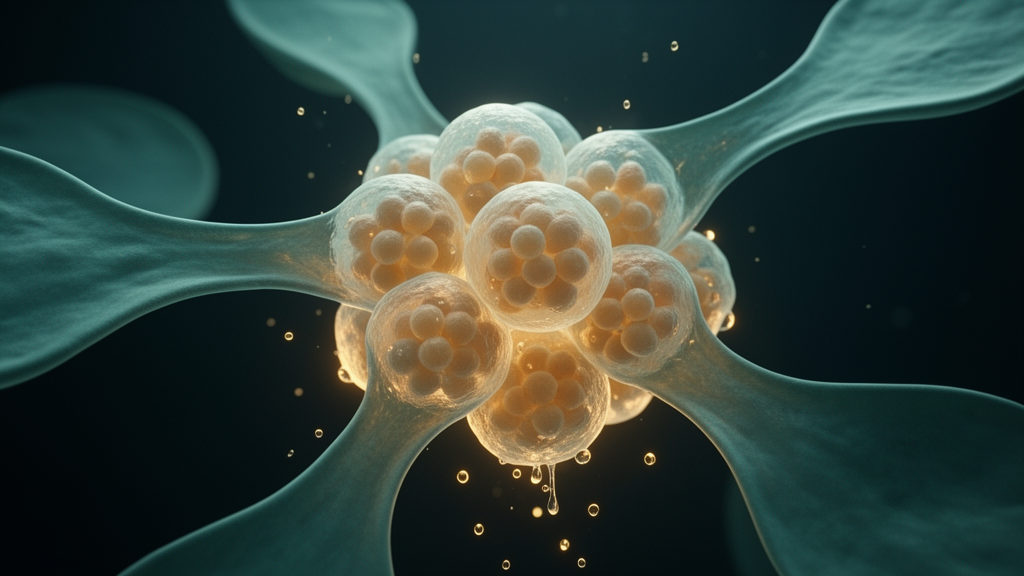
The review, led by Shruthi Bandyadka and Kimberly McCall of Boston University together with Hila Toledano of the University of Haifa, focuses on germline cysts. In most animals, germ cells do not develop as isolated units. Germline stem cells give rise to daughters that divide with incomplete cytokinesis, producing clusters of cells joined by intercellular bridges. In the testis, every cell of such a cyst differentiates into a spermatocyte. In the ovary, typically one cell becomes the oocyte while the others serve as nurse cells that pump their cytoplasmic contents into the developing egg. These cysts are ancient, found in the male germline of most if not all animals, and they present a logistical puzzle: how do you eliminate part of an interconnected collective without damaging the tissue around it?
The answer, the authors argue, is phagoptosis, a form of regulated cell death in which the phagocytic machinery of one cell is turned against another cell that would otherwise remain alive. Phagocytes classically clear corpses, engulfing cells that have already died by apoptosis and displaying eat-me signals such as phosphatidylserine. In phagoptosis, the phagocyte is the executioner. The phenomenon was first characterised in the brain, where microglia engulf viable but stressed neurons, and it has since been documented in multiple tissues. What the new review highlights is that the germline, of all places, has emerged as a premier model for this cellular assassination.
The most thoroughly analysed system is the Drosophila ovary. Each egg chamber contains the oocyte, its nurse cells and a monolayer of somatic follicle cells. Two distinct death paradigms operate here. Under starvation or stress, a checkpoint roughly halfway through oogenesis, between stages 7 and 9, triggers degeneration of the entire egg chamber; this midstage death is apoptotic and autophagic, and follicle cells expressing the phagocytic receptor Draper engulf the dying germ cells. But the developmental death of nurse cells at the end of a healthy oogenesis, from stages 12 to 14, is something else entirely. It proceeds despite disruption of caspases and autophagy genes in the germline, ruling out both apoptosis and autophagy as essential mechanisms.
Genetic ablation experiments revealed that a specialised subset of follicle cells, the stretch follicle cells that extend between the nurse cells, are required for nurse cell death. These epithelial cells act as non-professional phagocytes. They require the phagocytosis genes draper, ced-12 and the JNK signalling pathway, and loss of any of these blocks the DNA fragmentation and nuclear lamina breakdown that characterise nurse cell death. Remarkably, four to five stretch follicle cells collaborate around each nurse cell, and complete coverage by this phagocytic collective is required for clearance. This is not the single phagocytic cup of textbook engulfment; it is a coordinated, multi-cell strangling operation.
The final blow is delivered by acidification. Vacuolar ATPases, proton pumps normally confined to lysosomal membranes, become enriched on the plasma membrane of the stretch follicle cells, secreting protons into the extracellular space around the nurse cell remnants. Chloride channels localise similarly, presumably balancing the ion gradient. The low pH activates cathepsin proteases such as CP1 released by the follicle cells, and together with DNaseII these enzymes degrade the nurse cell lamins and chromatin. The transcription factor Mitf, a master regulator of V-ATPase genes, is required, and Draper is needed for acidification itself, suggesting the receptor influences proton pump deployment. In effect, the lysosomal acidification machinery is repurposed for extracellular killing: the nurse cells are digested from outside rather than inside a phagolysosome.
Strikingly similar logic operates in the Drosophila testis. Spermatogonial cysts, clutches of 2, 4, 8 or 16 interconnected germ cells wrapped by somatic cyst cells, die spontaneously under homeostatic conditions; imaging of fixed testes suggests 20 to 30 percent of mitotic cysts are engaged in death at any time, and the process takes more than 24 hours from initiation to completion. This death is non-apoptotic: loss of the effector caspases Drice and Dcp-1 does not reduce it, autophagy mutants do not affect it, and the caspase-9 homologue Dronc acts atypically, independently of its catalytic activity. Dying cysts co-stain with LysoTracker and TUNEL, and mutants in lysosomal genes including cathepsin D, deep-orange, carnation and DNaseII significantly decrease the number of dying cysts, squarely implicating lysosomes.
Live imaging then established that the somatic cyst cells are the killers. Lamp1-positive phagosomes of cyst cell origin aggregate between cyst cells and germ cells before acidification begins, and Rab5 and Rab7 positive endosomes localise around the entire spermatogonium, indicating that the interconnected germ cells are engulfed as a single unit. RNAi knockdown of Rab5 in cyst cells completely arrests germ cell death, a necessary qualifier for phagoptosis. The receptors Draper and Croquemort play complementary roles: draper and ced-12 are essential for engulfment but not acidification, whereas crq affects acidification without disrupting engulfment. Loss of engulfment causes hyperplasia at the testis apex, where live spermatogonia accumulate, a phenotype mirrored in p53 null mutants, pointing to the tumour suppressor as an intrinsic inducer of germ cell death, a role conserved in mice under mild heat shock.
The conservation extends to mammals. In the fetal mouse ovary, nurse cells in germline cysts of up to 32 cells are eliminated by the surrounding pregranulosa cells. LysoTracker activity rises in nurse cells during late oogenesis, and inhibition of V-ATPase activity with bafilomycin A1 abolishes this signal and leaves nurse cell nuclei persisting. Single-cell RNA sequencing shows late-oogenesis pregranulosa cells expressing multiple V-ATPase subunits and cathepsins Ctsb, Ctsd, Ctsl and Ctsz, the orthologue of Drosophila Cp1. Apoptosis also occurs simultaneously, albeit at far lower levels, apparently to remove non-viable germ cells, suggesting that specific cues deterministically activate one pathway or the other.
Why would evolution place a destructive acid bath so close to a precariously incubated gamete? The authors speculate that acidification may harm nurse cells without impairing the oocyte, and may even benefit gamete competence; the rodent male reproductive tract maintains an acidic luminal environment, by V-ATPase proton secretion, to help nascent sperm mature. Extracellular proton secretion by plasma membrane V-ATPases is known in kidney intercalated cells and osteoclasts, but its involvement in cell killing thus far appears confined to gametogenesis. Many questions remain: how the nurse cell plasma membrane is disposed of, whether trogocytosis or cellular nibbling precedes acidification, what eat-me signals mark live germ cells for recognition when phosphatidylserine appears only after engulfment, and how the Toll pathway and single-cell gene expression programmes shape the phagocytic fate of these somatic cells. What is already clear is that somatic cells across the animal kingdom share a conserved, non-apoptotic mechanism for pruning the germline, one that turns the protective envelope of the cyst into its executioner.
Subject of Research: Non-apoptotic germline cyst cell death via somatic cell acidification
Article Title: Sacrificing cells of the cyst: non-apoptotic cell death in germline cysts via acidification
Article References: Bandyadka, S., Tohline, L., Wandji, G.-V., Toledano, H., & McCall, K. (2025). Sacrificing cells of the cyst: non-apoptotic cell death in germline cysts via acidification. Frontiers in Cell Death, 4, Article 1677498. https://doi.org/10.3389/fceld.2025.1677498
Image Credits: AI Generated
DOI: 10.3389/fceld.2025.1677498
Keywords: germline cyst, phagoptosis, Drosophila, cell death, acidification, V-ATPase, oogenesis, spermatogenesis, Sacrificing, cells, cyst, non-apoptotic
Cite Scienmag News
Drew Townsend. (October 16, 2026). Somatic Cells Kill Germline Cysts by Acidification, Review Finds. Scienmag. https://scienmag.com/somatic-cells-kill-germline-cysts-by-acidification-review-finds/
Drew Townsend. "Somatic Cells Kill Germline Cysts by Acidification, Review Finds." Scienmag, 16 October 2026, https://scienmag.com/somatic-cells-kill-germline-cysts-by-acidification-review-finds/. Accessed 16 October 2026.
Drew Townsend. "Somatic Cells Kill Germline Cysts by Acidification, Review Finds." Scienmag. October 16, 2026. https://scienmag.com/somatic-cells-kill-germline-cysts-by-acidification-review-finds/


