


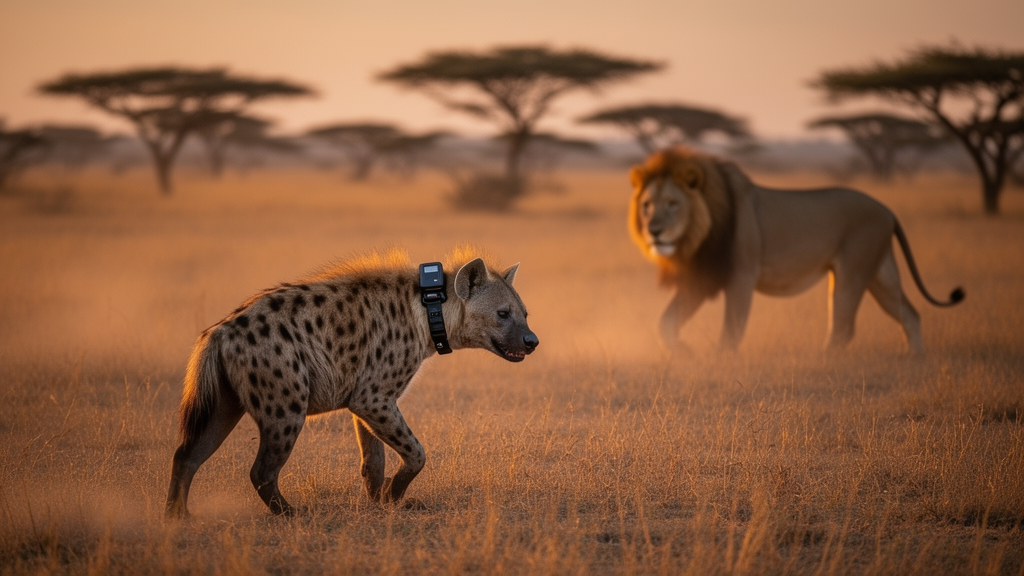
On the savannas of southern Africa, two of the world’s most formidable predators share prey, waterholes, and the cover of darkness. African lions and spotted hyenas have long been known to compete fiercely, with lions displacing hyenas from carcasses and occasionally killing them. Yet the moment-by-moment movement decisions that underpin this rivalry have been nearly impossible to observe directly in animals that range over vast, remote landscapes. A new study has now extracted that hidden geometry from GPS telemetry, revealing an asymmetric dance in which hyenas systematically retreat from lions while certain lions, particularly males, actively track hyena activity.
The research, published in Frontiers in Ethology, applied a relative-motion analysis to high-frequency GPS data from 17 lions and 14 spotted hyenas fitted with collars across two contrasting ecosystems: the fenced, semi-arid savanna of Etosha National Park in Namibia and the unfenced floodplains of the Chobe-Linyanti system in northern Botswana. Collars recorded fixes every 30 minutes overnight and every five minutes during the two-hour windows after sunset and before sunrise, when both species are most active. Data collection spanned 2013 to 2018 and yielded 349,163 GPS relocations, 55 percent from lions and 45 percent from hyenas.
The analytical approach was deliberately conservative. Rather than using model-imputed positions from continuous-time movement models, the team restricted their dyadic analysis to timestamps where both individuals in a pair had real, concurrent GPS fixes at the five-minute sampling rate. This choice substantially reduced the effective sample size but ensured that every inferred approach or retreat event corresponded to actual animal locations observed by the collars rather than to model-generated positions whose error structure could plausibly induce spurious directional patterns. Across the 23 dyads that met this criterion, the researchers classified each individual’s movement at each timestep as toward, orthogonal to, or away from its partner, dividing the circle of possible headings into eight equal 45-degree sectors.
To test for directional bias, the team deployed three complementary inferential layers that explicitly handle two sources of statistical non-independence: temporal autocorrelation within dyads, since consecutive five-minute fixes of the same animal are not independent observations, and between-dyad non-independence from individual reuse, since a single collared animal participates in multiple pairings. The first layer computed per-dyad exact Clopper-Pearson binomial confidence intervals on the toward-versus-away proportion at nine cumulative distance thresholds spanning 50 meters to 10 kilometers. The second applied an across-dyad Wilcoxon signed-rank test, treating each dyad’s ratio as a single observation against a null of 0.5. The third fit a generalized linear mixed-effects logistic regression on the per-timestep binary outcome with a random intercept for dyad.
All three layers converged on the same conclusion: hyenas retreat from lions. At the per-dyad layer, four of ten hyena focal animals showed significant retreat bias at the cumulative 10-kilometer threshold, and no hyena showed significant approach bias. At the across-dyad layer, the Wilcoxon test was significant at the 2-kilometer, 5-kilometer, and 10-kilometer thresholds, with the strongest signal at 5 kilometers where all nine dyads with usable data had hyena ratios below 0.5. The mixed-effects model estimated a population-level toward probability of 0.461 for hyenas, marginally below the no-bias value of 0.5. A sensitivity check pooling all timesteps for each unique hyena confirmed the pattern was not driven by any single individual: all three unique collared hyenas in the interspecific data showed pooled ratios below 0.5.
The lion signal was more heterogeneous. No inferential layer supported a uniform population-level lion approach to hyenas, but three specific lions showed significant approach bias in their dyads, and stratifying by sex recovered a directionally consistent pattern: across the three male-lion dyads, the mean toward ratio was 0.573 with all three above 0.5, while across the seven female-lion dyads the mean was 0.486 with five of seven below 0.5. A mixed-effects model with sex as a fixed effect estimated a male population-level toward probability of 0.548 against 0.501 for females, directionally consistent with field expectations though marginal in significance given that only two unique collared males contributed interspecific dyads. Night-follow observations in both ecosystems independently corroborated the pattern, with male lions repeatedly observed actively tracking hyenas while females showed more variable responses contingent on group composition.
The cleanest single example of the asymmetric signature came from the Etosha dyad pairing the male lion OF-34309 with the hyena SA-33872. At distances up to 10 kilometers, the lion’s toward-versus-away ratio was 0.687, significantly above 0.5, while the hyena’s ratio was 0.299, significantly below 0.5. By contrast, a dyad with three times as many concurrent fixes showed neither individual departing significantly from chance at any distance threshold, illustrating the dyad-level variability that characterizes the lion-focal signal. The authors interpret the lion approach bias as consistent with lions using hyena activity as an investigative cue, plausibly for scavenging opportunity or assessment of clan territory boundaries, rather than as aversive movement away from a threat.
Intraspecific dyads revealed fundamentally different coordination structures between the two species. In Etosha, three lion associations identified after collaring, two confirmed mating pairs and one satellite-pride pairing, produced concurrent fixes at distances as fine as 15 meters. The mating-pair signature was particularly diagnostic: at 50 to 200 meters, the male moved toward the female significantly more often than chance while the female moved away, and at distances below 15 meters the pattern reversed, with females moving toward males. This bidirectional asymmetry recovers the expected geometry of male-led pursuit at intermediate range and female presenting at close range, demonstrating that the relative-motion method can distinguish behavioral states from movement geometry alone. Hyena dyads told a different story: no concurrent five-minute fixes between any pair of collared hyenas in either ecosystem were recorded below 1 kilometer, recovering the exclusive clan-territorial structure of the species from telemetry alone.
The findings resolve a tension in the broader literature. Coarse-scale habitat selection analyses have reported that spotted hyenas do not systematically avoid lions at the landscape level, yet guild theory predicts that subordinate competitors should partition space and time in response to dominant ones. The fine-scale dyadic analysis reveals the mechanism that operates at the within-encounter scale and would be invisible to habitat selection methods: reactive avoidance by the subordinate species at multi-kilometer scales rather than symmetric two-species coordination. The authors caution that whether these short-term encounter responses scale up to the longer-term patterns of space use and demography that ultimately govern fitness remains an open question.
For conservation managers, the distance-dependence of this mechanism has practical implications. Interventions that compress the spatial scale at which lions and hyenas operate, including water-point concentration during drought, fence construction that constrains dispersal, and carcass aggregation through anthrax control, may reduce the operating distance over which hyena reactive avoidance functions. As movement ecology enters its big-data era, with order-of-magnitude increases in sample size and temporal resolution, the authors anticipate that relative-motion methods will become increasingly useful for testing specific predictions about the geometry of interference competition that occupancy-based and home-range-based approaches cannot resolve, extending the framework to other apex predator dyads where dual high-frequency telemetry is or will soon become available.
Subject of Research: Fine-scale GPS telemetry reveals asymmetric interference competition and coordination between African lions and spotted hyenas
Article Title: Predators in motion: fine-scale dyadic movements reveal interference competition and asymmetric coordination in African lions and spotted hyenas
Article References: Barker, N. A., Luisa Vissat, L., Joubert, F. G., Stowbunenko, V., Alexander, K. A., Slotow, R., & Getz, W. M. (2026). Predators in motion: fine-scale dyadic movements reveal interference competition and asymmetric coordination in African lions and spotted hyenas. Frontiers in Ethology, 5, Article 1901233. https://doi.org/10.3389/fetho.2026.1901233
Image Credits: AI Generated
DOI: 10.3389/fetho.2026.1901233
Keywords: African lions, spotted hyenas, interference competition, GPS telemetry, relative-motion analysis, movement ecology, Etosha National Park, Chobe-Linyanti, dyadic movement, predator guilds, reactive avoidance, fission-fusion sociality
Cite Scienmag News
Gavin Prescott. (October 16, 2026). GPS Collars Reveal Hyenas Retreat From Lions While Males Track Them. Scienmag. https://scienmag.com/gps-collars-reveal-hyenas-retreat-from-lions-while-males-track-them/
Gavin Prescott. "GPS Collars Reveal Hyenas Retreat From Lions While Males Track Them." Scienmag, 16 October 2026, https://scienmag.com/gps-collars-reveal-hyenas-retreat-from-lions-while-males-track-them/. Accessed 16 October 2026.
Gavin Prescott. "GPS Collars Reveal Hyenas Retreat From Lions While Males Track Them." Scienmag. October 16, 2026. https://scienmag.com/gps-collars-reveal-hyenas-retreat-from-lions-while-males-track-them/


