


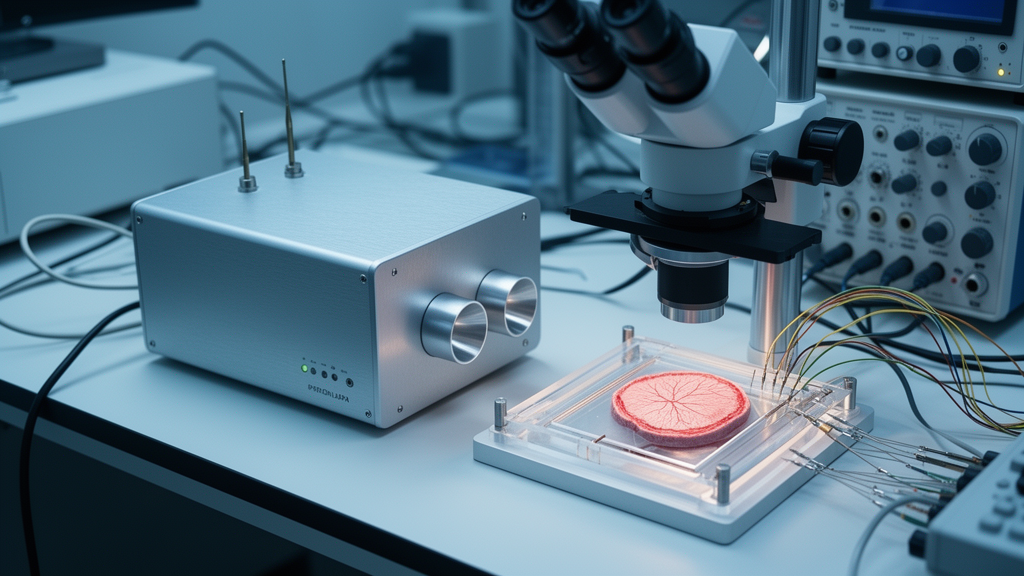
As fifth-generation (5G) wireless networks continue to expand across the globe, scientists face a pressing question: what happens to living cells when they are exposed to the radiofrequency (RF) fields these technologies emit? A research team from Sapienza University of Rome and the University of Bologna has now unveiled a sophisticated new tool designed to answer that question with unprecedented precision. Their innovation, described in the journal Frontiers in Antennas and Propagation, is a dual-band RF exposure system that can irradiate neuronal cultures while simultaneously recording their electrical activity in real time—a feat that has long eluded the bioelectromagnetics community.
The system, christened LoREC for Localized Radiating-End Coaxial line, operates at 0.7 GHz and 3.5 GHz, two of the most heavily deployed frequency bands in the 5G FR1 range, which spans roughly 0.45 GHz to 6 GHz and has recently been extended up to 7.125 GHz. The choice is deliberate: 0.7 GHz enables deeper penetration into biological tissue, whereas 3.5 GHz corresponds to one of the most widely adopted 5G bands worldwide. By targeting these two frequencies, the researchers ensure that their experimental conditions mirror real-world exposure scenarios rather than the legacy GSM and LTE bands—typically 0.9 GHz or 1.8 GHz—that dominated earlier studies.
At the heart of the platform lies a clever piece of microwave engineering. LoREC is an open-ended coaxial radiator: a copper inner and outer conductor separated by a PTFE dielectric layer, with an inner-to-outer radius ratio of 3.35 that satisfies the impedance matching requirement for a nominal 50-ohm line. Excited in the transverse electromagnetic (TEM) mode, the structure terminates in a free aperture that couples electromagnetic energy directly into the biological medium. The lowest non-TEM mode has a cutoff frequency well above both operating frequencies, confirming pure TEM propagation along the line. Higher-order modes excited at the open aperture are evanescent, contributing only locally to the near-field distribution.
To sharpen directivity and suppress unwanted lateral spreading, the team added a circular aluminium flange at the open end, extending 6 millimeters radially beyond the outer conductor with a thickness of 1 millimeter. The flange, roughly 20 millimeters in diameter, was sized to remain electrically small relative to the operating wavelengths—approximately 42.9 centimeters at 0.7 GHz and 8.6 centimeters at 3.5 GHz—so it cannot support resonant behavior. Instead, it acts as a passive reflector, reinforcing the vertical component of the radiated field while shielding the line from backward leakage and coupling to the incubator walls.
Integration with the biological setup demanded equal ingenuity. The LoREC was positioned vertically below the aluminium baseplate of a stage-top incubator, aligned with the central axis of a MicroElectrode Array (MEA) device. The open aperture faces upward toward the physiological saline solution filling the MEA’s glass chamber—about 1 milliliter of conductive medium with a relative permittivity of 75 and conductivity of 1.79 S/m at 0.7 GHz, rising to 4.36 S/m at 3.5 GHz. The coaxial aperture directly contacts the bottom glass layer of the MEA, whose 59 titanium nitride electrodes and one reference electrode are arranged in an 8-by-8 grid with 30-micrometer diameters and 200-micrometer spacing. The external feeding port extends beyond the incubator wall for connection to RF instrumentation via a standard SMA connector.
The team validated their design through full-wave simulations in COMSOL Multiphysics v6.2, using a custom mesh of approximately 22.7 million tetrahedral elements with a minimum size of 0.04 millimeters near the MEA electrodes and coaxial aperture. The results were striking. The simulated scattering parameter |S11| remained below −15 dB at both operating frequencies—reaching −38.2 dB at 0.7 GHz and −26.9 dB at 3.5 GHz—indicating excellent impedance matching. The extracted characteristic impedance of 49.8 ohms and voltage standing wave ratio of 1.06 closely matched the analytical target of 50.4 ohms and unity VSWR, confirming the accuracy of the design methodology.
Field confinement proved equally impressive. At 0.7 GHz, the electric field distribution is smooth and radially symmetric around the coaxial aperture, with evident attenuation both radially and axially across the saline solution. At 3.5 GHz, the pattern is less confined—the field extends beyond the saline interface, forming a dome-shaped region above the liquid with peak values above 30 V/m—yet it still decays to just a few volts per meter in proximity to the printed circuit board. The PCB experiences only residual fields below 1 V/m at 0.7 GHz and 7 V/m at 3.5 GHz, demonstrating negligible electromagnetic interference with the acquisition electronics that record the neurons’ extracellular signals.
Dosimetric analysis focused on the Specific Absorption Rate (SAR), the reference quantity used by international safety guidelines such as ICNIRP to assess RF energy absorption. The researchers defined four regions of interest aligned with the functional areas of the MEA: the central cellular domain where neurons are cultured, two orthogonal active stripes, and the square electrode region. At 0.7 GHz, mean SAR values ranged from 1.12 W/kg in the central cell domain to 7.23 W/kg in the peripheral electrode region, with low coefficients of variation indicating homogeneous exposure. At 3.5 GHz, both mean and local maxima increased by roughly one order of magnitude, reaching 23.73 W/kg, reflecting the combined effect of increased saline conductivity and stronger local fields at shorter wavelengths. For a 10-milliwatt input power, the exposure efficiency was 112 W·kg⁻¹/W at 0.7 GHz and 274 W·kg⁻¹/W at 3.5 GHz—approximately 2.5 times higher at the upper frequency.
A sensitivity analysis revealed that uncertainties in the saline’s dielectric properties produce relatively limited SAR variations, typically below about 12 percent. In contrast, geometrical positioning dominates the variability budget: lateral shifts of ±0.5 millimeters along the x and y axes produce SAR variations up to 49.6 percent, with sensitivity values reaching 23.6 at 3.5 GHz. Combining individual contributions via a root-sum-square approach, the expanded uncertainty (k = 2) for the biologically relevant central cell region is approximately 19.5 percent at 0.7 GHz and 27.5 percent at 3.5 GHz—comparable to values commonly reported for in vitro numerical dosimetry. The team notes that a dedicated mechanical anchoring system will be considered to improve positioning reproducibility in future implementations.
The implications extend beyond the laboratory bench. As part of the EU Horizon Europe GOLIAT project, which bridges engineering, biological, and epidemiological perspectives on 5G exposure, this platform offers a controlled and reproducible architecture for investigating frequency-dependent bioelectromagnetic effects under physiological conditions. The frequency-dependent behavior—uniform exposure at 0.7 GHz suited for probing global neuronal responses, and spatially selective hot regions at 3.5 GHz offering the possibility of threshold-dependent modulation—aligns with previous computational studies reporting enhanced field localization and reduced penetration depth in conductive biological media at higher frequencies. Experimental validation of the prototype is currently ongoing, and the researchers anticipate that LoREC may provide a standardized platform for MEA investigations of bioelectromagnetic interactions in the 5G-FR1 range, finally linking RF dosimetry directly with electrophysiological outcomes in real time.
Subject of Research: A dual-band RF exposure system for real-time electrophysiological recordings using microelectrode array device
Article Title: A dual-band RF exposure system for real-time electrophysiological recordings using microelectrode array device
Article References: Dolciotti, N., Pisano, C., Paffi, A., Cioni, M., Guerra, G., Zironi, I., Remondini, D., Aicardi, G., Liberti, M., & Apollonio, F. (2026). A dual-band RF exposure system for real-time electrophysiological recordings using microelectrode array device. Frontiers in Antennas and Propagation, 4, Article 1832099. https://doi.org/10.3389/fanpr.2026.1832099
Image Credits: AI Generated
DOI: 10.3389/fanpr.2026.1832099
Keywords: 5G, bioelectromagnetics, microelectrode array, RF exposure, electrophysiology, SAR dosimetry, dual-band, exposure, system, real-time, electrophysiological, recordings
Cite Scienmag News
Denise Maddox. (October 16, 2026). LoREC: A Dual-Band RF Exposure System for Real-Time Neuronal Recordings. Scienmag. https://scienmag.com/lorec-a-dual-band-rf-exposure-system-for-real-time-neuronal-recordings/
Denise Maddox. "LoREC: A Dual-Band RF Exposure System for Real-Time Neuronal Recordings." Scienmag, 16 October 2026, https://scienmag.com/lorec-a-dual-band-rf-exposure-system-for-real-time-neuronal-recordings/. Accessed 16 October 2026.
Denise Maddox. "LoREC: A Dual-Band RF Exposure System for Real-Time Neuronal Recordings." Scienmag. October 16, 2026. https://scienmag.com/lorec-a-dual-band-rf-exposure-system-for-real-time-neuronal-recordings/


