


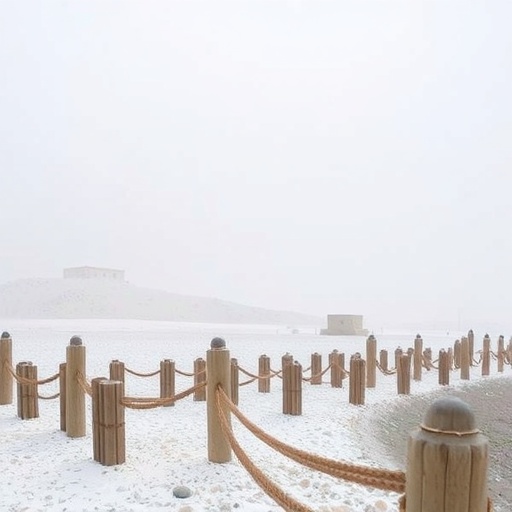
In the vast and arid expanse of the Taklimakan Desert, known as one of the driest and most desolate regions on Earth, a peculiar meteorological phenomenon has captured the attention of scientists worldwide. The recent study conducted by Yang, X., Zhou, C., Yang, F., and their colleagues sheds unprecedented light on the snowfall characteristics within this inhospitable desert’s hinterlands and elucidates the intricate relationship between snowfall patterns and dust weather, a pressing environmental concern that significantly impacts both regional and global atmospheric conditions.
Snowfall in deserts typically defies conventional expectations. The Taklimakan Desert—spanning approximately 337,000 square kilometers in China’s Xinjiang region—often conjures images of blazing heat, relentless sandstorms, and parched earth. Yet, this study reveals that snowfall is a not-so-rare event, and it plays a crucial role in modulating the desert’s dust activity. By analyzing detailed meteorological data through rigorous observational methods, the researchers identified specific snowfall events with unique spatial and temporal characteristics that challenge traditional assumptions about desert climates.
Their findings point out that snowfall events in the Taklimakan are largely influenced by complex interactions among atmospheric circulation, local topography, and seasonal climatic variations. The researchers employed satellite remote sensing combined with ground-based meteorological measurements to map snow distribution in the desert interior. These sophisticated techniques showcased distinct snowfall episodes that correspond with significant shifts in regional airflow patterns, particularly during the winter and early spring months, thereby affecting dust storm frequency and intensity.
At the core of this research lies an intricate balance: snowfall deposits moisture and snowpack that transiently stabilizes the surface, but once it melts or sublimates, it leaves behind fine sediments susceptible to wind erosion. This dynamic directly influences the onset and severity of dust weather—phenomena notorious for degrading air quality, disrupting transportation, and posing serious health risks. Understanding the timing, extent, and duration of snowfall could therefore be pivotal in predicting and mitigating the environmental and societal impacts of dust storms emanating from the Taklimakan Desert.
The team meticulously cataloged snowfall events, noting their duration, snow depth, and areal coverage. They reported that although the total snowfall amount is relatively modest compared to colder, more humid regions, its ecological relevance is profound. Snowfall events in this desert environment tend to be short-lived but intense enough to temporarily alter surface albedo, enhance soil moisture, and reduce dust emissions during and immediately after the snow cover period.
A particularly ground-breaking aspect of the study is the identification of the snowfall’s dual effect on dust emissions. On one hand, the protective snow layer suppresses the uplift of dust particles. On the other, the post-snowfall drying process exposes loosened, fine-grained sediments, primed to be lifted by high winds soon after the snow dissipates. This finding highlights the temporal complexity of atmospheric dust dynamics, stressing that not just the presence or absence of precipitation but its timing is essential for comprehending regional dust weather patterns.
By combining meteorological statistics with dust concentration measurements, the researchers uncovered correlations between snowfall events and subsequent dust storm occurrences, revealing a lag effect where intense dust storms are often observed shortly after snowmelt phases. This novel insight into the mechanistic linkage challenges oversimplified models that treat precipitation and dust activity independently, advocating for integrated approaches in desert climate modeling.
Furthermore, the study bridges gaps in knowledge by addressing the influence of snowfall on local ecosystems in an environment previously thought to be almost entirely devoid of moisture. The intermittent nature of snowfall facilitates ephemeral water availability, influencing microbial life and surface crust formation that, in turn, affects soil consolidative properties and dust emission potential. These coupled biophysical processes underscore the necessity to reassess desert landscapes as dynamic and reactive rather than inert and static.
Climate change projections add urgency to the implications of this research. Altered precipitation regimes and shifting atmospheric circulation patterns could modify snowfall frequency and intensity in the Taklimakan Desert. Consequently, this would impact not only the regional dust cycle but also broader climatological phenomena linked to aerosol transport, such as radiative forcing and cloud formation. The study thereby provides critical baseline data necessary for improved predictive models of climate-dust interactions.
Importantly, the research methodology exemplifies cutting-edge interdisciplinary science. It integrates atmospheric physics, remote sensing techniques, soil science, and climate modeling to construct a comprehensive understanding of the desert’s meteorological dynamics. This multidisciplinary approach ensures robustness in findings, enabling the scientific community to build upon these insights for future studies.
Public health considerations also emerge from understanding snowfall’s intricate role in modulating dust storms. Since airborne dust has been linked to respiratory illnesses, cardiovascular problems, and reduced visibility affecting transport safety, the ability to forecast dust weather more accurately has real-world implications. The researchers suggest that incorporating snowfall metrics into dust storm prediction systems could enhance early warning capabilities and minimize exposure risks for populations downwind of the desert.
Additionally, this work resonates with broader efforts to tackle desertification and land degradation in arid regions worldwide. By elucidating how snowfall interacts with sediment dynamics and dust mobilization, the findings offer insights that may inform land management and restoration strategies. For instance, leveraging natural snow events and their timing could optimize soil stabilization efforts, helping to curb desert expansion and mitigate dust storm generation.
The implications of the study ripple beyond the Taklimakan Desert alone, prompting questions about other arid and semi-arid regions where snowfall is rare yet potentially consequential. Comparative analyses could reveal universal processes or unique regional variations, advancing our understanding of Earth’s complex environmental systems.
In conclusion, this pioneering exploration into snowfall characteristics in one of the world’s most extreme deserts has unveiled surprising meteorological intricacies and profound environmental interconnections. The research not only challenges prevailing views of desert weather but also equips scientists, policymakers, and local communities with crucial knowledge to address dust-related challenges in an era of rapid environmental change. Through illuminating the silent, transformative role of snow amidst endless sand, this study opens a new chapter in desert climatology.
Cite Scienmag News
Violet Maxwell. (October 21, 2025). Snowfall Patterns Impact Dust in Taklimakan Desert. Scienmag. https://scienmag.com/snowfall-patterns-impact-dust-in-taklimakan-desert/
Violet Maxwell. "Snowfall Patterns Impact Dust in Taklimakan Desert." Scienmag, 21 October 2025, https://scienmag.com/snowfall-patterns-impact-dust-in-taklimakan-desert/. Accessed 4 September 2026.
Violet Maxwell. "Snowfall Patterns Impact Dust in Taklimakan Desert." Scienmag. October 21, 2025. https://scienmag.com/snowfall-patterns-impact-dust-in-taklimakan-desert/


