


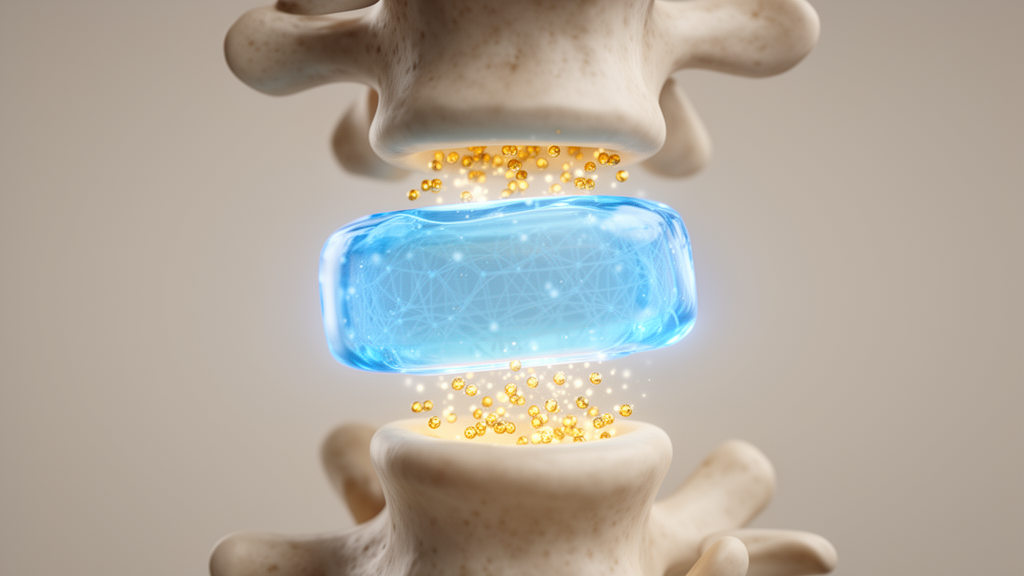
Scientists have engineered a dual-responsive hydrogel that carries the CRISPR-Cas9 gene-editing machinery directly into deteriorating spinal discs, releasing its payload only when the tissue turns acidic and chemically stressed. In a rat model of intervertebral disc degeneration, the material—dubbed SmartGel-Cas9/TRPV4—silenced a calcium channel implicated in disc breakdown, restored cellular waste-clearance machinery, and preserved disc height and hydration over eight weeks.
The target of the intervention is TRPV4, a mechanosensitive calcium channel found in the nucleus pulposus cells that populate the gel-like core of each spinal disc. In degenerating discs, abnormal TRPV4 activation drives excessive calcium influx, which in turn destabilizes mitochondria, elevates reactive oxygen species, and pushes cells toward apoptosis and senescence. Surplus calcium signaling also impairs autophagy, the cellular process that clears damaged mitochondria, thereby fueling inflammation and the enzymatic degradation of the disc’s extracellular matrix. Although small-molecule TRPV4 inhibitors can dampen this pathway in the laboratory, the researchers note that their therapeutic value is constrained by limited specificity, short exposure windows, and the difficulty of delivering drugs into disc tissue, which lacks a blood supply.
CRISPR-Cas9 offers a way to intervene at the source, but delivering the Cas9/sgRNA ribonucleoprotein complex into living tissue is notoriously difficult. The enzyme is rapidly degraded, lingers only briefly at the target site, and reaches lesions inefficiently after injection. To overcome these barriers, the team, led by Yuan-Ting Zhao of Xi’an Jiaotong University, built a hydrogel from gelatin methacrylate functionalized with phenylboronic acid and oxidized hyaluronic acid. Dynamic boronate ester bonds in the network respond to both acidity and oxidative stress—the two chemical hallmarks of the degenerating disc microenvironment—while the hyaluronic acid component improves adhesion and tissue integration.
Material characterization confirmed the design’s key properties. Scanning electron microscopy revealed interconnected porous networks with pores in the tens of micrometers, large enough for the Cas9/sgRNA complexes to infiltrate during loading. The gel gelled in roughly 140 seconds at body temperature, extruded smoothly through a 23-gauge needle with a maximum injection force of about 8.5 newtons, and degraded progressively in collagenase-containing solution. Release assays showed that cumulative sgRNA release was consistently higher at pH 6.5 than at the physiological pH 7.4, accelerated with increasing hydrogen peroxide concentrations, and reached its maximum when acidity and oxidative stress were combined—precisely the conditions found in degenerated disc tissue.
The hydrogel also displayed antioxidant activity in ABTS and DPPH radical-scavenging assays and proved biocompatible in both settings. Nucleus pulposus cells co-cultured with the material retained near-complete viability over five days, and live/dead staining showed predominantly living cells throughout. When injected subcutaneously into rats, the gel degraded gradually over six weeks without obvious inflammatory infiltration, and enzyme-linked immunosorbent assays found no significant elevation of IL-1β, IL-6, or TNF-α at the injection site compared with saline controls. Histological examination of major organs revealed no evident systemic toxicity.
In cell experiments, the researchers exposed rat nucleus pulposus cells to hydrogen peroxide to mimic the degenerative environment, then treated them with the hydrogel. The treatment reduced intracellular reactive oxygen species, restored mitochondrial membrane potential as measured by JC-1 staining, and lowered both early and late apoptotic cell populations detected by flow cytometry. Senescence markers including p16INK4a, p21, and p53, which rose under oxidative stress, declined after treatment, as did inflammatory cytokines associated with the senescence-associated secretory phenotype. Western blotting confirmed that the gel reduced TRPV4 protein expression, while a non-targeting sgRNA control did not, supporting sequence-specific gene silencing rather than a nonspecific material effect.
The mechanistic core of the study concerns autophagic flux—the complete cycle of autophagosome formation, fusion with lysosomes, and degradation of cargo. Static measurements of LC3 and p62 cannot distinguish enhanced autophagy initiation from blocked degradation, so the team used bafilomycin A1, which halts autophagic flux, and cycloheximide tracing to track LC3-II turnover dynamically. These experiments indicated that the treatment mainly restores autophagosome-lysosome fusion and autolysosomal degradation rather than merely initiating autophagy. Calcium imaging with Fluo-4 AM showed that hydrogen peroxide elevated intracellular calcium signals, which the treatment normalized. Downstream, the treatment suppressed phosphorylated p38 and JNK of the MAPK family and reduced β-catenin nuclear translocation, while raising expression of the matrix proteins Aggrecan and Collagen II and lowering the matrix-degrading enzymes MMP13, MMP3, ADAMTS1, and ADAMTS5.
Knockdown experiments pinpointed CaMKKβ as an essential link in this cascade. When researchers silenced CaMKKβ with siRNA, the treatment’s ability to activate AMPK, inhibit mTOR, and restore autophagic flux was attenuated, placing calcium signaling upstream of the CaMKKβ-AMPK-mTOR autophagy pathway. Conversely, adding exogenous calcium or the TRPV4 agonist GSK1016790A partially reversed the treatment’s effects, and the MAPK agonist anisomycin reactivated pathway signaling and eroded the treatment’s protective effect on matrix production. Together these interventions support a coordinated TRPV4-calcium-CaMKKβ-AMPK-mTOR-autophagy-MAPK/Wnt axis rather than an isolated single-pathway mechanism.
In vivo, the team used a puncture-induced rat model of disc degeneration with five groups: sham surgery, untreated degeneration, empty hydrogel, and the loaded hydrogel given either one week before or one day after injury. Fluorescently labeled Cas9/sgRNA retained in the disc region for more than fourteen days when carried by the hydrogel, whereas free ribonucleoprotein was nearly undetectable by day three. X-ray imaging showed that both prevention and treatment groups maintained a greater disc height index than untreated degenerated discs, and T2-weighted magnetic resonance imaging indicated restored nucleus pulposus signal intensity, consistent with improved hydration. Histology and immunohistochemistry showed more organized tissue architecture, greater matrix deposition, reduced MMP13, and lower levels of senescence markers, while the empty hydrogel produced little improvement on its own.
The authors caution that important uncertainties remain before any clinical translation. The single-cell RNA sequencing component included only two biological replicates per group and is explicitly exploratory, and the proteomic analysis, though conducted with three replicates per group, identified differential proteins linked to mitochondrial energy metabolism, oxidative stress, and p53 signaling that require larger cohorts for verification. Long-term safety, immune responses, DNA-level editing efficiency, and off-target editing risk all remain open questions. The study was conducted in rats with a puncture-induced model, which differs from the slow, multifactorial human disease. Still, the work demonstrates that a material engineered to release gene-editing cargo only in the acidic, oxidizing environment of a degenerating disc can sustain local delivery, silence a mechanistically relevant channel, and slow structural degeneration in a living animal—laying groundwork for precision biomaterial approaches to degenerative disc disease.
Subject of Research: A pH/ROS-responsive hydrogel delivering CRISPR-Cas9 against TRPV4 to regulate autophagy in intervertebral disc degeneration
Article Title: pH/ROS dual-responsive SmartGel-Cas9/TRPV4 for autophagy regulation in intervertebral disc degeneration
Article References: Yu, X.-J., Quan, B.-Y., Zou, P., Wang, S.-B., Li, L.-J., Luo, R., Zhang, Y.-Y., & Zhao, Y.-T. (2026). pH/ROS dual-responsive SmartGel-Cas9/TRPV4 for autophagy regulation in intervertebral disc degeneration. Materials Today Bio, 41, Article 103768. https://doi.org/10.1016/j.mtbio.2026.103768
Image Credits: AI Generated
DOI: 10.1016/j.mtbio.2026.103768
Keywords: CRISPR-Cas9, hydrogel, intervertebral disc degeneration, TRPV4, autophagy, nucleus pulposus, drug delivery, calcium signaling, CaMKKβ, AMPK, MAPK, preclinical study
Cite Scienmag News
Juliet Wilcox. (October 27, 2026). Smart Hydrogel Delivers CRISPR Gene Editing to Treat Degenerating Spinal Discs in Rats. Scienmag. https://scienmag.com/smart-hydrogel-delivers-crispr-gene-editing-to-treat-degenerating-spinal-discs-in-rats/
Juliet Wilcox. "Smart Hydrogel Delivers CRISPR Gene Editing to Treat Degenerating Spinal Discs in Rats." Scienmag, 27 October 2026, https://scienmag.com/smart-hydrogel-delivers-crispr-gene-editing-to-treat-degenerating-spinal-discs-in-rats/. Accessed 27 October 2026.
Juliet Wilcox. "Smart Hydrogel Delivers CRISPR Gene Editing to Treat Degenerating Spinal Discs in Rats." Scienmag. October 27, 2026. https://scienmag.com/smart-hydrogel-delivers-crispr-gene-editing-to-treat-degenerating-spinal-discs-in-rats/


