


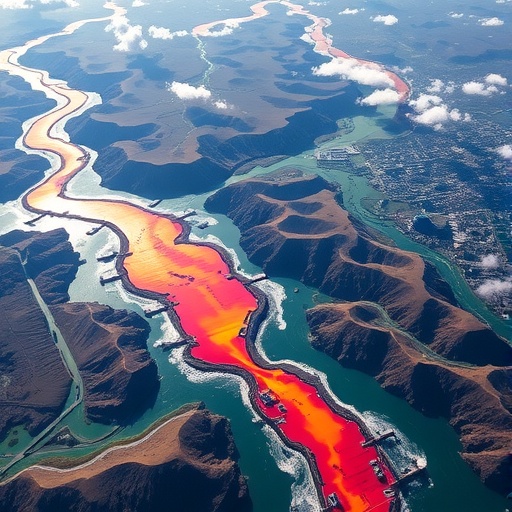
Atmospheric rivers—long, narrow corridors of moving moisture in the sky—may be a hidden driver of marine heatwaves, according to a new study in Nature Communications by researchers at Duke University’s Nicholas School of the Environment. The work, supported by NASA funding, is the first to systematically connect these “rivers in the sky” with episodes of abnormally warm ocean conditions.
Marine heatwaves are stretches of unusually high sea-surface temperatures that can persist for weeks or even months. Because many marine organisms are adapted to seasonal temperature swings, sudden warming can disrupt ecosystems and threaten fisheries and coastal livelihoods, amplifying impacts far beyond the ocean itself.
Atmospheric rivers are widely known for their influence over land, where they can unleash extreme rainfall and flooding, especially across regions like the western United States and parts of western Europe. However, these systems spend much of their lifetime over the ocean, where their energy and moisture transport can reshape sea-surface temperature patterns before the weather ever arrives on shore.
To probe that connection, the team analyzed satellite, ship, and other observational datasets to identify atmospheric rivers and marine heatwaves across the North Pacific and North Atlantic, outside the tropics, from 1982 to 2023. These mid-to-high-latitude oceans are typically where both phenomena are strongest, making them ideal for testing a statistical link between air-sea interactions.
The researchers found a particularly strong association between atmospheric rivers and the occurrence of marine heatwaves. In winter, enhanced atmospheric river activity tended to appear a couple of days before marine heatwaves reached their peak, suggesting a potential causal pathway rather than a coincidence.
Seasonal contrasts emerged. In summer, fewer atmospheric rivers preceded marine heatwaves, indicating that the ocean’s response to atmospheric forcing changes with the broader seasonal background state and the prevailing heat-transfer conditions.
A key mechanism appears to involve competing effects on the sea surface. Cloud cover associated with atmospheric rivers can increase, which may cool the ocean by reducing incoming solar radiation. At the same time, warm, moisture-rich air can promote ocean warming through heat fluxes between the atmosphere and the surface, and the balance between these processes varies by season and region.
Overall, the study emphasizes that brief, transient ocean-atmosphere exchanges can meaningfully influence extreme marine temperature events. With global warming intensifying both marine heatwaves—because the ocean stores most excess heat from greenhouse gases—and atmospheric rivers—because warmer air holds more moisture—the interaction between them could become even more important.
The next step, the authors suggest, is to refine the physical understanding of how these events co-evolve and how their relationship will shift under future climate conditions. If atmospheric rivers increasingly push the ocean toward extremes, marine ecosystems may face more frequent and more complex heat stress.
Cite Scienmag News
Russell Cooper. (July 28, 2026). Sky Rivers Shape Marine Heatwaves, New Study Finds. Scienmag. https://scienmag.com/sky-rivers-shape-marine-heatwaves-new-study-finds/
Russell Cooper. "Sky Rivers Shape Marine Heatwaves, New Study Finds." Scienmag, 28 July 2026, https://scienmag.com/sky-rivers-shape-marine-heatwaves-new-study-finds/. Accessed 4 September 2026.
Russell Cooper. "Sky Rivers Shape Marine Heatwaves, New Study Finds." Scienmag. July 28, 2026. https://scienmag.com/sky-rivers-shape-marine-heatwaves-new-study-finds/


