


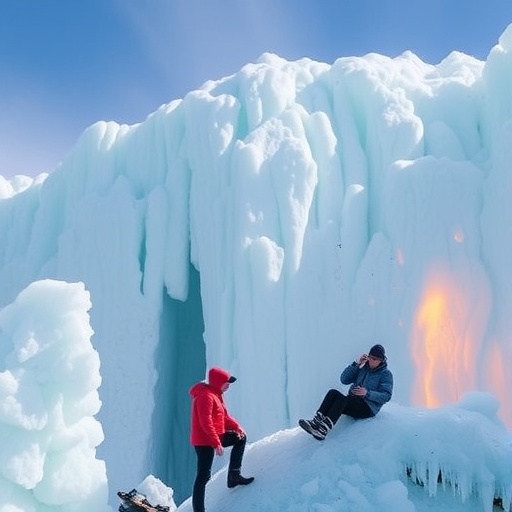
In a groundbreaking advance for paleoclimatology, an international team of U.S. scientists has uncovered the oldest directly dated ice core and entrapped air bubbles on Earth, sourced from the Allan Hills blue ice region in East Antarctica. This extraordinary discovery stretches our climatic archive back six million years, a monumental leap beyond the previous limit of approximately 800,000 years, offering an unprecedented glimpse into Earth’s Miocene and Pliocene epochs, periods marked by significantly warmer global temperatures and elevated sea levels compared to today.
The project, spearheaded by Sarah Shackleton of Woods Hole Oceanographic Institution and John Higgins of Princeton University under the auspices of the National Science Foundation-funded Center for Oldest Ice Exploration (COLDEX), signifies a monumental achievement in climate science. Unlike prior ice core studies relying on deep drilling of more than 2,000 meters into the Antarctic interior, COLDEX scientists tapped into unique local topographical and climatological features at Allan Hills. The combination of rugged mountainous terrain, katabatic winds, and extraordinarily cold surface temperatures has preserved ancient ice layers near the surface, enabling the extraction of ice cores without the logistical burdens of ultra-deep drilling.
These ice cores capture minute quantities of air trapped within tiny bubbles formed when snow compresses into ice. The direct dating of ice using argon isotope ratios—signifying an innovative methodological breakthrough—allows precise age determination of the ice itself, circumventing uncertainties inherent in indirect dating techniques. This direct dating revealed ice samples aged approximately six million years, a period characterized by climatic conditions vastly different from the present, making this trove invaluable for reconstructing ancient atmospheric composition and temperature fluctuations.
Analyses of oxygen isotopes within the ice show a persistent cooling trend of approximately 12 degrees Celsius (22 degrees Fahrenheit) over the six million years preceding the present. This is the first direct quantitative assessment of long-term Antarctic cooling through this deep temporal lens, offering new context to the geological and paleoenvironmental records of global climate shifts. These data also provide essential insight into the progression of glaciation and greenhouse gas fluctuations through the Miocene and Pliocene, epochs critical for understanding the mechanisms driving Earth’s climate system.
COLDEX’s approach is distinguished by its ability to retrieve relatively shallow cores that represent non-continuous but extraordinarily ancient climate snapshots. By compiling these discrete temporal data points, the researchers have constructed an invaluable climatic “library” that enriches our understanding of polar climate dynamics over millions of years. This complements younger, more continuous ice core records obtained from conventional deep Antarctic drilling, enhancing the resolution of long-term climate reconstructions and offering clarity on how polar ice and atmospheric composition evolved during major climate transitions.
The logistical challenges of working in Allan Hills are formidable. The remote location demands extended field campaigns with teams enduring harsh Antarctic conditions. The combination of strong, persistent winds and bitter cold not only preserves the ice but also complicates collection efforts. Yet, the research team’s perseverance is opening new frontiers in ice core recovery and analysis, pushing the science of climate history into unprecedented territory.
The trapped atmospheric gases in these ancient ice cores hold keys to reconstructing past greenhouse gas concentrations, especially carbon dioxide and methane, thereby illuminating natural variability before significant anthropogenic influence. These reconstructions are crucial for benchmarking climate models and improving projections of future climate scenarios amid ongoing global warming. Moreover, the data offer insights into ocean heat content variation and its interaction with atmospheric changes, integral components of the Earth system.
Looking ahead, COLDEX is poised to expand its investigations in Allan Hills, with plans for additional drilling campaigns that could further extend the age range of recovered ice and deepen time-series coverage. These future efforts aim to refine our understanding of polar climate evolution and to resolve outstanding questions about ice sheet stability and response to climatic drivers over multimillion-year timescales.
This pioneering research exemplifies the interdisciplinary collaboration between geoscientists, glaciologists, chemists, and climatologists. It relies on cutting-edge methodologies in isotope geochemistry and ice core analysis, enabled by robust support from national science foundations and polar research programs. The success at Allan Hills underscores the importance of exploring diverse glacial environments to unlock Earth’s climatic past.
In summary, the discovery of six-million-year-old ice at Allan Hills fundamentally redefines the temporal limits of the Antarctic ice core record. It enables a direct and detailed investigation of Earth’s climatic conditions long before the Quaternary ice ages, offering an invaluable archive to decipher the natural variability and drivers of climate change. This work not only transforms our understanding of polar climate history but also serves as a critical benchmark for modeling future global climate trajectories.
News Publication Date:
28-Oct-2025
Web References:
DOI: 10.1073/pnas.2502681122
References:
Shackleton, S., Higgins, J., et al. (2025). Miocene and Pliocene ice and air from the Allan Hills blue ice area, East Antarctica. Proceedings of the National Academy of Sciences. DOI: 10.1073/pnas.2502681122
Cite Scienmag News
Violet Maxwell. (October 28, 2025). Six-Million-Year-Old Antarctic Ice Unlocks New Insights into Earth’s Ancient Warm Climate. Scienmag. https://scienmag.com/six-million-year-old-antarctic-ice-unlocks-new-insights-into-earths-ancient-warm-climate/
Violet Maxwell. "Six-Million-Year-Old Antarctic Ice Unlocks New Insights into Earth’s Ancient Warm Climate." Scienmag, 28 October 2025, https://scienmag.com/six-million-year-old-antarctic-ice-unlocks-new-insights-into-earths-ancient-warm-climate/. Accessed 3 September 2026.
Violet Maxwell. "Six-Million-Year-Old Antarctic Ice Unlocks New Insights into Earth’s Ancient Warm Climate." Scienmag. October 28, 2025. https://scienmag.com/six-million-year-old-antarctic-ice-unlocks-new-insights-into-earths-ancient-warm-climate/


