


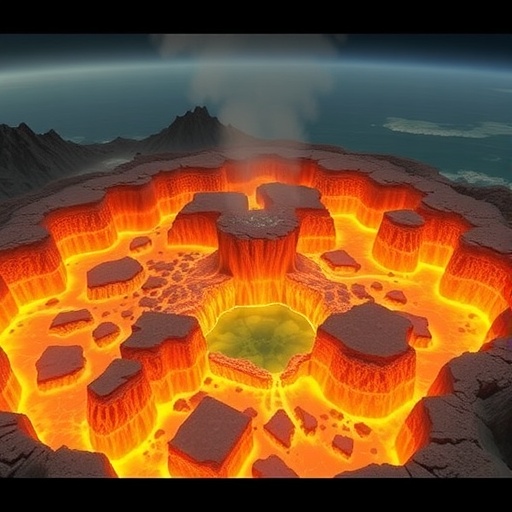
In a groundbreaking study published in Communications Earth & Environment, researchers have revealed compelling evidence for a long-lived hydrothermal system generated by the Chicxulub impact, the colossal asteroid collision responsible for one of Earth’s most well-known mass extinction events. This new research offers an unprecedented window into the intricate post-impact geological processes that unfolded beneath the surface of the Yucatán Peninsula, illuminating the potential for habitable environments to arise within impact craters well beyond the immediate aftermath of the collision. The findings not only reshape our understanding of planetary impact mechanics but also bear profound implications for the study of early life habitats on Earth and potentially other planets.
For decades, the Chicxulub crater, located offshore beneath the northern Yucatán Peninsula, has fascinated scientists as the relic of the asteroid impact that triggered the mass extinction event approximately 66 million years ago. While its role in Earth’s biological history is well cemented, the subsurface geological activity that persisted post-impact has remained enigmatic. This latest research addresses this knowledge gap by combining seismic imaging, geochemical analysis, and hydrothermal system modeling to reveal that hydrothermal activity, fueled by residual heat from the impact, endured for hundreds of thousands of years.
At the heart of this discovery is the recognition that the tremendous energy released during the Chicxulub impact generated intense heating of Earth’s crust, resulting in widespread melting and fracturing of the target rock. Unlike previous estimates that suggested a short-lived thermal spike, the new data indicates that the hydrothermal system persisted on a timescale of hundreds of thousands of years. This prolonged period of heating facilitated substantial fluid circulation within the fractured rock, creating a dynamic environment conducive to complex water-rock interactions and mineral alteration.
The researchers employed state-of-the-art seismic tomography techniques to map the heterogeneity within the crater’s subsurface. These high-resolution images unveiled extensive zones of altered rock characterized by mineral assemblages indicative of hydrothermal alteration. Moreover, isotopic analyses of core samples extracted from within the crater revealed chemical signatures consistent with fluids heated to high temperatures but maintained over an extended period. This hydrothermal persistence contrasts sharply with the commonly held view that impact-generated heat dissipates rapidly.
The longevity of this hydrothermal system suggests that the Chicxulub crater became a prolonged hotspot of mineralogical transformation and geochemical cycling. Such environments are critical to understanding abiotic and biotic processes. Hydrothermal systems are known to facilitate the synthesis of organic compounds and provide energy-rich niches, potentially nurturing microbial life. This raises tantalizing possibilities that impact craters may have served as cradles for early life forms or sanctuary environments during periods of planetary upheaval.
Significantly, this work also integrates numerical simulations of post-impact thermal evolution with empirical data, demonstrating how the unique structural framework of the Chicxulub crater contributed to sustained hydrothermal activity. The crater’s peak ring—a circular ridge formed within the crater floor—created a complex network of fractures and permeability pathways that allowed heated fluids to circulate extensively. This enhanced fluid flow not only sustained thermal gradients but also promoted the deposition of economically important minerals, highlighting the interplay between impact processes and resource formation.
From an astrobiological standpoint, the discovery of a long-lived impact-generated hydrothermal system at Chicxulub reinvigorates discussions about the potential habitability of impact craters on other planets and moons. For example, on Mars and icy moons like Europa, where evidence suggests past impact craters combined with subsurface ice and volatiles, hydrothermal systems could represent oases for life. Therefore, the Chicxulub crater serves as a valuable terrestrial analog, offering insights into the conditions that might support life beyond Earth.
The study also underscores the necessity of revisiting other terrestrial impact craters to assess the prevalence and longevity of hydrothermal systems in these environments. Previous research has identified indications of fluid-rock interaction in craters worldwide, but the combination of high-resolution geophysical imaging and detailed geochemical characterization used here sets a new standard for future investigations seeking to unravel impact-related hydrothermal processes.
Furthermore, the persistence of hydrothermal circulation challenges current models of planetary heat dissipation following colossal impacts. The findings imply that planetary lithospheres can retain and redistribute impact heat over geologically significant timescales. This has ramifications for understanding thermal and mechanical evolution of planetary crusts, influencing tectonics, magmatism, and the potential for hydrothermal mineral deposits.
The implications of this study reach even into the realm of natural resource exploration. Hydrothermal systems in impact structures can concentrate metals and rare elements, offering a hidden bounty beneath ancient crater floors. By unlocking the thermal history of Chicxulub, scientists can better predict where valuable mineralization might occur, potentially guiding future mining endeavors in regions associated with large impact structures.
Environmental scientists and climatologists might also find relevance in these results. The prolonged hydrothermal system suggests that post-impact geochemical cycles, including carbon sequestration through mineral carbonation, could have influenced atmospheric composition and climate stabilization following the mass extinction event. Understanding these processes enriches our grasp of how Earth’s biosphere recovered in the wake of catastrophic disturbances.
At the same time, the discovery brings fresh perspectives to the study of Earth’s deep biosphere. Hydrothermal environments foster chemosynthetic microbial communities independent of sunlight, highlighting the diversity of ecosystems possible on early Earth and providing analogs for subsurface life detection in extraterrestrial settings. The Chicxulub hydrothermal system exemplifies such habitats, potentially preserving biosignatures that might be probed by future drilling projects.
In conclusion, this landmark study sheds new light on the long-term dynamics of impact-generated hydrothermal systems, revealing that the energy unleashed by the Chicxulub impact catalyzed prolonged thermal and geochemical activity beneath the Earth’s surface. This revelation recasts our understanding of the role of asteroid impacts in shaping planetary environments, emphasizing their capacity not only for destruction but also for facilitating complex geological and biological phenomena. As researchers continue to explore these subterranean chronicles, the legacy of Chicxulub stands as both a monument to catastrophic change and a beacon illuminating the resilience and adaptability of planetary processes.
This pioneering work speaks to the enduring curiosity and innovation driving Earth sciences today, where multi-disciplinary approaches converge to decode the planet’s most profound secrets. The methodologies and insights arising from this research will undoubtedly influence future explorations of impact craters on Earth and across the solar system, inspiring new hypotheses about planetary habitability, resource generation, and the interplay between geo-events and life.
The Chicxulub impact system now emerges not merely as a chapter in Earth’s extinction narrative but as a dynamic geochemical laboratory, preserving the echoes of deep-time activity and fueling scientific dialogues that bridge geology, biology, and planetary science. This revelation underscores how impact events, rather than simply marking ends, also serve as genesis points for renewed environmental complexity.
Cite Scienmag News
Violet Maxwell. (June 9, 2026). Long-Lived Hydrothermal System Found at Chicxulub Impact. Scienmag. https://scienmag.com/long-lived-hydrothermal-system-found-at-chicxulub-impact/
Violet Maxwell. "Long-Lived Hydrothermal System Found at Chicxulub Impact." Scienmag, 9 June 2026, https://scienmag.com/long-lived-hydrothermal-system-found-at-chicxulub-impact/. Accessed 4 September 2026.
Violet Maxwell. "Long-Lived Hydrothermal System Found at Chicxulub Impact." Scienmag. June 9, 2026. https://scienmag.com/long-lived-hydrothermal-system-found-at-chicxulub-impact/


