


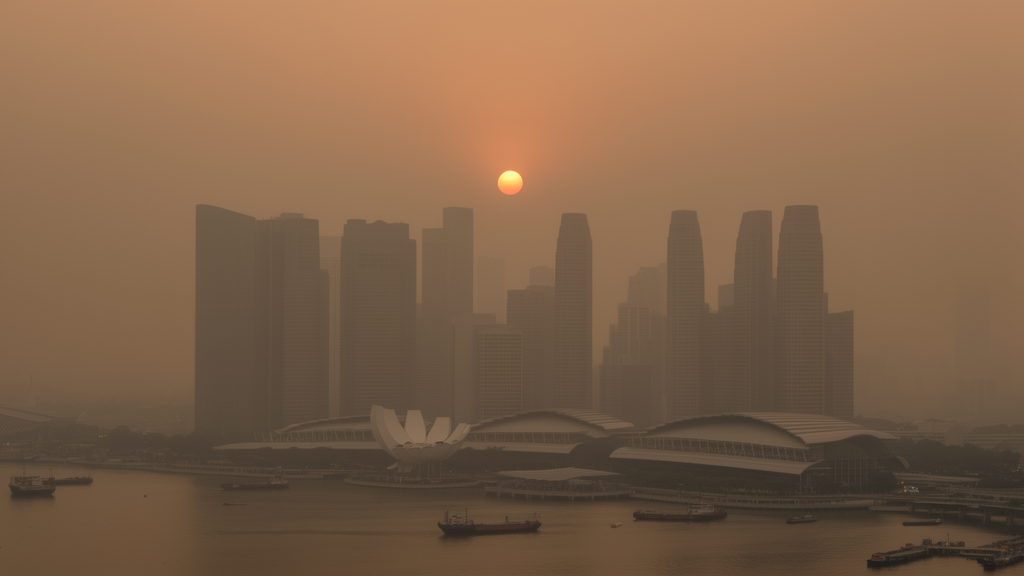
Seventeen years of ground-based measurements over Singapore show that the city-state’s tropical atmosphere is overwhelmingly shaped by pollution-related aerosols rather than dust, according to a new open-access study published in Aerosol and Air Quality Research. Using AERONET Version 3 inversion products from 2007 to 2023, researchers classified optically defined aerosol regimes over the island by combining four measured optical properties: the particle linear depolarization ratio (PLDR), the dust ratio (Rd), the fine-mode fraction (FMF), and the single scattering albedo (SSA).
The classification scheme rests on a simple physical distinction. Lower PLDR values point to fine-mode, relatively spherical particles, the signature of pollution-related aerosols, while higher PLDR values indicate non-spherical coarse particles associated with dust. When the team examined the joint FMF-Rd distribution, fine-mode, low-dust aerosol conditions predominated, already hinting that urban and regional pollution, not mineral dust, drives most of Singapore’s aerosol loading.
Among the quality-assured AERONET inversion retrievals, dust-free pollution regimes accounted for 74 percent of observations. These were subdivided by absorption strength into strongly absorbing (SA), moderately absorbing (MA), weakly absorbing (WA), and non-absorbing (NA) categories. Dust-related regimes, including dust-dominated mixtures (DDM), pollution-dominated mixtures (PDM), and pure dust (PD), made up the remaining 26 percent.
The occurrence fractions reveal a striking hierarchy. Non-absorbing aerosols were the most prevalent regime at roughly 36 percent, followed by weakly absorbing aerosols at about 21 percent and pollution-dominated mixtures at 20 percent. Moderately absorbing aerosols occurred around 11 percent of the time, strongly absorbing aerosols about 7 percent, dust-dominated mixtures roughly 5 percent, and pure dust just 1 percent. In other words, the single rarest aerosol type in Singapore’s sky is pure dust, while non-absorbing pollution aerosols dominate by a wide margin.
Seasonal structure emerged from the analysis as well. The non-absorbing regime persisted as the dominant category throughout the record, reflecting the near-constant presence of fine-mode pollution aerosols over the tropical urban environment.
A key methodological choice shapes how the study’s reanalysis comparison should be read. The researchers compared the CAMS and MERRA-2 reanalysis datasets with their AERONET-derived optical regimes and found qualitative differences in how the models represent aerosols. Because of these differences, the comparison was treated as qualitative rather than as direct quantitative validation. This is an important caveat: the reanalysis products were not used to confirm the AERONET classifications numerically, but to contrast how different datasets depict the aerosol environment.
The study’s scope is specific and worth keeping in mind. It covers a single tropical urban station over 2007-2023, relies on quality-assured ground-based remote sensing retrievals, and classifies aerosols by optical behavior rather than by direct chemical composition. The findings therefore characterize what the atmosphere over Singapore looks like optically, not the exact sources of every particle.
For air-quality assessment in tropical urban environments, the results carry a clear message: pollution-related aerosol regimes dominate Singapore’s atmosphere, and combining long-term ground-based observations with reanalysis datasets offers a practical framework for characterizing them.
Subject of Research: Classification of aerosol types over Singapore using ground-based remote sensing and reanalysis datasets from 2007 to 2023
Article Title: Aerosol Types Classification in the Tropical Climate of Singapore by Integrating Ground-Based Remote Sensing and Reanalysis Datasets
Article References: Sharma, N., Dahal, S., Kumar, S., Patel, K., Srivastava, A., Singh, V., & Choudhary, A. (2026). Aerosol Types Classification in the Tropical Climate of Singapore by Integrating Ground-Based Remote Sensing and Reanalysis Datasets. Aerosol and Air Quality Research. https://doi.org/10.1007/s44408-026-00164-9
Image Credits: AI Generated
DOI: 10.1007/s44408-026-00164-9
Keywords: aerosols, Singapore, AERONET, air quality, dust, pollution, remote sensing, reanalysis, tropical climate, single scattering albedo, fine-mode fraction, inter-monsoon
Cite Scienmag News
Russell Cooper. (October 27, 2026). Singapore’s Skies Are Dominated by Pollution Aerosols, 17-Year Study Finds. Scienmag. https://scienmag.com/singapores-skies-are-dominated-by-pollution-aerosols-17-year-study-finds/
Russell Cooper. "Singapore’s Skies Are Dominated by Pollution Aerosols, 17-Year Study Finds." Scienmag, 27 October 2026, https://scienmag.com/singapores-skies-are-dominated-by-pollution-aerosols-17-year-study-finds/. Accessed 27 October 2026.
Russell Cooper. "Singapore’s Skies Are Dominated by Pollution Aerosols, 17-Year Study Finds." Scienmag. October 27, 2026. https://scienmag.com/singapores-skies-are-dominated-by-pollution-aerosols-17-year-study-finds/


