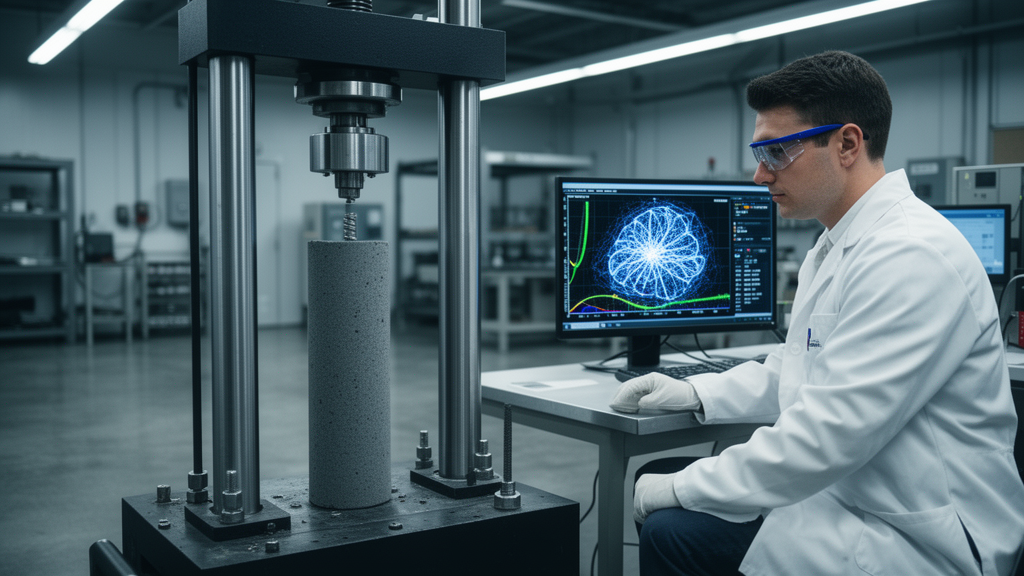
Engineers studying how to make coal mining greener have turned an artificial intelligence model loose on one of the industry’s messier problems: predicting how strong a mixture of crushed coal waste, fly ash, cement and synthetic fibers will be before anyone pours it into an abandoned underground void. A research team writing in GeoEnergy Communications reports that a machine learning model they tuned with an algorithm inspired by bird flocks can forecast three key mechanical properties of gangue-cemented backfill materials with coefficients of determination reaching as high as 0.97814 on their test data.
Backfill mining, in which waste material is pumped or packed into the galleries left behind after coal extraction, has been established as a primary method for achieving green and low-carbon coal mining. The backfill body acts as the load-bearing unit that controls strata movement in goafs, the emptied workings, so its mechanical properties directly influence the effectiveness of strata control and surface ecological protection. The trouble is that the properties of these materials depend on multiple parameters at once, and the traditional way of finding the right recipe relies on extensive repetitive laboratory tests characterized by long specimen preparation cycles, low testing efficiency and high economic costs, which hinders timely guidance for on-site production decisions.
The team, led by Yun Zhang of what the paper lists as the first affiliation, built their dataset from laboratory experiments on cemented coal gangue backfill. The coal gangue came from a coal mine in the Yushen Mining Area of northern Shaanxi and was crushed and sieved to a particle size range of 0 to 15 millimeters to meet the gradation requirements of the Talbot Index. The fly ash, sourced from a coal-fired power plant in the same mining area, ranged from 5 to 50 micrometers in particle size and consisted mainly of hollow microbeads, spongy glassy particles, quartz, iron oxide, carbon particles and sulfates. The mix also included commercially available ordinary Portland cement of the P.O 42.5 grade, polypropylene fibers 12 to 16 millimeters long and 18 micrometers in diameter, and ordinary tap water from the mining area.
The experimental design was deliberately systematic. Conventional backfill materials were prepared at Talbot indices of 0.2, 0.4, 0.6 and 0.8 for aggregate gradation, while modified materials incorporating polypropylene fibers were prepared primarily at indices of 0.4 and 0.6. The fibers, selected at a length of 16 millimeters, were set at 0.6 percent of the solid mass of the backfill. Cube specimens with a side length of 70.7 millimeters were prepared, cured for 28 days and tested in strict compliance with relevant standards, with three identical specimens prepared for each mix group to minimize experimental error. In total, 18 groups with different mix proportions yielded 54 sample datasets, which were divided into training and testing sets in an 8:2 ratio.
The laboratory phase itself produced a clear physical story about gradation. When the gradation index was 0.2, the maximum compressive strength of the backfill was only 4.86 megapascals, attributed to an excessively high proportion of coarse gangue particles that left voids insufficiently filled by fine particles. At an index of 0.4, strength improved significantly to 6.53 megapascals, and it peaked at 8.51 megapascals when the index reached 0.6, a point at which the particle size distribution exhibited a continuous coarse-medium-fine gradation that maximized packing density. Raising the index further to 0.8 caused strength to drop sharply to 4.56 megapascals, because the excessive proportion of fine particles increased the specific surface area so much that the cementitious material could not cover all particle surfaces. Compressive strength also rose gradually with higher cement content and lower fly ash content, while the fibers contributed indirectly by inhibiting crack propagation.
With the dataset in hand, the researchers turned to modeling. They selected gangue content, gangue particle size, fly ash, cement and fiber content as input features, and set uniaxial compressive strength, elastic energy index and impact energy index as the outputs. A correlation analysis found all pairwise correlation coefficients between the features were below 0.3, indicating the absence of severe multicollinearity. The core of their approach was the Extreme Gradient Boosting algorithm, or XGBoost, an ensemble method that sequentially builds decision trees, each new learner trained to reduce the errors of the existing ensemble, with a regularization term to control model complexity. Because XGBoost’s parameter tuning process is notably influenced by randomness, the team employed Particle Swarm Optimization, in which a population of candidate solutions, each encoding a set of hyperparameters such as learning rate, maximum depth and number of estimators, iteratively updates its positions based on individual and global best solutions until convergence.
The comparisons were thorough. Among four non-optimized algorithms evaluated on an identical test set, XGBoost consistently outperformed linear regression, support vector regression and random forest, achieving a coefficient of determination of 0.94009 for compressive strength, 0.89663 for the elastic energy index and 0.93446 for the impact energy index. When XGBoost was paired with four different optimizers, the PSO-tuned version came out on top across all three targets, with coefficients of determination of 0.96846 for compressive strength, 0.97814 for the elastic energy index and 0.96403 for the impact energy index, along with the lowest mean absolute and root mean square errors. Notably, the grid search variant managed a coefficient of determination of only 0.43976 for the elastic energy index, and when PSO was applied to the other base models, PSO-SVR sank to 0.07974 for impact energy while PSO-RF reached a respectable 0.96020, still short of PSO-XGBoost.
To guard against luck in the data split, the team ran a 100-time repeated cross-validation procedure. The PSO-XGBoost model achieved a stable average coefficient of determination of 0.96846 for compressive strength and 0.97814 for the elastic energy index, with the range between maximum and minimum values for the latter only 0.02083, and a maximum of 0.96809 for the impact energy index. On the 11-sample test set, relative errors for all three properties were concentrated within the range of minus 20 percent to 20 percent, fluctuating randomly around zero without evident trends or periodicity, which the authors interpret as the absence of systematic bias.
Perhaps the most practically useful contribution is a sensitivity analysis based on SHAP values, a technique rooted in cooperative game theory that quantifies each feature’s contribution to predictions. For compressive strength, fly ash exhibited the highest SHAP value at 0.4756, making it the most influential factor, while fiber and particle size showed relatively minor impact. For the elastic energy index, gangue and cement dominated with SHAP values of 0.3127 and 0.2494 respectively, and for the impact energy index, fly ash and gangue led with values of 0.3722 and 0.3324, while cement registered the lowest value at 0.0265, its inherent brittleness apparently more pronounced in that context. These results suggest the mechanical behavior of the backfill is governed by the synergistic effects of multiple components rather than any single ingredient.
The authors are candid about the boundaries of the work. The limited scale of the dataset requires further validation of the model’s generalizability across a wider range of material types and working conditions, and the input features focus on mixture proportion parameters while time-varying factors such as curing time and environmental temperature and humidity were not considered. Future work, they write, will include multi-factor orthogonal experiments to expand the sample size, long-term curing tests under varying temperature and humidity conditions, and optimization with field data. For now, the study demonstrates that a swarm-optimized gradient boosting model, trained on 54 laboratory samples, can reproduce the mechanical fingerprints of a waste-based building material quickly enough to plausibly replace some of the repetitive lab testing that currently stands between a mine and its next backfill recipe.
Subject of Research: Machine learning prediction of the mechanical properties of gangue-cemented coal mine backfill materials
Article Title: Intelligent prediction of mechanical properties of backfill materials using a PSO-optimized XGBoost model
Article References: Zhang, Y., Li, J., Yang, Y., Yang, Y., Gu, W., Shen, W., Song, T., Liu, Y., & Zhang, S. (2026). Intelligent prediction of mechanical properties of backfill materials using a PSO-optimized XGBoost model. GeoEnergy Communications, 2(1), Article 15. https://doi.org/10.1007/s44421-026-00028-3
Image Credits: AI Generated
DOI: 10.1007/s44421-026-00028-3
Keywords: backfill mining, coal gangue, XGBoost, particle swarm optimization, machine learning, uniaxial compressive strength, fly ash, polypropylene fibers, SHAP analysis, green mining, elastic energy index, cross-validation
Cite Scienmag News
Blake Davidson. (October 27, 2026). AI Model Predicts Strength of Coal Mine Backfill Materials with High Accuracy. Scienmag. https://scienmag.com/ai-model-predicts-strength-of-coal-mine-backfill-materials-with-high-accuracy/
Blake Davidson. "AI Model Predicts Strength of Coal Mine Backfill Materials with High Accuracy." Scienmag, 27 October 2026, https://scienmag.com/ai-model-predicts-strength-of-coal-mine-backfill-materials-with-high-accuracy/. Accessed 28 October 2026.
Blake Davidson. "AI Model Predicts Strength of Coal Mine Backfill Materials with High Accuracy." Scienmag. October 27, 2026. https://scienmag.com/ai-model-predicts-strength-of-coal-mine-backfill-materials-with-high-accuracy/