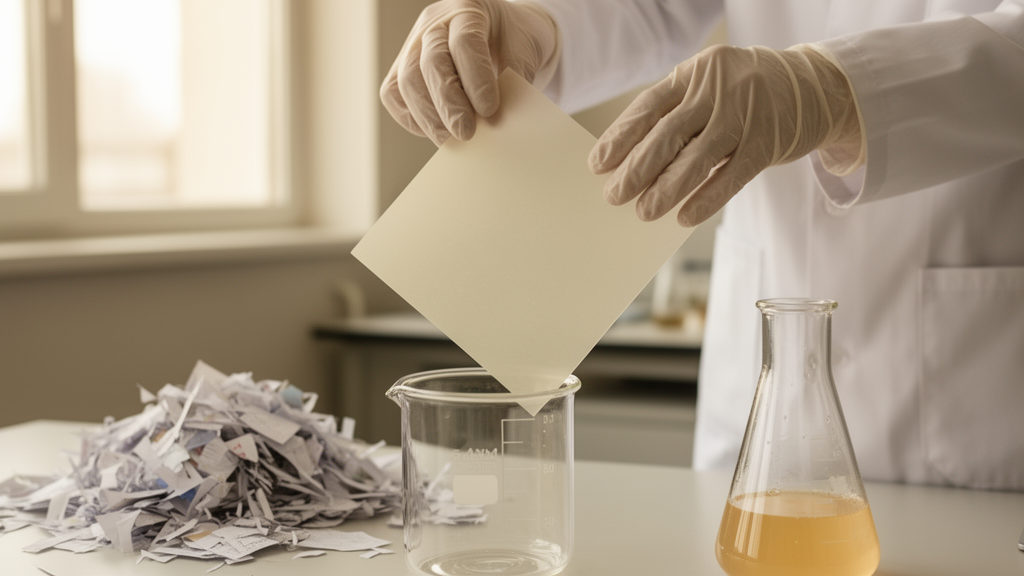
Researchers have converted waste paper into cellulose acetate and used it as a hydrophilic additive for polyethersulfone (PES) ultrafiltration membranes, reporting improvements in water permeability and fouling resistance alongside a trade-off in mechanical strength. The peer-reviewed, accepted study, published open access in Discover Materials on 25 October 2026 by Anisa Malau, Sri Aprilia, Fauzi Djuned, Sofyana Sofyana and Syaubari Syaubari, was shared early as a version that may still be subject to further edits before the final Version of Record.
PES membranes are widely used in ultrafiltration but are limited by hydrophobicity-induced fouling, in which organic matter adheres to the membrane surface and reduces water flux. The study’s stated novelty lies in directly valorizing waste paper into cellulose acetate as a functional PES-membrane additive, linking solid-waste utilization with membrane antifouling enhancement within a circular-material framework.
The additive measurably changed the membrane surface. Water contact angle, a standard indicator of hydrophilicity, decreased from approximately 83 degrees for pristine PES to approximately 61 to 62 degrees at the highest cellulose acetate loading, indicating a more water-attracting surface.
Spectroscopic evidence supported the blend chemistry. Fourier-transform infrared (FTIR) analysis detected the characteristic cellulose acetate carbonyl band and showed spectral changes consistent with intermolecular interactions between cellulose acetate and PES, suggesting the additive is not merely physically dispersed but interacts with the polymer matrix.
Performance testing showed substantial gains in flux and fouling recovery. The highest pure-water flux reached approximately 252 liters per square meter per hour, and during bovine serum albumin (BSA) fouling tests the flux recovery ratio increased from approximately 61 percent for the unmodified membrane to approximately 89 percent, meaning a larger share of water flux was regained after cleaning. A higher flux recovery ratio indicates that fouling in the blended membranes was more reversible, with less irreversible contamination bound to the material.
The improvements came at a mechanical cost. At higher cellulose acetate loading, tensile strength decreased from approximately 142.2 megapascals for pristine PES to 107.9 megapascals for the M3 membrane, which the authors describe as a trade-off between structural openness and mechanical strength.
Overall, the authors conclude that waste-paper-derived cellulose acetate improved membrane hydrophilicity, permeability and fouling resistance, and they present the work as a proof-of-concept route for integrating paper-waste valorization with PES membrane engineering. The findings are laboratory-scale membrane characterization results rather than deployed-system performance, and the reported values are approximate figures from the abstract. The study frames its contribution as connecting paper waste accumulation, a growing disposal problem, with value-added membrane materials for water treatment, while the measured strength reduction marks the practical limit of how much additive can be incorporated before mechanical performance suffers.
Subject of Research: Using waste-paper-derived cellulose acetate as a hydrophilic additive to improve the antifouling performance of polyethersulfone ultrafiltration membranes
Article Title: Waste paper derived cellulose acetate enhances antifouling performance of polyethersulfone membranes
Article References: Malau, A., Aprilia, S., Djuned, F., Sofyana, S., & Syaubari, S. (2026). Waste paper derived cellulose acetate enhances antifouling performance of polyethersulfone membranes. Discover Materials. https://doi.org/10.1007/s43939-026-01011-9
Image Credits: AI Generated
DOI: 10.1007/s43939-026-01011-9
Keywords: cellulose acetate, waste paper, polyethersulfone, ultrafiltration, antifouling, membranes, hydrophilicity, flux recovery ratio, phase inversion, BSA fouling, tensile strength, circular materials
Cite Scienmag News
Denise Maddox. (October 28, 2026). Waste paper turned into cellulose acetate boosts antifouling performance of PES membranes. Scienmag. https://scienmag.com/waste-paper-turned-into-cellulose-acetate-boosts-antifouling-performance-of-pes-membranes/
Denise Maddox. "Waste paper turned into cellulose acetate boosts antifouling performance of PES membranes." Scienmag, 28 October 2026, https://scienmag.com/waste-paper-turned-into-cellulose-acetate-boosts-antifouling-performance-of-pes-membranes/. Accessed 28 October 2026.
Denise Maddox. "Waste paper turned into cellulose acetate boosts antifouling performance of PES membranes." Scienmag. October 28, 2026. https://scienmag.com/waste-paper-turned-into-cellulose-acetate-boosts-antifouling-performance-of-pes-membranes/