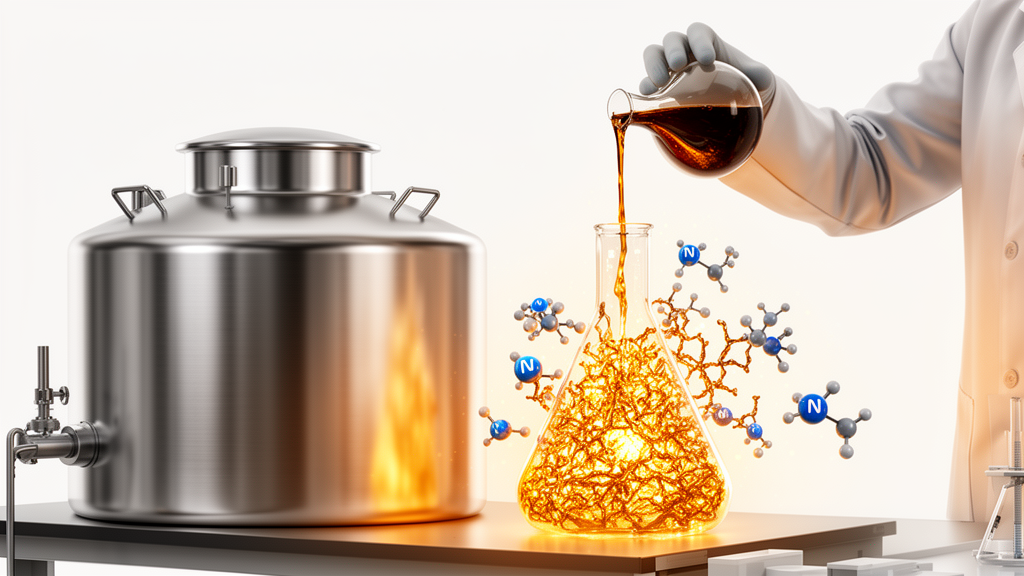
Scientists in China have shown that biogas digestate, the bulky residue left behind after anaerobic digestion at biogas plants, can be converted into nitrogen-enriched artificial humic acid using a hydrothermal process, and that replacing plain water with biogas slurry as the reaction medium substantially boosts both the yield and the nitrogen content of the product. The study, published in the journal Biochar, reports that the highest artificial humic acid selectivity, 40.16% of the hydrochar mass, was achieved at 220 degrees Celsius when biogas slurry served as the reaction medium.
Biogas digestate is produced in enormous quantities. According to the researchers, China alone generates more than 400 million tons annually as a byproduct of large-scale anaerobic digestion, which treats wastes such as cattle manure and corn straw to produce renewable energy. The digestate retains most of the original feedstock mass, roughly 70 to 90%, along with about 60% of its carbon and energy, and is rich in cellulose and lignin that can serve as precursors for humic-like substances. Yet its high moisture content, typically above 80%, its complex composition, and its potential environmental risks make efficient utilization difficult.
Hydrothermal humification is a relatively new strategy for turning wet organic wastes into artificial humic acid under subcritical conditions of 150 to 350 degrees Celsius and 5 to 250 bar, without the need for energy-intensive drying or added water. The resulting material is operationally defined as a humic acid-like substance rather than an exact structural replica of natural humic acid; it shares key physicochemical features, including aromatic carbon domains and abundant oxygen-containing functional groups, but differs in molecular structure because it forms through an abiotic, short-timescale pathway. This distinguishes it from the highly carbonized, humin-like hydrochar produced by conventional hydrothermal carbonization, which is aimed at solid fuels or catalyst carriers rather than humic products.
In the new work, a team led by Yanan Zhao and Lixin Zhao obtained digestate from a large-scale anaerobic digestion plant in Hebei Province that processes cattle manure and corn straw. The digestate was separated into a solid fraction and a liquid fraction, the biogas slurry, using a screw press. Six grams of the dried, ground solid were mixed with 54 milliliters of either deionized water or biogas slurry in a stainless steel autoclave, then heated at 15 degrees Celsius per minute to target temperatures of 180, 200, 220, 240, or 260 degrees Celsius and held for two hours, at estimated pressures of roughly 1.0 to 4.7 megapascals. Artificial humic acid was then extracted from the resulting hydrochar using a modified International Humic Substances Society standard procedure, with all experiments performed in triplicate.
The choice of reaction medium proved decisive. As the temperature rose from 180 to 260 degrees Celsius, hydrochar yield declined by 32.62% in the deionized water system and by 25.86% in the slurry system, reflecting the conversion of insoluble digestate components into soluble low-molecular-weight intermediates. Artificial humic acid selectivity in the water system first decreased and then increased with temperature, while in the slurry system it peaked at 40.16% at 220 degrees Celsius before declining, a drop the authors attribute to possible thermal depolymerization of pre-formed humic acid, excessive carbonization into hydrochar, and decomposition of nitrogen-rich slurry components at higher temperatures.
Nitrogen incorporation was markedly enhanced by the slurry. The nitrogen content of the slurry-derived product was significantly higher than that of the water-derived product, increasing by 80.95% at 200 degrees Celsius. A nitrogen mass balance showed that adding biogas slurry raised the total nitrogen input from 97.92 milligrams to 161.10 milligrams, and at 220 degrees Celsius the amount of nitrogen retained in the artificial humic acid rose from 17.72 milligrams to 26.02 milligrams. The carbon-to-nitrogen ratios of the slurry-derived product all fell below the critical threshold of 24:1, above which temporary nitrogen deficiency can occur, suggesting greater potential as a nitrogen-rich soil amendment.
A suite of analytical techniques revealed what was happening at the molecular level. Fourier transform ion cyclotron resonance mass spectrometry, three-dimensional excitation-emission fluorescence spectroscopy, and solid-state 13C nuclear magnetic resonance indicated that lignin in the digestate was the main precursor for aromatic artificial humic acid synthesis in the deionized water system. When biogas slurry was introduced, lignin depolymerization and nitrogen-involving Maillard reactions, in which nitrogen compounds react with carbonyl products of carbohydrate degradation, were likely enhanced. The slurry-derived product also showed a greater abundance of oxygen-rich functional groups such as carboxyl and ester moieties, and its lignin-like fraction decreased by 35.8% while unsaturated and phenolic compounds increased by 80.9%, a larger shift than in the water system.
X-ray photoelectron spectroscopy traced the fate of the nitrogen. In the water-derived product, protein-type nitrogen fell sharply from 70% to 31% as temperature rose from 180 to 200 degrees Celsius, while quaternary nitrogen rose from 22% to 64%, indicating cyclization or condensation near 200 degrees Celsius. In the slurry-derived product, quaternary nitrogen peaked at 73% at 240 degrees Celsius, suggesting enhanced formation or retention of relatively stable nitrogen structures. The authors propose that nitrogen is incorporated into stable heterocyclic structures through covalent carbon-nitrogen bonding and retained within the humic matrix, consistent with the observed nitrogen retention maximum at 220 degrees Celsius.
Analysis of the aqueous phase supported this picture. The biogas slurry itself contained 1170 milligrams per liter of total nitrogen, almost all of it as ammonium nitrogen, and the slurry system showed a sharp 74.12% reduction in ammonium nitrogen concentration at 220 degrees Celsius, an inflection point shifted to lower temperature than in the water system. The researchers suggest that the abundant nitrogen sources in the slurry supplied precursors while its mildly alkaline environment, around pH 8.0, facilitated decomposition of the solid digestate, together promoting Maillard and condensation-polymerization reactions that moved soluble nitrogen into the solid humic fraction.
The study’s authors caution that the work focused on chemical characterization and structural analysis of the artificial humic acid; its agronomic performance, environmental safety, nutrient-release behavior, and phytotoxicity were not experimentally evaluated. They call for plant-growth assays, soil incubation experiments, and ecotoxicological assessments to confirm practical applicability. Even so, because biogas digestate and biogas slurry are generated together in large quantities at biogas plants, their combined hydrothermal treatment offers a practical and potentially scalable route to integrated waste management, converting plant residues into nutrient- and humic-rich products without external alkali or nitrogen additives, and providing a theoretical foundation for optimizing reaction temperature and medium to tune the properties of the resulting soil amendment candidates.
Subject of Research: Hydrothermal conversion of biogas digestate into nitrogen-enriched artificial humic acid using biogas slurry as reaction medium
Article Title: Valorization of biogas digestate through hydrothermal humification for nitrogen-enriched artificial humic acid production
Article References: Zhao, Y., Liu, Z., Yao, Z., Wang, D., Su, J., Yang, J., Huo, L., Jia, J., Li, H., & Zhao, L. (2026). Valorization of biogas digestate through hydrothermal humification for nitrogen-enriched artificial humic acid production. Biochar, 8(1), Article 145. https://doi.org/10.1007/s42773-026-00662-4
Image Credits: AI Generated
DOI: 10.1007/s42773-026-00662-4
Keywords: biogas digestate, artificial humic acid, hydrothermal humification, biogas slurry, Maillard reaction, lignin, nitrogen fixation, soil amendment, hydrochar, waste valorization, anaerobic digestion, Biochar journal
Cite Scienmag News
Alan Morgan. (October 27, 2026). Biogas Waste Transformed Into Nitrogen-Rich Artificial Humic Acid. Scienmag. https://scienmag.com/biogas-waste-transformed-into-nitrogen-rich-artificial-humic-acid/
Alan Morgan. "Biogas Waste Transformed Into Nitrogen-Rich Artificial Humic Acid." Scienmag, 27 October 2026, https://scienmag.com/biogas-waste-transformed-into-nitrogen-rich-artificial-humic-acid/. Accessed 28 October 2026.
Alan Morgan. "Biogas Waste Transformed Into Nitrogen-Rich Artificial Humic Acid." Scienmag. October 27, 2026. https://scienmag.com/biogas-waste-transformed-into-nitrogen-rich-artificial-humic-acid/