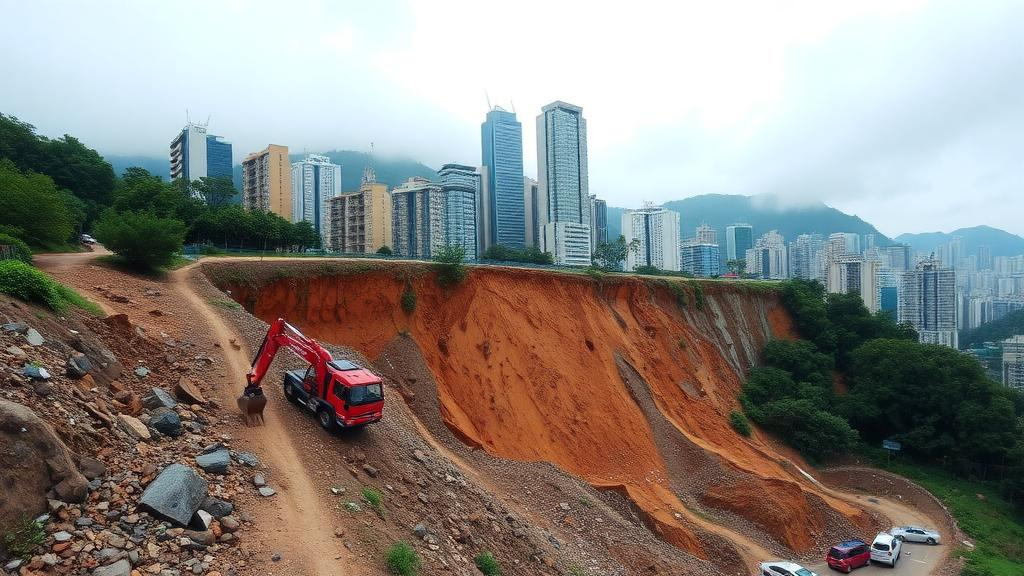
Heavy rainfall in Hong Kong can keep slopes failing for days after a storm has passed, and a new study argues that daily landslide inventories have been hiding that delayed response. Researchers built a knowledge-graph workflow that connects thousands of landslide records with rainfall measurements, slope characteristics, spatial relationships and detailed investigation reports, then used it to map when landslides occur after heavy rain and what failure mechanisms are most likely behind them.
The dataset covers 2,961 landslide records from Hong Kong spanning 2001 to 2021. The team linked each record to daily rainfall, slope attributes and spatial relations, and drew on 57 investigation reports for deeper evidence. Not every record could be used for every analysis: lag analysis was possible for 2,950 records, mechanism analysis for 2,940, and 43 events had traceable anchors in the investigation reports. The work, by Kejin Qu and Yan Li of Harbin Institute of Technology, is published in Frontiers in Earth Science.
By calculating daily incidence rates and testing rainfall thresholds against time windows, the researchers identified two distinct hazard stages. The first four days after a storm, days 0 to 3, form a high-hazard stage. Days 4 to 7 form an extended-hazard stage, when landslide activity continues at a lower but still meaningful level. This staging matters because conventional daily inventories tend to treat each day in isolation, obscuring the fact that a single storm can drive failures across an entire week.
A practical threshold test quantified the pattern. With a rainfall threshold of 50 millimetres and a look-back window of seven days, 42.2 percent of landslide events occurred on a day when qualifying rainfall was recorded, and another 30.1 percent occurred during the following week. A robustness check using the nearest of 21 rain gauges instead of the baseline rainfall assignment produced 89.4 percent agreement with the original stage classification, suggesting the staging is not an artefact of how rainfall stations were matched to landslides.
The second half of the workflow addresses a harder question: what actually caused each failure. The knowledge graph combined four strands of evidence — storm characteristics, slope form, neighbourhood context and regional patterns — to estimate five mechanism classes. Across the lag stages, pore-pressure-dominated soil slides and channelized debris flows together accounted for 78.9 percent to 84.4 percent of the classifications, marking them as the dominant mechanisms in the record.
That dominance comes with an important caveat. The researchers report that posterior uncertainty increased with lag, meaning the graph became less confident about mechanism assignments for landslides that occurred further after the storm.
The team also tested how well the mechanism reasoning performs, using a leakage-controlled leave-one-out procedure to avoid optimistic estimates. The results were modest: Top-1 accuracy of 0.163 and Top-2 accuracy of 0.349. Event-specific causes, the paper concludes, still require field evidence.
What the workflow does support, according to the authors, is storm-cluster interpretation and investigation prioritization.
The study’s limitations are stated plainly. The mechanism analysis rests on 2,940 of the original records, and only 43 events have traceable report anchors, so the deep evidence layer is thin relative to the full inventory. The accuracy figures for mechanism inversion are far from what would be needed for reliable event-level attribution. The authors position the tool as a way to organize evidence and prioritize attention, not as a substitute for site investigation.
Subject of Research: A knowledge-graph analysis linking Hong Kong landslide records to rainfall timing and failure mechanisms.
Article Title: Knowledge-graph reasoning for temporal lag effects and mechanism inversion of heavy-rainfall-induced landslide events: case study on Hong Kong
Article References: Qu, K., & Li, Y. (2026). Knowledge-graph reasoning for temporal lag effects and mechanism inversion of heavy-rainfall-induced landslide events: case study on Hong Kong. Frontiers in Earth Science, 14, Article 1976444. https://doi.org/10.3389/feart.2026.1976444
Image Credits: AI Generated
DOI: 10.3389/feart.2026.1976444
Keywords: landslide, Hong Kong, heavy rainfall, knowledge graph, temporal lag, debris flow, soil slide, pore pressure, hazard staging, rainfall threshold, mechanism inversion, uncertainty
Cite Scienmag News
Violet Maxwell. (October 28, 2026). Knowledge graph links Hong Kong landslides to delayed rainfall hazards. Scienmag. https://scienmag.com/knowledge-graph-links-hong-kong-landslides-to-delayed-rainfall-hazards/
Violet Maxwell. "Knowledge graph links Hong Kong landslides to delayed rainfall hazards." Scienmag, 28 October 2026, https://scienmag.com/knowledge-graph-links-hong-kong-landslides-to-delayed-rainfall-hazards/. Accessed 30 October 2026.
Violet Maxwell. "Knowledge graph links Hong Kong landslides to delayed rainfall hazards." Scienmag. October 28, 2026. https://scienmag.com/knowledge-graph-links-hong-kong-landslides-to-delayed-rainfall-hazards/