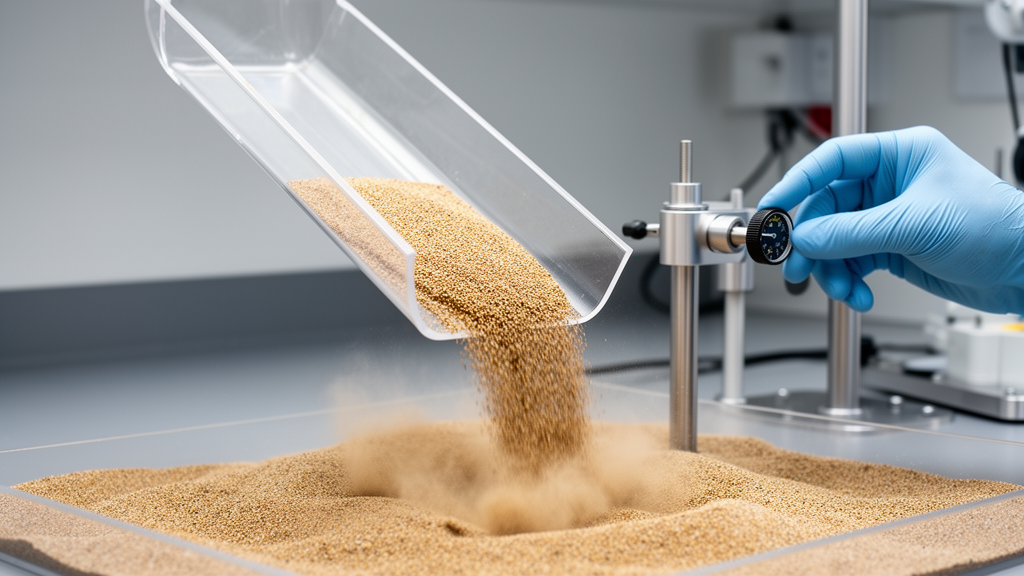
Dry granular flows, from rock avalanches to debris flows, can grow dramatically more mobile when they erode the sediment beneath them, yet the material properties that decide whether an erosive flow speeds up, slows down, or simply keeps going remain stubbornly unclear. A laboratory study now published in Natural Hazards and Earth System Sciences set out to test one specific suspect: a contrast in solid particle density between the moving mass and the erodible bed it plows into. The answer that emerged is more subtle than the density contrast itself. Low-density beds did produce deeper erosion and longer runout, but the equal- and high-density beds behaved almost identically despite a nearly twofold difference in solid particle density, pointing instead to friction, particle shape, and bed deformation as the dominant controls.
The team, led by Katharina Wetterauer of the University of the Bundeswehr Munich, built a purpose-designed flume at the university’s hydraulic laboratory. The channel was 5 meters long and 0.26 meters wide, with vertical sidewalls half a meter high. Upstream, a funnel-shaped reservoir held 130 kilograms of dry quartz grains, the slide material used in every experiment. A pneumatic flap released the quartz instantaneously down a 37-degree incline, chosen because it was steep enough to mobilize dry material by gravity alone and close to the internal friction angles of the quartz and magnetite beds, representing the steepest angle at which those beds stayed stable without spontaneous failure. The channel contained an upper rigid section of rough plywood to let the slide develop, a transitional lattice section overfilled with erodible material to prevent immediate scouring at the bed’s upstream edge, a roughly 1-meter-long erodible bed 10 centimeters thick, and a lower rigid section before the flow spilled onto a 10-degree inclined runout area 3.4 meters long and 2 meters wide.
Four slide-bed configurations were tested. In the low-density scenario, the quartz slide overrode a bed of expanded glass with a solid particle density of roughly 400 to 600 kilograms per cubic meter. In the equal-density scenario, slide and bed were both quartz at 2700 kilograms per cubic meter. In the high-density scenario, the slide ran over magnetite at 4800 kilograms per cubic meter. A non-erosive reference used a rigid, rough plywood plate. Each scenario was repeated with a finer 0.25 to 2 millimeter sand fraction and a coarser 0.25 to 8 millimeter sand-to-gravel fraction, giving 24 experiments in total, three repetitions for each of the four scenarios in each size class. Particle-size distributions were sieved to be comparable across scenarios, which kept porosity differences to a minimum, so the differences in dry bulk density mainly reflected the solid particle density of the bed material itself.
Seven ultrasonic sensors along the channel centerline tracked flow height and average flow-front velocity, sampling every 60 milliseconds with millimeter accuracy. A 3D surface scanner mapped the final deposits on the runout area, and lateral cross sections sliced through selected deposits revealed their internal structure. Before reaching the erodible bed, the flows were nearly indistinguishable across all scenarios, confirming that any differences farther downslope stemmed from flow-bed interactions rather than from the release itself. Fine-particle flow fronts reached the first sensor about 1.3 seconds after release, thickening to 5 centimeters, while coarse-particle fronts arrived at the same time with thinner 3.5-centimeter peaks.
The erosion records at the erodible bed split the scenarios into two sharply different groups. Over the glass beds, flow heights dropped in a stepwise pattern: an abrupt first decline about 2 seconds after release, then a second, deeper decline near the end of the event. In the fine-particle glass experiment, successive drops reached 2.5 and then 8.7 centimeters below the original bed surface, an apparent mean erosion rate of about 1.2 centimeters per second; the coarse-particle version dropped about 1.0 and 8.9 centimeters at roughly 1.5 centimeters per second. After flow passage, the entire 10-centimeter bed was eroded. The quartz and magnetite beds, by contrast, lowered gradually and stayed nearly identical to each other, with final erosion depths of about 2.9 to 3.7 centimeters and apparent mean erosion rates of 0.4 to 0.6 centimeters per second. The stepwise glass signal is consistent with episodic bed failure, while the gradual quartz and magnetite signals point to progressive, shear-driven erosion.
Velocity measurements reinforced the divide. Along the upper rigid bed, flow fronts accelerated to about 1.5 meters per second. Over the non-erosive reference, they kept accelerating to final velocities of about 2.4 meters per second for fine particles and 2.6 for coarse. Over the glass beds, acceleration continued, though at a reduced gradient, reaching about 2.2 meters per second. Over the quartz and magnetite beds, acceleration stopped entirely once the slide hit the erodible bed, with velocities holding nearly constant at 2.0 meters per second. The authors attribute the glass behavior to the low mass that must be accelerated for a given eroded bed volume, the rounded particle shape that reduces grain interlocking, and the low internal friction angle of 29 to 31 degrees, well below the 37-degree flume inclination. The quartz and magnetite beds, with friction angles of 35 to 39 degrees and angular particles that promote interlocking, resisted erosion and demanded more momentum transfer from the slide.
The deposits told the same story. Glass deposits spread into elongated lobes with runout length and area increasing disproportionately relative to volume; the main bodies of the quartz-glass deposits were about 1.6 times longer and covered nearly twice the area of the corresponding quartz-quartz deposits, and the coarse glass deposit stretched to 303 centimeters, more than twice the runout of its quartz counterpart. Quartz and magnetite deposits, meanwhile, were compact and proximal and nearly indistinguishable from each other in shape and contour pattern, despite magnetite’s substantially higher density. Travel angles were systematically lower for the glass beds, about 29 to 30 degrees in the coarse experiments compared with roughly 34 degrees for quartz and magnetite, a bulk sign of lower apparent resistance. Cross sections added a further layer: in the quartz-glass deposits, a sharp boundary separated the two materials, with glass particles forming the lateral edges and the deposit front while quartz concentrated in the interior core. In the quartz-magnetite deposits, magnetite appeared only as sparse basal clusters and lateral lenses, largely absent from the front, suggesting that denser material was eroded locally but never fully incorporated into the moving flow.
To check whether collisions between grains might be driving the differences, the team calculated Savage numbers, the ratio of grain-collision stresses to gravitational grain-contact stresses. Values above 0.1 indicate that collisions significantly affect flow dynamics. Nearly all experiments stayed well below that threshold, with fine-particle runs between 0.0015 and 0.0269 and erosive coarse-particle runs between 0.0068 and 0.0575. Only the non-erosive coarse-particle reference crossed into the collision-influenced regime, reaching about 0.25. In these dry experiments, Coulomb friction dominated the bulk flow response, and collisional dissipation played a minor role.
The study’s authors are careful about what the results do and do not show. The experiments were designed as systematically imposed density-contrast scenarios, not as an isolation of solid particle density, because accompanying properties such as particle shape and frictional resistance could not be controlled fully independently. The expanded glass, chosen partly because its buoyancy allowed efficient separation and reuse after each run, is an artificial material with nearly spherical particles, and its low friction and round shape enhanced mobility beyond any density-related effect. The authors also note that surface-based measurements alone cannot resolve what happens at the flow-bed interface: the ultrasonic records cannot distinguish bed-level change from changes in slide thickness, so the quartz and magnetite runs may have differed in basal slip, shear localization, or the incorporation of mobilized material while still producing similar surface signals. Depth-resolved imaging methods such as particle tracking velocimetry would be needed to directly relate erosion and entrainment to mass and momentum exchange.
The broader implication is that mobility emerges from the interaction of multiple material properties and flow processes rather than from any single variable. The experiments were motivated in part by a theoretical model that proposed a density-dependent mobility response for lower-density erodible beds, but the authors state that the observed macroscopic response does not provide direct experimental support for that proposal, while the underlying formulation cannot be conclusively evaluated from these measurements. The low-density glass response, considered in isolation, is qualitatively consistent with that model and with earlier experiments showing that lower bed bulk density through higher porosity increases mobility. But the high-density magnetite beds showed no corresponding reduction in mobility relative to quartz, breaking the expected pattern. The team also compared their deposit-scale mobility against a compilation of laboratory experiments and natural events, finding that their runs occupy the lower-mobility end of that spectrum, consistent with the dry, friction-dominated conditions, while still overlapping the mobility range of many large-scale experiments and natural events. The reproducible dataset, freely available under an open license, now offers benchmark data for testing whether numerical models can reproduce material-dependent erosion, mobility, and deposition, and a clear pointer toward the depth-resolved measurements needed to see what really happens where a moving mass meets the bed beneath it.
Subject of Research: Laboratory experiments on how solid particle density contrasts between dry granular flows and erodible bed materials affect erosion, flow evolution, and deposit mobility.
Article Title: Mobility of dry granular flows over contrasting erodible bed materials in laboratory experiments
Article References: Wetterauer, K., Müller, S., Krautblatter, M., Pudasaini, S. P., & Baselt, I. (2026). Mobility of dry granular flows over contrasting erodible bed materials in laboratory experiments. Natural Hazards and Earth System Sciences, 26(10), 5315-5338. https://doi.org/10.5194/nhess-26-5315-2026
Image Credits: AI Generated
DOI: 10.5194/nhess-26-5315-2026
Keywords: granular flows, erosion, entrainment, erodible bed, particle density, flume experiments, runout, internal friction, particle shape, debris flows, laboratory experiments, mobility
Cite Scienmag News
Violet Maxwell. (October 28, 2026). Granular flows ignore bed density when friction takes over, lab tests show. Scienmag. https://scienmag.com/granular-flows-ignore-bed-density-when-friction-takes-over-lab-tests-show/
Violet Maxwell. "Granular flows ignore bed density when friction takes over, lab tests show." Scienmag, 28 October 2026, https://scienmag.com/granular-flows-ignore-bed-density-when-friction-takes-over-lab-tests-show/. Accessed 28 October 2026.
Violet Maxwell. "Granular flows ignore bed density when friction takes over, lab tests show." Scienmag. October 28, 2026. https://scienmag.com/granular-flows-ignore-bed-density-when-friction-takes-over-lab-tests-show/