


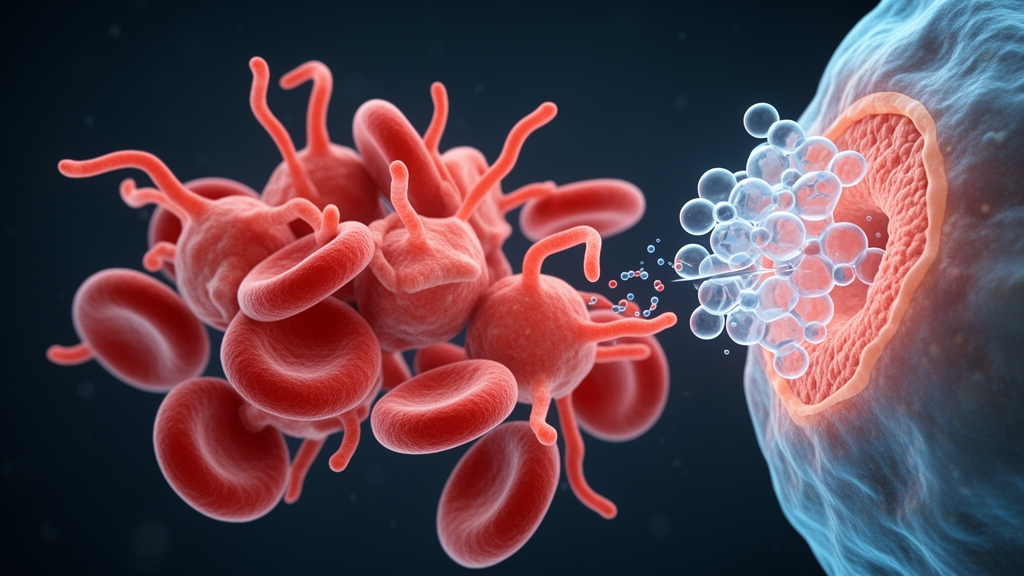
Platelets from adults with sickle cell disease showed increased activation and heightened caspase-1 activity in a Guadeloupe study, linking thromboinflammation with the release of molecules generated by red blood cell breakdown. Researchers measured P-selectin, a marker of platelet degranulation, and active caspase-1 in blood samples from 81 patients at steady state: 34 with hemoglobin SC disease and 47 with hemoglobin SS disease. Both groups had more activated platelets than 17 healthy donors, while platelet caspase-1 activity was associated with several markers of hemolysis in the SS group.
Sickle cell disease is caused by a mutation in the beta-globin gene that produces hemoglobin S, an abnormal hemoglobin that polymerizes when oxygen levels fall. The resulting rigid, fragile red blood cells undergo hemolysis and promote chronic inflammation and vaso-occlusive episodes. The SC and SS forms included in the study differ in clinical pattern. Although SC disease is generally less severe than SS disease, it can be accompanied by hypercoagulability, retinopathy and osteonecrosis. The participants were recruited from the University Hospital of Guadeloupe’s sickle cell unit, and all were adults who had avoided acute complications, including infection, vaso-occlusive crisis, acute chest syndrome, stroke and priapism, for at least one month before enrollment.
Blood counts and biochemical measurements documented the expected biological differences between the groups. Mean hemoglobin concentration was 13.5 grams per deciliter in healthy donors, compared with 11.1 in SC patients and 8.7 in SS patients. Median reticulocyte counts were 56 × 10^9 per liter in controls, 109 × 10^9 per liter in SC patients and 209 × 10^9 per liter in SS patients, indicating substantially greater red cell turnover in SS disease. SS patients also had higher concentrations of lactate dehydrogenase, total bilirubin and aspartate aminotransferase. Thirty-one of the 47 SS patients had received hydroxycarbamide for more than six months, but the study found no significant difference between treated and untreated patients in P-selectin expression, platelet–neutrophil aggregates or platelet caspase-1 activity.
Flow cytometry showed that the proportion of platelets expressing P-selectin averaged 13.38% in healthy donors, 23.80% in SC patients and 26.86% in SS patients. The increases were significant in both patient groups relative to controls, but P-selectin expression did not differ significantly between SC and SS patients. Platelet caspase-1 activity, detected with a fluorescent inhibitor of activated caspase-1, was also elevated in both disorders: the median was 4.24% in healthy donors, 10% in SC patients and 7.91% in SS patients. The difference between the two patient groups was not significant. In SS patients, caspase-1 activity correlated positively with P-selectin expression, with a correlation coefficient of 0.3702, and the same association was present in SC patients, with a coefficient of 0.4755.
The degree of hemolysis offered additional context for the SS results. Platelet caspase-1 activity correlated negatively with fetal hemoglobin, with a coefficient of −0.3872, and positively with total bilirubin, with a coefficient of 0.3238. Correlations with reticulocyte count and aspartate aminotransferase were positive but did not meet the study’s threshold for statistical significance. No comparable hemolysis associations were detected in the SC group, although the authors cautioned that lower hemolysis and less interindividual variation in that group may have reduced the study’s statistical power. These observations are compatible with the hypothesis that products released by damaged red cells contribute to inflammatory signaling in platelets, but the study did not directly demonstrate that free hemoglobin, heme or another circulating molecule caused the association.
Platelet–neutrophil aggregates were more frequent in SS patients than in healthy controls, reaching a median of 16.65% compared with 7.18%, a statistically significant difference. The median was 9.21% in SC patients, with no significant difference from either controls or SS patients. Because P-selectin on platelets can bind P-selectin glycoprotein-1 on leukocytes, the elevated aggregate counts in SS disease are consistent with a role for platelet activation in cell-to-cell interactions that contribute to vascular inflammation. However, aggregate levels were not significantly associated with a history of vaso-occlusive crisis or acute chest syndrome, nor with the number of either event during the three years before enrollment.
To examine whether circulating factors could transmit the effect, researchers incubated platelets from healthy donors for one hour with plasma from healthy donors or SS patients. SS plasma significantly increased platelet caspase-1 activity, raising the median from 5.17% to 15.81%, while its effect on P-selectin expression showed only a nonsignificant trend. The experiment demonstrates that material present in SS plasma can trigger an inflammatory pathway in platelets from healthy donors, consistent with the authors’ broader inflammasome hypothesis. It does not, by itself, establish which plasma constituent is responsible or prove that NLRP3 inflammasome assembly is the mechanism. Activated caspase-1 can arise downstream of inflammasome signaling, yet the study did not directly assay platelet NLRP3 or ASC assembly.
Bruton tyrosine kinase, or BTK, was investigated because it can regulate platelet activation and the NLRP3 inflammasome. Western blots showed numerically higher BTK phosphorylation in SS platelets than in controls, but the difference was not statistically significant; no significant differences were found among healthy, SC and SS groups. Phosphorylation also did not correlate significantly with either platelet caspase-1 activity or P-selectin expression. Only 12 controls, 12 SC patients and 13 SS patients were included in this analysis, limiting its ability to detect a moderate difference, and the authors noted that the sensitivity of the method might also have been insufficient. Thus, the study did not establish increased platelet BTK activation in the patient groups.
In a separate in vitro experiment, healthy platelets were exposed to 30 micromolar hemin, an oxidized form of heme chosen to approximate circulating concentrations in sickle cell disease. Hemin significantly increased P-selectin expression, from a mean of 28.78% to 67.21%, but did not significantly increase caspase-1 activity. Pretreatment with 5 micromolar ibrutinib, a BTK inhibitor, suppressed the hemin-induced P-selectin response to 10.84% on average. Ibrutinib did not significantly reduce caspase-1 activity, which remained similar to the level in hemin-treated platelets without the inhibitor. These results separate two responses under the tested conditions: hemin promoted BTK-dependent platelet degranulation, whereas it was not the principal stimulus for platelet caspase-1 activation detected here. The experiment used isolated platelets and a single concentration, so it cannot establish the behavior of the pathway during human crises or in every disease genotype.
Taken together, the results identify a blood-cell inflammatory circuit in which sickle cell disease is associated with platelet activation, elevated caspase-1 activity and, particularly in SS disease, more platelet–neutrophil aggregates. The study was observational for its patient comparisons and used in vitro experiments to probe potential mechanisms, so it does not show that caspase-1 activity causes clinical events or that inhibiting the pathway would prevent vaso-occlusion. Its principal limitations include the modest sample size, restriction to adults in steady state, incomplete BTK sampling and the absence of direct platelet NLRP3 measurements. Nevertheless, the findings support further investigation of inflammasome-related platelet signaling as a component of sickle cell thromboinflammation, while showing that different hemolytic signals and drug responses cannot be treated as interchangeable.
Subject of Research: Platelet caspase-1 activation and inflammasome-related signaling in sickle cell disease
Article Title: Activation of Platelet Caspase‐1 and P‐Selectin Over‐Expression in Sickle Cell Disease Patients: An Involvement of NLRP3 Inflammasome?
Article References: Claude, L., Martino, F., Mordier, L., Célanie, D., Bernit, E., Etienne‐Julan, M., Tressières, B., Romana, M., & Baccini, V. (2026). Activation of Platelet Caspase‐1 and P‐Selectin Over‐Expression in Sickle Cell Disease Patients: An Involvement of NLRP3 Inflammasome?. Journal of Cellular and Molecular Medicine, 30(20), Article e71390. https://doi.org/10.1111/jcmm.71390
Image Credits: AI Generated
DOI: 10.1111/jcmm.71390
Keywords: sickle cell disease, platelet activation, caspase-1, NLRP3 inflammasome, P-selectin, hemolysis, platelet-neutrophil aggregates, Bruton tyrosine kinase, hemin, Guadeloupe, Activation, Platelet
Cite Scienmag News
Drew Townsend. (October 20, 2026). Sickle Cell Patients Show Activated Platelets and Caspase-1 Activity. Scienmag. https://scienmag.com/sickle-cell-patients-show-activated-platelets-and-caspase-1-activity/
Drew Townsend. "Sickle Cell Patients Show Activated Platelets and Caspase-1 Activity." Scienmag, 20 October 2026, https://scienmag.com/sickle-cell-patients-show-activated-platelets-and-caspase-1-activity/. Accessed 20 October 2026.
Drew Townsend. "Sickle Cell Patients Show Activated Platelets and Caspase-1 Activity." Scienmag. October 20, 2026. https://scienmag.com/sickle-cell-patients-show-activated-platelets-and-caspase-1-activity/


