


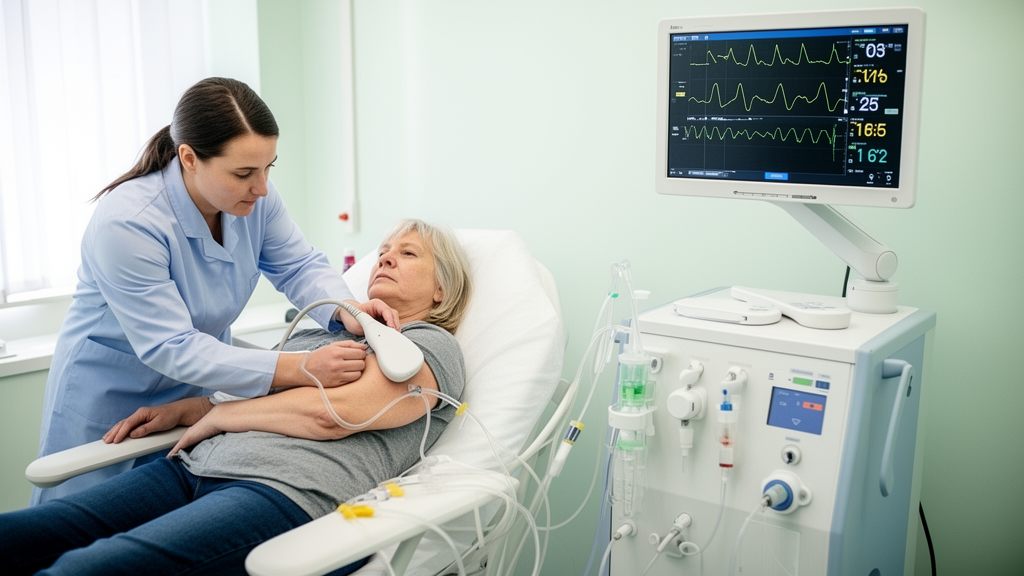
A prospective observational protocol from Brussels will examine whether multi-organ point-of-care ultrasound can characterise haemodynamic and fluid-related changes in adults receiving maintenance haemodialysis. Researchers plan to enrol approximately 60 patients at the HUB Hôpital Erasme outpatient dialysis unit and follow them for 12 months. Scheduled ultrasound examinations immediately before and after dialysis will assess cardiac function, pulmonary congestion and systemic venous congestion at baseline and at 3, 6 and 9 months. The study is designed to describe ultrasound profiles and estimate within-patient associations with intradialytic hypotension; it will not test whether ultrasound-guided treatment improves clinical outcomes.
Fluid management during haemodialysis is delicate because excessive fluid removal can precipitate intradialytic hypotension, while persistent fluid accumulation can contribute to hypertension, heart failure and pulmonary oedema. The protocol notes that reported intradialytic hypotension prevalence ranges from 8% to 40% across studies and definitions. Clinicians commonly combine clinical examination, blood-pressure trends, weight changes and chest radiography when assessing volume status, but these approaches have important limitations for estimating ultrafiltration tolerance. The proposed study will therefore use a standardised bedside assessment combining focused cardiac ultrasound, eight-zone lung ultrasonography and a modified venous excess ultrasound approach.
The cardiac component will use focused transthoracic echocardiography to measure left ventricular systolic function, estimated cardiac output, diastolic measures, left atrial volume and right-heart function. Pulmonary artery systolic pressure, pulmonary-vein Doppler and Simpson biplane ejection fraction will be assessed when image quality and clinical conditions permit. Doppler measurements in participants with arrhythmia will be averaged over ten consecutive beats. The lung protocol will count B-lines in eight zones across the two hemithoraces, producing a total of 0 to 80 when every zone is assessable. These vertical reverberation artefacts are used as an indirect marker of extravascular lung water. The venous assessment will combine inferior vena cava diameter and respiratory variation with hepatic-vein and portal-vein Doppler waveforms. Intrarenal venous Doppler, included in the original VEXUS framework, will be omitted because the protocol reports limited feasibility and interpretability in kidney failure, particularly with small or atrophic kidneys and altered renal perfusion.
The resulting inferior vena cava, hepatic-vein and portal-vein combination will be described as a modified VEXUS phenotype rather than as equivalent to the original composite score. Grade 0 may be assigned when the inferior vena cava is narrower than 2.0 cm. At a diameter of 2.0 cm or more, interpretable Doppler waveforms from both veins are required: grade 1 denotes no severe Doppler abnormality, grade 2 one severe abnormality, and grade 3 severe abnormalities in both veins. Inferior vena cava collapsibility will be recorded separately but will not contribute to the modified grade. Unavailable or technically inadequate Doppler recordings will be classified as non-assessable rather than normal, and the composite will not be prorated from incomplete components. The protocol states that the diagnostic and prognostic validity of this modified measure in maintenance haemodialysis has not been established.
Each participant will be assigned at enrolment to have scheduled scans during either the first dialysis session after the long interdialytic interval or a mid- or late-week session, with the allocation kept consistent at all follow-up visits. This is intended to capture both peak fluid accumulation and more steady-state conditions. Blood pressure will be measured immediately before dialysis, every 30 minutes during treatment and at the end, with additional measurements obtained when symptoms occur or staff suspect haemodynamic instability. The primary intradialytic hypotension definition requires a documented systolic-pressure decrease of at least 20 mmHg from the pre-dialysis reference value together with at least one compatible symptom or acute nursing intervention undertaken in response. A separate definition based on a session nadir below 90 mmHg, or below 100 mmHg when the pre-dialysis pressure was at least 160 mmHg, will also be applied and reported independently.
The main association analysis will use an embedded case-crossover design based on scheduled pre-dialysis examinations. It will compare sessions in which hypotension occurred with other sessions from the same patient in which it did not, so each participant serves as their own control. This controls by design for time-invariant characteristics such as age, sex, comorbidities, dialysis vintage and vascular access type, while preserving temporal ordering because each measurement precedes dialysis. Conditional logistic regression stratified by patient will analyse within-patient differences. Time-varying factors such as interdialytic weight gain, pre-dialysis blood pressure, prescribed ultrafiltration volume, dialysate composition and prescribed session duration may be included if the number of outcome-informative patients and within-patient measurement variation support stable estimation. The analysis is explicitly exploratory and non-confirmatory, and the protocol makes no formal power claim for a specified conditional effect size.
Additional intradialytic scans may be performed when clinically feasible and safe for current hypotension, suspected clinically significant fluid overload or a suspected mismatch between prescribed target weight and the best clinically tolerated weight. These event-triggered examinations will not be pooled with scheduled sessions and will not contribute cases to the primary case-crossover analysis. A separate exploratory model will include only scans completed while participants were clinically stable, before the first hypotension event in that session and not in response to evolving instability. Scans obtained during or after hypotension will be used solely to describe the peri-event haemodynamic phenotype. The researchers will account for the planned treatment time remaining at each scan because the likelihood of hypotension varies with time into dialysis, and will report the number of eligible scans, subsequent events, contributing patients and repeated observations per patient.
After each scheduled session and its outcome data have been recorded, study ultrasound findings will normally be disclosed to the treating physician. Before disclosure, the physician will record intended management for the session; afterward, the physician will report whether the findings appeared clinically relevant, increased confidence or prompted a change. A documented change must be entered in the routine dialysis prescription program, providing evidence of an implemented change rather than a hypothetical intention, and applies only after the completed index session. Findings meeting prespecified emergency criteria may be communicated immediately. The protocol will not impose a therapeutic algorithm or require the research team to recommend changes. The questionnaire component can therefore document prescribing behaviour but cannot establish whether disclosure produces safer, more appropriate or more effective treatment.
The study is sized primarily for feasibility. Four scheduled assessments could yield as many as 240 profiled sessions, with approximately 216 expected after allowing for missed visits, incomplete examinations or withdrawal. Using a 10% planning assumption for intradialytic hypotension, the investigators estimate about 24 events with complete follow-up and about 22 after a 10% allowance for missing or incomplete visits. Repeated sessions from the same patient are not statistically independent, however, and the number of patients contributing both hypotensive and non-hypotensive sessions is likely to be smaller than the raw event count suggests. The protocol consequently anticipates imprecise estimates and says that null findings will be interpreted as inconclusive rather than as evidence that no association exists. Longitudinal analyses of hospitalisation, cardiovascular events and mortality will also remain exploratory; approximately nine to 12 deaths are expected over 12 months.
Reliability and missing data will be addressed through prespecified procedures. A second experienced physician, either a cardiologist or critical-care physician with relevant echocardiography certification, will independently reassess a random 20% sample from each ultrasound domain while blinded to the original measurements and clinical outcomes. Agreement will be evaluated using intraclass correlation coefficients, Bland–Altman analysis for continuous measurements and weighted Cohen’s kappa for ordinal classifications. Unavailable measurements will be separated into four categories: not applicable, not interpretable, not obtained and obtained but quality-limited. Only measurements classified as “not obtained” will be eligible for imputation, while structurally inapplicable or uninterpretable values will remain un-imputed. Sensitivity analyses will compare complete-domain, domain-specific, multiple-imputation and complete-case results. The single-centre design, modest sample, low expected event count, dependence on one trained acquisition operator and absence of an inter-operator acquisition assessment limit generalisability and interpretation, but the protocol is intended to generate feasibility and variability estimates for evaluation in a larger multicentre cohort or future interventional trial.
Subject of Research: Prospective observational evaluation of multi-organ point-of-care ultrasound for haemodynamic profiling during maintenance haemodialysis
Article Title: Ultrasound-guided haemodynamic profiling in haemodialysis patients: a single-centre prospective observational study protocol
Article References: Larsen, S., Taccone, F. S., Le Moine, A., Annoni, F., & Baudoux, T. (2026). Ultrasound-guided haemodynamic profiling in haemodialysis patients: a single-centre prospective observational study protocol. Frontiers in Nephrology, 6, Article 1939088. https://doi.org/10.3389/fneph.2026.1939088
Image Credits: AI Generated
DOI: 10.3389/fneph.2026.1939088
Keywords: haemodialysis, intradialytic hypotension, point-of-care ultrasound, lung ultrasound, echocardiography, venous congestion, fluid management, VEXUS, observational cohort, clinical protocol, Ultrasound-guided, haemodynamic
Cite Scienmag News
Jerry Hayes. (October 20, 2026). Ultrasound-guided haemodynamic profiling in haemodialysis patients: a single-centre prospective observational study protocol. Scienmag. https://scienmag.com/ultrasound-guided-haemodynamic-profiling-in-haemodialysis-patients-a-single-centre-prospective-observational-study-protocol/
Jerry Hayes. "Ultrasound-guided haemodynamic profiling in haemodialysis patients: a single-centre prospective observational study protocol." Scienmag, 20 October 2026, https://scienmag.com/ultrasound-guided-haemodynamic-profiling-in-haemodialysis-patients-a-single-centre-prospective-observational-study-protocol/. Accessed 20 October 2026.
Jerry Hayes. "Ultrasound-guided haemodynamic profiling in haemodialysis patients: a single-centre prospective observational study protocol." Scienmag. October 20, 2026. https://scienmag.com/ultrasound-guided-haemodynamic-profiling-in-haemodialysis-patients-a-single-centre-prospective-observational-study-protocol/


