


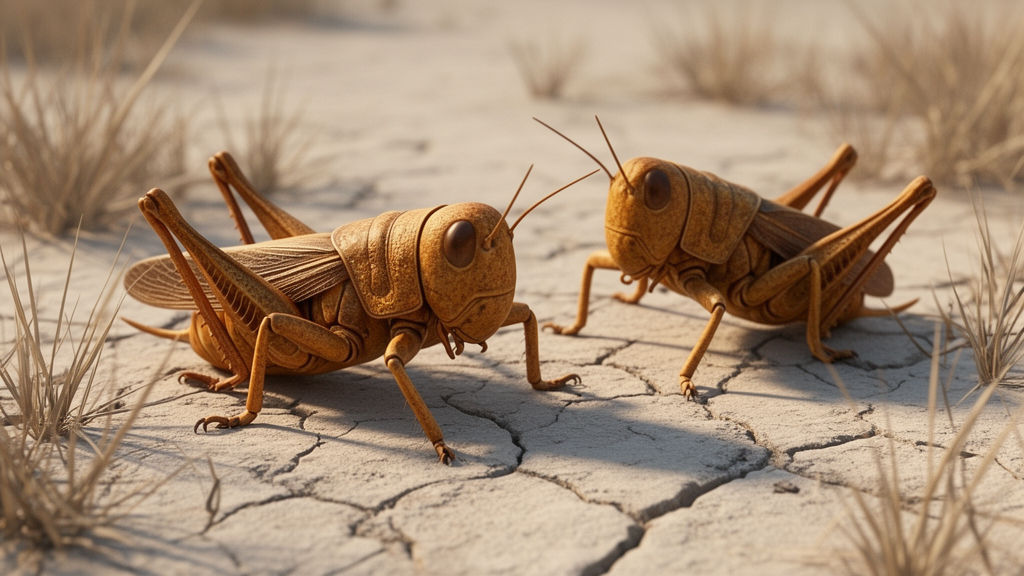
Male and female badlands crickets are measurably different in body proportions, but a detailed study found no significant difference in their overall body size. Researchers measured the heads, mouthparts, pronota and hind legs of adult Gryllus personatus, revealing that males have wider heads and broader maxillae, while females have longer pronotums and hind femora. Multivariate analyses detected strong sexual shape dimorphism, or SShD, but no detectable sexual size dimorphism, or SSD. In practical terms, the crickets appear to be built in two different proportions rather than scaled-up or scaled-down versions of the same basic body plan.
The distinction matters because size and shape can be conflated when researchers compare only one anatomical measurement. Sexual size dimorphism refers to differences in overall body magnitude, whereas sexual shape dimorphism describes differences in the proportions of body structures. A difference in total length or head width may therefore reflect a sex-specific body plan rather than a general tendency for one sex to be larger across every dimension. The study combined four measurements—head width, maxillae span, pronotum length and mean hind femur length—using statistical methods designed to distinguish overall size from shape.
For the main experiment, the authors examined 167 adult crickets initially: 71 males and 96 females. One male was excluded because he had deformed forewings, while 26 females were removed with a random number generator to create equal analytical groups of 70 males and 70 females. The animals came from a laboratory colony founded with crickets collected near Winslow, Arizona, and were reared at 25 °C, 70% relative humidity and a 12-hour light:12-hour dark daily cycle. The colony was euthanized at -20 °C for 24 hours when the study ended, and the preserved individuals were measured under a stereomicroscope. Standardized images were used to place landmarks and convert views into linear measurements; the left and right femur lengths were averaged to produce a single hind-leg measure.
Every one of the four measured traits differed significantly between males and females, but the direction of the differences changed from one structure to another. Adult males had wider heads, averaging 5.18 millimetres compared with 4.99 millimetres in females, and broader maxillae spans, 4.87 millimetres versus 4.38 millimetres. Females went in the opposite direction for the other two structures: their pronota averaged 3.45 millimetres, compared with 3.29 millimetres in males, and their mean hind femora were 10.22 millimetres long, compared with 9.90 millimetres in males. The four measurements had means plus or minus standard deviations and observed ranges in the study, with 70 individuals in each sex. Because some dimensions favored males while others favored females, the raw differences could not be summarized as males being larger or females being larger.
The researchers then combined the measurements in two complementary ways. First, they calculated the geometric mean of the four traits as a multivariate index of overall size. Males averaged 5.35 on that index and females 5.27, but the difference was not statistically significant in a t-test. Second, they used principal components analysis to create uncorrelated axes, with the first component interpreted as a multivariate size measure and the second as a shape variable. The sexes did not differ on the first principal component, which accounted for 78.311% of the variance, but they differed strongly on the second, which accounted for 17.471%. The second-component difference was highly significant, with a t statistic of 16.961 and p less than 0.001; the first-component difference was not significant, with a t statistic of 0.888 and p of 0.376. Together, these analyses indicated sexual shape dimorphism without detectable sexual size dimorphism. The authors cautioned that the conclusion is conditional on the traits measured and does not prove that males and females are identical in size.
A discriminant function analysis provided an additional test by asking whether a weighted combination of the measurements could identify an individual’s sex. The resulting function classified 64 of 70 males and 66 of 70 females correctly, or 91.4% and 94.3% respectively, and the overall discriminant function was significant, with a chi-square value of 167.489 and p less than 0.001. Head width and maxillae span loaded positively on the function, whereas pronotum length and mean femur length loaded negatively, closely matching the pattern identified by principal components analysis. The strongest statistical separation between the sexes therefore consisted of a contrast between relatively broad heads and mouthparts in males and relatively long thoraces and hind legs in females, rather than a simple difference in overall magnitude.
The study also produced a simple shape index: the ratio of head width to pronotum length. This ratio differed significantly between the sexes, with a t statistic of 11.520 and p less than 0.001, and was strongly correlated with both the second principal component and the discriminant function. Because ratios are independent of image magnification, they can be calculated from photographs without absolute calibration. The researchers applied that approach to citizen-science records on iNaturalist, selecting research-grade observations with a photograph taken from above and perpendicular to the frontal plane. Their usable wild sample contained nine females and one male, too small for a statistical comparison with the laboratory group, but the single male had a higher head-width-to-pronotum ratio than the wild females, as did laboratory males relative to laboratory females.
The wild ratios were also less than 5% different from the averages for laboratory-reared crickets. Although the tiny sample precluded strong statistical inference, the result was consistent with the proportional pattern persisting in wild animals rather than being solely a laboratory effect. The iNaturalist comparison also illustrates a possible route for studying morphology at broad scale: citizen scientists can supply images for traits visible from standard viewpoints. The authors noted that automated image-recognition systems also depend on scale-independent characteristics such as ratios among dimensions, making image-based morphometric measurements compatible with large digital collections. The data set, photographs and measurements from the laboratory study were made available through Dryad, allowing the analyses to be checked and extended.
Why might males and females emphasize different body regions? One plausible explanation involves male competition. Male field crickets can grapple with rivals using their heads and mouthparts, and relatively larger male heads have been linked to success in aggressive contests in the fall field cricket. If male badlands crickets use similar tactics, sexual selection could favor broader heads and maxillae. A complementary possibility concerns movement. Females search for sedentary singing males while attempting to avoid predators, and longer legs could support greater stride length, while a larger thorax could accommodate more leg muscle. These are proposed explanations rather than demonstrated mechanisms. The researchers called for future work to examine sex-specific mobility, diet, burrow digging and aggression, as well as the adaptive significance of variation in head and mouthpart size versus thorax and leg size.
The results also challenge a widespread assumption about sexual size dimorphism in Orthoptera, the order that includes crickets, katydids, grasshoppers and their allies. A review of more than 1,500 species reported almost universal female-biased size dimorphism, but much of that evidence came from total body length alone. Total length can vary with nutritional status, egg development and preservation, and a difference in one structure can be mistaken for a difference in overall size. The badlands cricket result shows why researchers need to measure multiple body regions and explicitly test shape as well as size. The authors recommend using the geometric mean of head width, pronotum length and hind femur length as a practical index for orthopteran studies. They argue that this measure is multivariate, represents multiple body regions and axes, is convenient for live or preserved specimens, applies broadly across Orthoptera, is comparable between samples, and avoids the abdomen’s sensitivity to condition and preservation artifacts. Wider adoption could help determine whether apparent size differences across species are genuine or partly products of differing body shape.
Subject of Research: Sexual shape dimorphism and body-size measurements in adult badlands crickets
Article Title: Sexual dimorphism in the badlands cricket ( Orthoptera , Gryllinae , Gryllus personatus )
Article References: Madera, E. M., & Judge, K. A. (2023). Sexual dimorphism in the badlands cricket (Orthoptera, Gryllinae, Gryllus personatus). Journal of Orthoptera Research, 32(2), 119-126. https://doi.org/10.3897/jor.32.93513
Image Credits: AI Generated
DOI: 10.3897/jor.32.93513
Keywords: badlands cricket, Gryllus personatus, sexual dimorphism, body shape, body size, morphometrics, orthopterans, sexual selection, iNaturalist, citizen science, Sexual, dimorphism
Cite Scienmag News
Gavin Prescott. (October 20, 2026). Badlands crickets are shaped differently, not simply bigger. Scienmag. https://scienmag.com/badlands-crickets-are-shaped-differently-not-simply-bigger/
Gavin Prescott. "Badlands crickets are shaped differently, not simply bigger." Scienmag, 20 October 2026, https://scienmag.com/badlands-crickets-are-shaped-differently-not-simply-bigger/. Accessed 20 October 2026.
Gavin Prescott. "Badlands crickets are shaped differently, not simply bigger." Scienmag. October 20, 2026. https://scienmag.com/badlands-crickets-are-shaped-differently-not-simply-bigger/


