


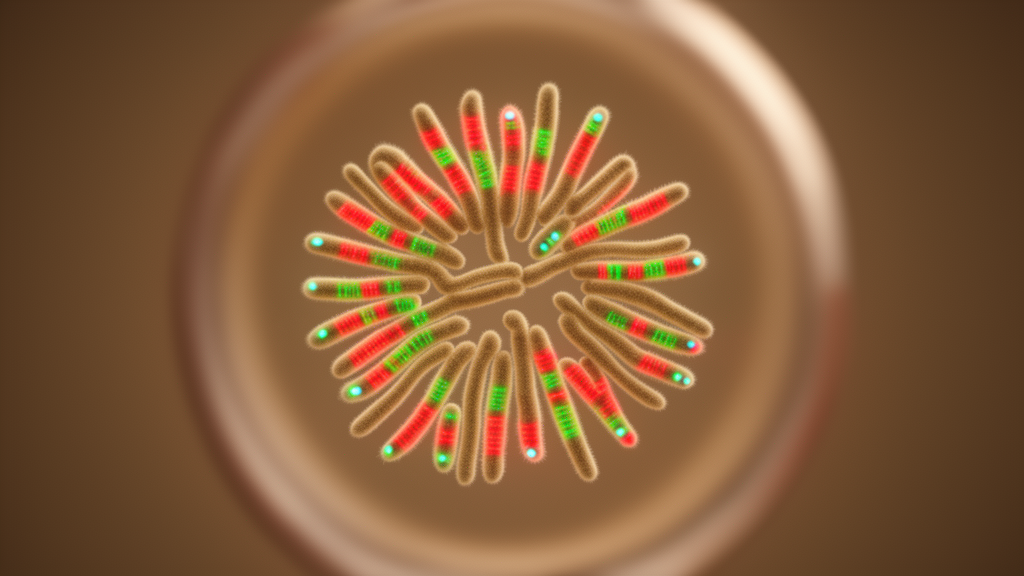
Researchers have constructed a chromosome-level map of the perennial grass Kengyilia hirsuta, revealing strong conservation of gene order in its St genome, several structural rearrangements in the Y and P genomes, and 47 chromosome variants among 29 plants from seven populations in Qinghai, China. The study used fluorescence in situ hybridization (FISH), genomic in situ hybridization and repetitive-sequence probes to identify the chromosomes, establish their correspondence with the seven homoeologous groups of common wheat and characterize variation within natural populations. The reference karyotype was based on plants from the Haiyan population, while the broader survey covered seven locations. These findings provide a physical framework for locating genes in a cold- and drought-tolerant perennial relative of wheat, although the study did not isolate or validate any trait gene.
Kengyilia hirsuta is a member of the grass tribe Triticeae and a close wild relative of wheat. The source material describes approximately 32 documented species and subspecies in the genus, which occurs in meadows, steppes, forest fringes and dry or semi-desert habitats across central Asia and the Qinghai–Tibetan Plateau. K. hirsuta is distributed in Qinghai and Gansu and grows in sandy areas at high elevations. It is characterized by tall stalks, high seed-setting rates and mild seed shattering, making it a potential candidate for perennial grain development. Its chromosome complement consists of St, Y and P genomes, conventionally denoted StPY; the St genome is associated with Pseudoroegneria, the P genome with Agropyron, and the origin of the Y genome remains unknown. The species’ large, repetitive and complex genome makes targeted gene discovery difficult, even with modern sequencing methods.
For the reference analysis, the investigators selected 14 full-length complementary DNA probes that had previously been mapped to the short and long arms of the seven homoeologous chromosome groups in common wheat. Most probes produced the expected six FISH signals in K. hirsuta, corresponding to a site on each member of its three paired chromosome sets. Probe 6L-1 produced eight signals, while 7S-1 produced 10, indicating that some gene-associated sequences were present on more than one chromosome. The researchers then used sequential hybridizations with probes for 45S ribosomal DNA, 5S ribosomal DNA, pAs1 and the (AAG)10 tandem repeat to identify additional landmarks. A final round of genomic in situ hybridization with DNA from Pseudoroegneria stipifolia and Agropyron cristatum assigned the identified chromosomes to the St, Y and P genomes. The sequential procedure produced a molecular karyotype and idiogram in which each chromosome was associated with both gene-probe and repeat-probe positions.
Chromosome measurements showed that the three genomes differed markedly in size. St chromosomes ranged from 6.60 to 8.76 micrometres in length and averaged 7.68 micrometres, while Y chromosomes ranged from 5.54 to 7.56 micrometres and averaged 6.55 micrometres. P chromosomes were substantially larger, measuring 11.70 to 14.21 micrometres with an average of 12.96 micrometres. Long-arm to short-arm ratios ranged from 1.07 to 2.13 in the St genome, 1.09 to 2.08 in the Y genome and 1.12 to 1.90 in the P genome. Repeated sequences also supplied recognizable landmarks: 1St and 5St carried 5S and 45S ribosomal DNA sites on their short arms, respectively; 1P had a major 45S site in the telomeric region of its short arm; 5P carried separated 5S and 45S sites; and 7P displayed dispersed pAs1 signals on both arms. These markers allow chromosomes to be recognized even where repeat patterns differ among individuals.
Comparison with common wheat showed that the St genome was the most strongly conserved. All 14 single-gene probes hybridized at their expected positions in the corresponding St chromosomes, indicating a high degree of chromosomal synteny. The Y genome retained much of the same organization but contained localized departures. The 7S-1 probe produced an additional interstitial signal on 3Y, and both 7S-1 and 7L-4 mapped to the long arm of 7Y, a pattern consistent with a pericentric inversion. The researchers also noted a 5S ribosomal DNA site on 2Y even though 1Y lacked one, suggesting that a rearrangement may have transferred the site between these chromosomes. These interpretations are based on probe positions and were presented as structural assignments rather than as complete sequence-level descriptions of the affected regions.
The P genome displayed the greatest distortion of wheat-like collinearity. The 2S-1 and 4S-6 probes hybridized on 4P, whereas 2L-1 and 4L-4 signals appeared on 2P, leading the team to interpret chromosomes 2P and 4P as reciprocal translocation chromosomes. They tentatively designated these as 4PL/2PL and 2PS/4PS, pending further structural evidence. Additional hybridization of 6L-1 was detected in the subtelomeric long-arm region of 1P, and an additional 7S-1 site occurred in the telomeric short-arm region of 2P. Comparisons with A. cristatum indicated that the 2P–4P reciprocal translocation may be an ancient feature shared by the two species, while other structural differences distinguished their 1P chromosomes. K. hirsuta also lacked the paracentric inversion on the long arm of 6P previously reported in A. cristatum.
The population survey used the repeat probes as chromosomal landmarks to karyotype 29 individuals from seven locations: Guinan, Haiyan, Gangcha and Qilian in Qinghai. It identified 47 variants in total, comprising 19 in the St genome, 16 in the Y genome and 12 in the P genome. Most variants were changes in the presence, absence, duplication or deletion of pAs1, (AAG)10 or ribosomal DNA hybridization sites rather than differences affecting entire chromosome sets. Chromosomes 1St, 5Y, 6Y, 4P, 6P and 7P had identical variants across the populations and were the most stable, whereas 7St was the most variable, with more than three forms. A tentative pericentric inversion was identified in 5P in different populations. The sampled populations did not contain equal numbers of individuals, so the survey describes the chromosomes represented by this collection rather than providing a complete estimate of diversity throughout the species’ range.
Less common rearrangements occurred in individual plants. A chromosome carrying a P-genome segment within a Y chromosome was identified in the GCN population, consistent with an inter-genomic translocation. In the HCZ population, a reciprocal translocation involving 4Y and 3P was detected. The Qilian sample showed the greatest chromosome heterozygosis: all five sampled individuals had mixed chromosome states, equivalent to 80 percent heterozygosis in that population. Across the complete sample, 10 of 29 plants, or 34.48 percent, had heterozygous karyotypes. The researchers suggested that this pattern may indicate outcrossing, but they did not directly measure reproductive behavior. The proposed origin of Kengyilia through natural hybridization between an StY species and the P-genome species A. cristatum provides a possible context for such variation, while the role of facultative allogamy remains unresolved.
The chromosome map could assist targeted gene discovery in group 3, whose relevance to domestication was illustrated by the conserved locations of the seed-shattering genes Btr-1 and Btr-2 on the short arms of group 3 chromosomes in barley and wheat. The study found conserved synteny in 3St and 3P and possible structural change in 3Y. It also established that group 3 chromosomes could be recognized with specific markers, providing a basis for their possible isolation by flow sorting or microdissection. More generally, knowledge of collinearity and rearrangement helps determine whether a chromosome segment can be compared directly with the annotated wheat genome or whether structural differences must first be accounted for. The study did not transfer genes or produce a perennial crop, so its contribution is a cytogenetic reference rather than proof of improved breeding performance.
The ribosomal DNA findings also supplied useful but unresolved targets for further research. In K. hirsuta, 45S rDNA sites were mapped to the short arms of 5St, 1P and 5P, and the positions in 1P and 5P were consistent with those in the P genome of A. cristatum. The placement of 45S, 5S or both on the short arms of group 5 chromosomes across the three genomes was also consistent with the strong conservation of that group in common wheat. Population differences in whether 45S or 5S signals were present could reflect copy-number or positional variation, and 2P sometimes carried an additional 5S site. The authors noted that rDNA copy number and location may be sensitive to genomic stress and may contribute to adaptive responses, but they did not establish that the observed variants were caused by stress or associated with population differentiation. The resulting karyotype offers a detailed physical framework for testing those questions and for investigating the genetic basis of useful traits in K. hirsuta.
Subject of Research: Chromosomal organization and karyotype variation in the perennial wheat relative Kengyilia hirsuta
Article Title: The Kengyilia hirsuta karyotype polymorphisms as revealed by FISH with tandem repeats and single-gene probes
Article References: Tao, X., Liu, B., & Dou, Q. (2021). The Kengyilia hirsuta karyotype polymorphisms as revealed by FISH with tandem repeats and single-gene probes. Comparative Cytogenetics, 15(4), 375-392. https://doi.org/10.3897/compcytogen.v15.i4.71525
Image Credits: AI Generated
DOI: 10.3897/compcytogen.v15.i4.71525
Keywords: Kengyilia hirsuta, fluorescence in situ hybridization, chromosome mapping, karyotype polymorphism, Triticeae, wheat relatives, genome organization, chromosomal translocations, perennial grasses, Qinghai populations, Kengyilia, hirsuta
Cite Scienmag News
Juliet Wilcox. (October 20, 2026). The Kengyilia hirsuta karyotype polymorphisms as revealed by FISH with tandem repeats and single-gene probes. Scienmag. https://scienmag.com/the-kengyilia-hirsuta-karyotype-polymorphisms-as-revealed-by-fish-with-tandem-repeats-and-single-gene-probes/
Juliet Wilcox. "The Kengyilia hirsuta karyotype polymorphisms as revealed by FISH with tandem repeats and single-gene probes." Scienmag, 20 October 2026, https://scienmag.com/the-kengyilia-hirsuta-karyotype-polymorphisms-as-revealed-by-fish-with-tandem-repeats-and-single-gene-probes/. Accessed 20 October 2026.
Juliet Wilcox. "The Kengyilia hirsuta karyotype polymorphisms as revealed by FISH with tandem repeats and single-gene probes." Scienmag. October 20, 2026. https://scienmag.com/the-kengyilia-hirsuta-karyotype-polymorphisms-as-revealed-by-fish-with-tandem-repeats-and-single-gene-probes/


