


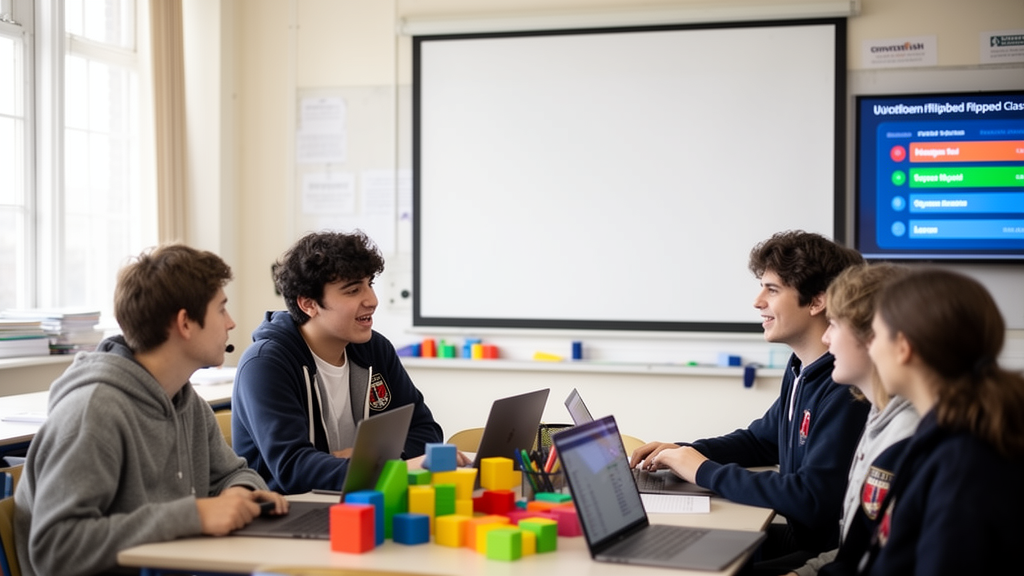
A semester-long online English course combining pre-class study materials with daily digital games was perceived by undergraduate students as motivating, confidence-building and socially engaging, according to an exploratory qualitative case study. Interviews with 10 volunteers found that motivation and the engaging nature of the games were the most pervasive themes, while learners also valued collaborative play, challenging questions and opportunities to practise language skills. These results represent students’ retrospective perceptions rather than measured changes in motivation or English proficiency, and they come from one Foundation English course at a private university in Chennai, India, during the COVID-19 pandemic.
The intervention combined a flipped sequence with gamified in-class activities. For the flipped component, the teacher uploaded PowerPoint slides, videos and audio recordings to the class WhatsApp group before each session, covering the concepts addressed in class. During the subsequent online lesson, students played digital games on those concepts using Kahoot and LearningApps. Activity formats included quizzes, cloze tests, matching and pairing games, sentence ordering, millionaire-style questions, image matching, audio or video prompts, number-line exercises and group assignments. The content addressed grammar, vocabulary, discourse conventions, picture description, résumés and cover letters, parts of speech, tense, modal verbs, conditionals, dangling modifiers, parallelism, instructions and technical proposals. The course ran from July to December 2020, with 90-minute laboratory sessions on weekdays except Wednesday.
All 28 students enrolled in the Foundation English course experienced the intervention, but only 10 volunteered for end-of-semester interviews and provided the data analysed in the study. The interviewees included three women and seven men and had a mean age of 18. Placement in the course was determined by an institutional English proficiency test, producing a cohort described as relatively homogeneous in language proficiency. Researchers selected a qualitative case-study design because the question concerned students’ own accounts of emotion, motivation, confidence and preference rather than responses on predefined psychological scales. Each semi-structured, one-to-one interview lasted about 20 minutes, was audio-recorded with consent and was transcribed verbatim by the first author. Each transcript was checked against its recording before analysis.
The transcripts were analysed in NVivo 14 using a codebook-based thematic approach. The first author conducted the initial coding, consolidated related codes into 10 thematic nodes under the parent construct of the affective domain and refined the structure against the full corpus. Two co-authors who had not taught the cohort independently reviewed all 10 coded transcripts against the node definitions; discrepancies were resolved through discussion, and no formal intercoder agreement statistic was calculated. No new thematic nodes appeared after the eighth transcript, while the final two interviews confirmed and enriched existing themes. Word-frequency queries, co-occurrence analysis, coding summaries and sentiment coding were used as descriptive tools. The researchers explicitly treated these outputs as aids to interpretation rather than statistical evidence of theme importance.
Motivation appeared in all 10 transcripts and accounted for 17.9% of coded transcript text, while the engaging nature of the games also appeared in all 10 and covered 16.3%. Language suitability was coded in nine interviews and covered 14.7%. Students described persisting with difficult Kahoot questions rather than abandoning them, sometimes playing beyond scheduled class time and describing picture-description tasks as imaginative and interesting. They connected the activities with vocabulary, grammar, speaking and writing, although the study did not test the perceived skill improvements. The percentages describe the share of transcript text assigned to each node, not effects in the wider student population. They can overlap because an excerpt could receive more than one code; across the 10 nodes, total coverage was 110% by design.
Collaboration was another prominent feature. A preference for playing together appeared in eight transcripts, and social presence appeared in seven. Learners reported choosing group play for unfamiliar or difficult topics and individual play when they felt confident with the material. Group activities created opportunities to ask questions, share responses and learn from peers, while individual games allowed students to test their ability with less immediate social pressure. One participant explained that when a topic was familiar, they played alone, whereas otherwise they learned from others. Some students also said they could support classmates as well as learn from them. The pattern was interpreted through social constructivist and self-efficacy theories, but those frameworks informed the study’s analysis rather than functioning as experimentally tested mechanisms.
Students did not regard the two platforms as interchangeable. Coded references to Kahoot were more often associated with motivation and excitement, consistent with its competitive, timed quiz format. LearningApps was more frequently associated with social presence and language suitability because its varied templates supported activities such as matching pairs, cloze exercises and vocabulary games. These were descriptive tendencies rather than numerical platform ratings: participants did not comment equally on both services, and references were unevenly distributed across interviews. Overall, the accounts suggest complementarity, with Kahoot providing competitive energy and LearningApps supporting focused, skill-specific practice, but the study did not experimentally compare the platforms or establish that either produced better learning outcomes.
One of the clearest findings concerned the timing of instruction. Despite the flipped design, students often preferred to receive conceptual explanation during class before being allowed to play. Their comments suggested that materials shared through WhatsApp were not consistently prepared, either because students failed to complete the preparation or because some concepts were difficult to understand independently. Continuous gameplay also produced boredom for at least one participant. These observations qualify the assumption that placing explanatory materials before class automatically creates a successful flipped sequence. The study did not test alternative classroom sequences or evaluate readiness checks. Instead, it identified timing as a design issue: learners in this particular case generally wanted brief in-class conceptual input before gameplay, while uninterrupted play was not always engaging.
The findings also showed that positive and mixed responses coexisted. Learners reported that choice over when, how and with whom to play could support autonomy; feedback, rewards and graduated difficulty could reinforce perceived competence; and collaborative formats could foster relatedness. Accounts of persistence, absorption and rapid feedback resembled the flow experience described in the study’s theoretical framework, while peer support resembled social scaffolding. At the same time, enthusiasm was accompanied by boredom, inconsistent preparation, platform preferences and variation in prior experience with educational games. Six of the participants reported that they had not played classroom games before, making initial unfamiliarity part of the experience rather than evidence of a longer-term adaptation pattern.
The evidence base remains narrow and should not be read as proof that gamification improves learning or motivation. The study relied on retrospective self-reports from volunteer interviewees in one pandemic-era course, and the instructor’s dual role as teacher and interviewer could have encouraged socially desirable responses even though final grades had been submitted before interviews. Coding was performed by one researcher with co-author review rather than independent double-coding. No pre- and post-intervention proficiency tests, performance scores, classroom observations or platform analytics were used, and the games primarily targeted language knowledge rather than systematically assessing listening, speaking, reading and writing. Future work could triangulate interviews with observations, analytics and proficiency measures, follow learners beyond the novelty phase and include more diverse academic programmes. Within these limits, the case provides detailed qualitative evidence about how game design, collaboration, challenge and the timing of conceptual support shaped students’ reported motivation, confidence and sense of connection in an online English class.
Subject of Research: Perceived affective experiences of undergraduate learners in a gamified flipped online English course
Article Title: Gamified flipped learning and the affective domain of language learning: a qualitative case study of online English classes
Article References: Sivakami, B., Jayasudha, M., & Sanmuganathan, K. (2026). Gamified flipped learning and the affective domain of language learning: a qualitative case study of online English classes. Frontiers in Education, 11, Article 1888127. https://doi.org/10.3389/feduc.2026.1888127
Image Credits: AI Generated
DOI: 10.3389/feduc.2026.1888127
Keywords: gamified learning, flipped classroom, online English, student motivation, social presence, qualitative case study, Kahoot, LearningApps, higher education, language learning, Gamified, flipped
Cite Scienmag News
Glenn Wilkins. (October 20, 2026). Student interviews reveal affective appeal of gamified flipped English classes. Scienmag. https://scienmag.com/student-interviews-reveal-affective-appeal-of-gamified-flipped-english-classes/
Glenn Wilkins. "Student interviews reveal affective appeal of gamified flipped English classes." Scienmag, 20 October 2026, https://scienmag.com/student-interviews-reveal-affective-appeal-of-gamified-flipped-english-classes/. Accessed 20 October 2026.
Glenn Wilkins. "Student interviews reveal affective appeal of gamified flipped English classes." Scienmag. October 20, 2026. https://scienmag.com/student-interviews-reveal-affective-appeal-of-gamified-flipped-english-classes/


