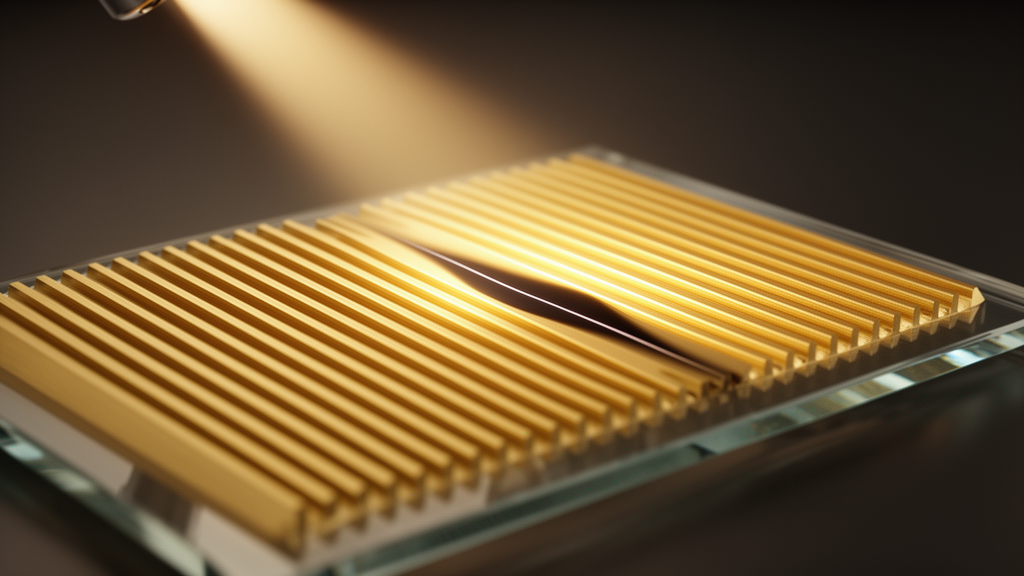
Surface plasmon resonance sensors have long promised label-free, highly sensitive detection of chemical and biological analytes, but a stubborn limitation has held back their performance in one important regime: liquids with low refractive indices. A team of Japanese researchers now reports a way to squeeze a sharper signal out of a reflective plasmonic grating by reading not the reflectance itself but its angular derivative, turning a broad, asymmetric resonance into a narrow, easily located dip. The work, published in Applied Physics B, combines rigorous simulations with experimental measurements on a fabricated gold grating in contact with ethanol.
The study, led by Atsushi Motogaito and colleagues at institutions including the laboratory of Kazumasa Hiramatsu, builds on the team’s earlier work with a single-layer gold grating operated in transmission. That earlier sensor, initially interpreted as involving a nonpropagating surface-plasmon mode, was later understood to rely on a Fano-type interaction between an edge-induced localized surface plasmon and a propagating surface plasmon at the gold–medium interface. But the transmissive configuration, the authors note, is better suited to high-refractive-index media and less effective for low-index liquids such as ethanol and water. The new device flips the geometry: light now illuminates the grating from the analyte side, and the sensor operates in reflection.
The structure itself is deliberately simple to make. A double-layer diffraction grating was fabricated on a C-plane sapphire substrate using electron-beam lithography and vacuum deposition. The design consists of a 100-nanometer electron-beam resist relief pattern topped by a 50-nanometer gold film with a 5-nanometer chromium adhesion layer, with a grating period of 440 nanometers and a 50 percent duty cycle. Because the refractive indices of the resist and sapphire are similar, the developed resist pattern effectively defines the optical grating without any substrate etching, and the resist is retained as part of the final optical structure. This lift-off-free approach, which the group has used in previous studies, eliminates a fabrication step that would otherwise be needed to pattern the metal.
To understand what the structure should do, the researchers turned to rigorous coupled-wave analysis, or RCWA, implemented in MATLAB with an open-source package. They checked convergence carefully, finding that the calculated optical response stabilized above 20 Fourier harmonics and changed negligibly between 40 and 150 harmonics, so they used 41 harmonics throughout. The simulations modeled ethanol, with a refractive index of 1.36, as the surrounding medium and evaluated the optical response under 780-nanometer illumination incident from the analyte side, with the chromium layer explicitly included in the model.
The simulated angular reflectance spectrum for ethanol showed a broad, asymmetric peak rising gradually from roughly 10.0 degrees to 17.8 degrees before falling sharply. That asymmetry is the hallmark of a Fano-type response, which arises when a narrow resonant mode interferes with a broad background mode. In plasmonic nanostructures, such interference commonly involves localized surface plasmons, propagating surface plasmons, and Rayleigh anomalies. The trouble is that the reflectance peak itself is relatively wide, which limits the figure of merit when conventional peak-tracking is used. The team’s solution was to differentiate: numerically computing the derivative of reflectance with respect to angle produced a pronounced, narrow dip near 17.8 degrees, slightly on the high-angle side of the reflectance maximum. This sharp feature, born from the steep angular variation of the Fano-type response, offers a far sharper readout for refractive-index sensing than the original broad peak.
To pin down the physics, the researchers calculated a reflectance map as a function of incident angle and wavelength and overlaid it with dispersion curves for Rayleigh anomalies and propagating surface plasmons at both the gold–ethanol and gold–sapphire interfaces. The enhanced reflectance region sits near the propagating surface plasmon dispersion curve, consistent with the broad spectral feature of a Fano-type response involving both localized and propagating plasmonic components. The differential-reflectance dip, by contrast, lies close to the Rayleigh anomaly dispersion curve, indicating that the sharpest part of the response is tied to the Rayleigh anomaly condition.
Quantitative near-field analysis added further detail. At an incident angle of 17.8 degrees, near the reflectance maximum, the team examined the spatial distributions of the electric field components over one grating period, averaging field intensities in regions extending about 22 nanometers laterally from each gold edge and from 1.7 to 19.3 nanometers into the ethanol side of the gold–ethanol interface. The results revealed a pronounced, spatially and component-dependent redistribution of the near field around the sharp far-field response rather than a uniform enhancement. The tangential field component behaved differently at the two gold edges, decreasing rapidly at one edge in the angular region of the sharp response while first decreasing and then increasing at the other. Together with the dispersion analysis, this behavior points to a change in local plasmonic coupling and interference near the Rayleigh anomaly condition.
The experimental verification followed. Scanning electron microscopy confirmed the periodic chromium/gold grating, and atomic force microscopy verified the intended resist relief, with local measurements of approximately 227, 212, and 142 nanometers for the resist width, space width, and relief height, respectively. Angular reflectance measurements used a 780-nanometer laser with p-polarized light irradiating the ethanol-contacted sample from the analyte side. The measured spectra reproduced the key simulated features: an asymmetric reflectance peak and a sharp differential reflectance dip near 17.5 degrees, close to the simulated 17.8 degrees. The slight shift was attributed to fabrication tolerances and material-parameter variations. The large noise in the measured differential spectrum stemmed mainly from the coarse 0.5-degree angular sampling interval of the manual rotation stage, which the authors say could be reduced with a motorized stage offering finer angular resolution.
To gauge potential sensing performance, the researchers simulated the refractive-index dependence of the differential reflectance dip across indices from 1.33 to 1.56, finding that both the reflectance peak and the differential dip shift toward lower angles as the index increases. From the angular shift of the dip, they estimated a simulated angular sensitivity of 49 degrees per refractive-index unit. Using the standard linewidth-based definition of the figure of merit, the simulated value came to 180 per refractive-index unit at an index of 1.36. Combining the simulated sensitivity with the experimentally measured linewidth yielded a semiexperimental figure of merit of 41 per refractive-index unit, an estimate the authors caution applies specifically under their 0.5-degree sampling conditions, since numerical differentiation makes the measured linewidth sensitive to sampling interval, alignment uncertainty, and noise.
Compared with previously reported surface plasmon resonance and Fano-based sensors, the angular sensitivity of 49 degrees per refractive-index unit is lower than values reported for grating-coupled SPR sensors, though the authors note that sensitivities expressed in different units should not be directly compared. The simulated figure of merit of 180, however, is of the same order as the high simulated value of 201 reported for a grating-coupled SPR sensor, and the semiexperimental figure of 41 is comparable in magnitude to the experimentally reported 50.1 for a Kretschmann SPR sensor. The high figure of merit stems mainly from the narrow differential-reflectance feature of the Fano-type response rather than from an exceptionally large resonance-angle shift. The authors emphasize that a rigorous experimental evaluation, including direct sensitivity measurements with multiple liquids and a systematic analysis of how linewidth and figure of merit depend on angular sampling, remains for future work. For now, the results demonstrate that differential reflectance provides a useful readout of a Fano-type plasmonic response in reflective grating sensors, particularly for low-refractive-index liquids, and offer a practical route toward compact SPR sensing without bulky prism optics.
Subject of Research: A reflective double-layer gold diffraction-grating plasmonic sensor whose Fano-type response is read out through differential reflectance for low-refractive-index liquid sensing
Article Title: Differential reflectance signature of a Fano-type plasmonic response in a reflective Au diffraction-grating structure
Article References: Motogaito, A., Ukai, K., Nabuchi, T., Kato, T., & Hiramatsu, K. (2026). Differential reflectance signature of a Fano-type plasmonic response in a reflective Au diffraction-grating structure. Applied Physics B, 132(11), Article 113. https://doi.org/10.1007/s00340-026-08729-7
Image Credits: AI Generated
DOI: 10.1007/s00340-026-08729-7
Keywords: surface plasmon resonance, Fano resonance, diffraction grating, differential reflectance, gold nanostructure, refractive-index sensing, RCWA simulation, sapphire substrate, electron-beam lithography, Rayleigh anomaly, propagating surface plasmon, figure of merit
Cite Scienmag News
Denise Maddox. (October 28, 2026). Sharp differential reflectance dip reveals Fano plasmonic response in gold grating sensor. Scienmag. https://scienmag.com/sharp-differential-reflectance-dip-reveals-fano-plasmonic-response-in-gold-grating-sensor/
Denise Maddox. "Sharp differential reflectance dip reveals Fano plasmonic response in gold grating sensor." Scienmag, 28 October 2026, https://scienmag.com/sharp-differential-reflectance-dip-reveals-fano-plasmonic-response-in-gold-grating-sensor/. Accessed 28 October 2026.
Denise Maddox. "Sharp differential reflectance dip reveals Fano plasmonic response in gold grating sensor." Scienmag. October 28, 2026. https://scienmag.com/sharp-differential-reflectance-dip-reveals-fano-plasmonic-response-in-gold-grating-sensor/