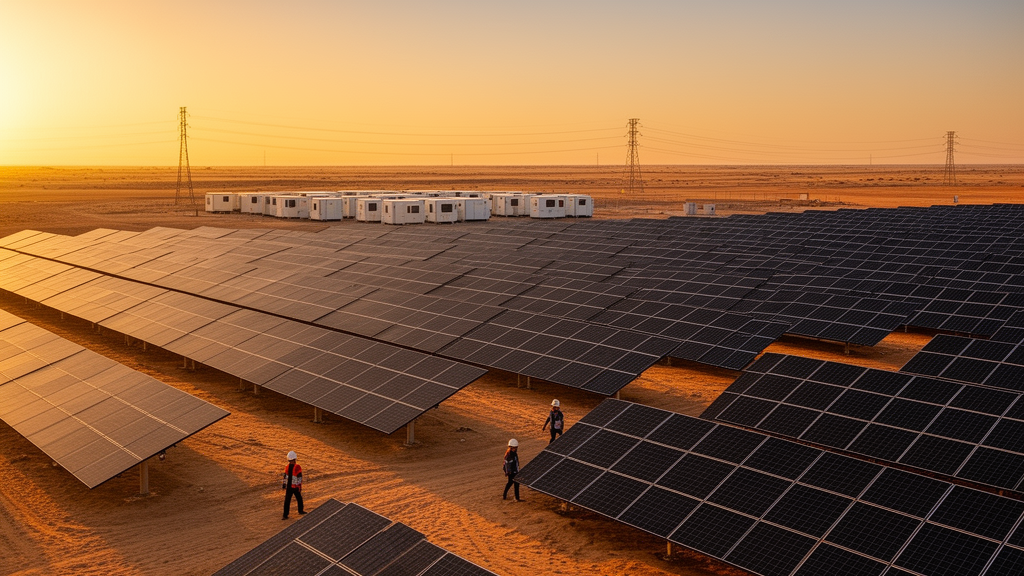
A new modeling study argues that Iraq’s decarbonization pathway cannot be planned from annual energy balances alone, because in a supply-constrained system new solar and wind generation may first restore electricity that was never being served rather than displace fossil fuel. The research, published in the journal Carbon Neutral Systems, builds a planning framework for the 15-governorate federal-Iraq study area and finds that a modeled 2050 state would require 34.745 gigawatts of photovoltaic capacity, 8.314 gigawatts of wind, and 37.323 gigawatts of battery power delivering 149.292 gigawatt-hours of stored energy. Yet even that build leaves 66 shortage hours in the year, with a peak hourly deficit of 13.115 gigawatts, despite annual energy not served falling to about 0.095 percent.
The study’s central accounting warning is that renewable-capacity planning can overstate decarbonization when the grid starts short of electricity service. Photovoltaic, wind, and battery capacities were optimized within fixed multi-sector service trajectories and then revalidated across all 8,784 hours of a reconstructed 2024 chronology. Because Iraq’s electricity service remains supply-constrained in the public-evidence-based reconstruction used, the authors grant renewable fossil-displacement credit only when hourly dispatch physically displaces fossil generation. A separate ledger preserves the official inventory structure from Iraq’s first Biennial Transparency Report, which recorded 152.604 million tonnes of carbon-dioxide equivalent from the Energy sector in 2021.
The consequences of crediting generation without checking physical use are large. A diagnostic that multiplies gross photovoltaic-plus-wind output by the hourly local-fossil carbon-intensity proxy, without verifying whether that output serves unmet load, charges batteries, or is curtailed, overstates renewable abatement by 13.719 million tonnes of carbon-dioxide equivalent per year in 2035, 46.553 in 2040, and 118.295 in 2050. The gap grows because variable renewable output increasingly restores otherwise-unserved service or fills storage rather than contemporaneously displacing fossil plants. This diagnostic was never used in the optimization itself; it quantifies the over-credit the service-first rule is designed to prevent.
The reconstruction behind the numbers is explicit about its own status. No complete observed 2024 national hourly dispatch and outage chronology was available, so hourly demand, dispatch, energy not served, and marginal carbon-intensity proxies are modeled or reconstructed quantities, not measured supervisory control and data acquisition records. The procedure reconciles annual and quarterly electricity quantities to published totals, distributes governorate-sector demand using temperature, day-type, and hour-of-day shapes, and draws photovoltaic and wind resource traces from ERA5 reanalysis fields aligned to the same hourly index. Observed information is preserved at its published aggregation level while the hourly sequence is treated as reconstructed rather than measured.
Eight action classes are represented, but only three capacity variables are endogenous. Photovoltaic, wind, and four-hour battery storage are optimized, while building efficiency, road electrification, industrial electrification, flexible demand, and flare recovery follow prescribed trajectories fixed before the capacity search. Building-efficiency coverage rises from 20 percent in 2030 to 50 percent from 2035 onward; road-electric-vehicle service rises from 5 percent to 40 percent by 2050; industrial electrification rises from 10 percent to 40 percent; and the flexible-demand activation fraction remains 5 percent. The modeled flare-recovery action is zero in 2030 and 106.286 million standard cubic feet per day thereafter, tied to the Halfaya gas-processing chain rather than a fraction of national flaring.
Recovered flare gas occupies a deliberately ambiguous position in the framework. The World Bank continues to identify Iraq among the world’s largest flaring countries, and Iraq-specific work reports substantial energy and economic losses from routine flaring, but the model does not assume all observed flares are recoverable. Net abatement subtracts processing, capture and leakage, and downstream-use emissions while adding displaced-fuel effects, so recovered gas remains a transitional fossil resource rather than renewable energy. As renewable penetration rises, the authors argue, recovered gas is better interpreted as transitional firm and flexibility support than as zero-carbon bulk generation, because downstream combustion remains in the physical ledger and can erode the gross flare-avoidance benefit.
The temporal structure of the residual shortage is the study’s most striking diagnostic. In 2050, the 66 shortage hours represent only 0.751 percent of the year but occur in 29 separate episodes; the longest lasts 5 consecutive hours and the median lasts 2 hours. Around the annual peak shortfall, dated 25 August at 04:00 in the reference local-clock chronology, modeled battery energy is exhausted and the residual deficit before battery discharge reaches 13.115 gigawatts. The storage state of charge repeatedly hits its lower bound during the modeled stress sequence. A low annual fraction can therefore coexist with a large instantaneous deficit when the remaining shortage concentrates in a small number of severe hours.
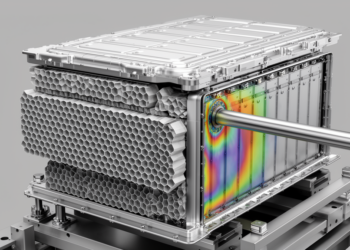
Re-optimizing the 2050 capacity problem across 2, 3, 4, 6, and 8 hour battery architectures shows that the four-hour duration is a declared reference architecture, not an inferred optimum. Feasible storage-energy requirements remain approximately 149.290, 149.292, 149.292, 150.582, and 153.848 gigawatt-hours respectively, while battery power falls from 74.645 gigawatts at 2 hours to 19.231 gigawatts at 8 hours. The chronology imposes an energy-shifting requirement of roughly this scale within the restricted flexibility menu, and duration mainly reallocates it between power and energy ratings. Transmission reinforcement, long-duration storage, demand response, interconnection, or probabilistic reserve design could change both quantities.
Robustness testing reveals how narrow the feasible region is around the central pathway. Only 4 of 19 non-base deterministic stress branches satisfy every annual energy-not-served limit without re-optimization, but the failures differ enormously in severity. The smallest failing case, a 25 percent relative increase in industrial-electrification uptake, misses the 2050 limit by only 0.000982 percentage points, whereas a 10 percent service-growth stress exceeds a limit by as much as 2.823 percentage points and the compound adverse case by 2.463 percentage points. Uniform service-growth headroom above the central trajectory is only 0.244 percent in 2035, 0.088 percent in 2040, and 0.090 percent in 2050 before the annual target is breached, and tolerance to a shortfall in the exogenous firm-supply proxy is similarly tight.
The 2030 result requires particular care. Under the central boundary, the capacity search selects no additional endogenous photovoltaic, wind, or battery capacity in 2030, conditional on an exogenous public-project supply trajectory and a combined-cycle complement derived from a 7.7-gigawatt announcement at a 75 percent availability assumption. Iraq’s NDC 3.0 assigns mitigation to a broader set of pathways, including grid-loss reduction, fuel switching, conversion of around 9 gigawatts of simple-cycle capacity to combined cycle by 2030, and demand-side measures, so the absence of additional capacity in the three-variable decision set does not imply an absence of renewable construction in Iraq’s real transition. A conservative sensitivity that removes the combined-cycle complement entirely raises the 2050 solution to 43.436 gigawatts of photovoltaics, 21.107 gigawatts of wind, and 45.520 gigawatts of battery power with 182.080 gigawatt-hours of energy, showing that the zero-additional-capacity 2030 result depends materially on delivery of the assumed firm-supply bridge.
The authors are explicit that the results are conditional planning diagnostics, not forecasts of Iraq’s eventual build-out, and not estimates of national technical potential. The analysis is bounded by one reconstructed 2024 weather and load chronology; the plus-or-minus 10 percent renewable-availability cases are controlled sensitivities rather than a multi-year climate ensemble. Transmission power flows, N-1 security, operating reserves, unit commitment, and probabilistic forced-outage states are excluded, and annual energy not served is the binding adequacy metric. Service trajectories are prescribed, milestone capacities are optimized independently rather than intertemporally, and costs use global 2024 installed-cost benchmarks of 691 dollars per kilowatt for utility photovoltaics, 1,041 dollars per kilowatt for onshore wind, and 192 dollars per kilowatt-hour for fully installed utility-scale batteries, not Iraqi engineering quotations. Stress branches carry no probabilities, and multistart agreement within 0.0005 percent supports numerical stability but is not a mathematical certificate of global optimality.
What the framework offers, ultimately, is an auditable sequencing discipline rather than a reliability certificate. Renewable generation and storage must expand without treating electricity that first restores unmet service as fossil displacement, and least-cost capacity should be accompanied by shortage-duration, peak-deficit, and stress-headroom metrics rather than annual fractions alone. Procurement, the authors suggest, should be staged and re-optimized as project delivery, demand, storage performance, gas availability, and renewable yield become known. The deterministic capacity-insurance envelopes, which quantify the additional build needed for one capacity state to survive selected downside sets, produce a cost-of-protection screen at 82 to 86 percent of the central capacity-cost proxy through 2050, a deliberately conservative common-build requirement rather than an expected economic cost of uncertainty.
Subject of Research: Energy-adequacy-constrained renewable capacity planning for Iraq's power-system decarbonization
Article Title: From gas flaring to renewable flexibility: energy-adequacy-constrained decarbonization pathways for Iraq
Article References: Hasan, M. W. (2026). From gas flaring to renewable flexibility: energy-adequacy-constrained decarbonization pathways for Iraq. Carbon Neutral Systems, 2(1), Article 17. https://doi.org/10.1007/s44438-026-00038-y
Image Credits: AI Generated
DOI: 10.1007/s44438-026-00038-y
Keywords: Iraq, renewable energy, battery storage, solar photovoltaics, wind power, gas flaring, energy adequacy, carbon accounting, decarbonization, capacity expansion modeling, energy not served, sector coupling
Cite Scienmag News
Faith Mcneil. (October 28, 2026). Iraq’s 2050 solar and battery plan hinges on hourly adequacy, not annual totals. Scienmag. https://scienmag.com/iraqs-2050-solar-and-battery-plan-hinges-on-hourly-adequacy-not-annual-totals/
Faith Mcneil. "Iraq’s 2050 solar and battery plan hinges on hourly adequacy, not annual totals." Scienmag, 28 October 2026, https://scienmag.com/iraqs-2050-solar-and-battery-plan-hinges-on-hourly-adequacy-not-annual-totals/. Accessed 28 October 2026.
Faith Mcneil. "Iraq’s 2050 solar and battery plan hinges on hourly adequacy, not annual totals." Scienmag. October 28, 2026. https://scienmag.com/iraqs-2050-solar-and-battery-plan-hinges-on-hourly-adequacy-not-annual-totals/