
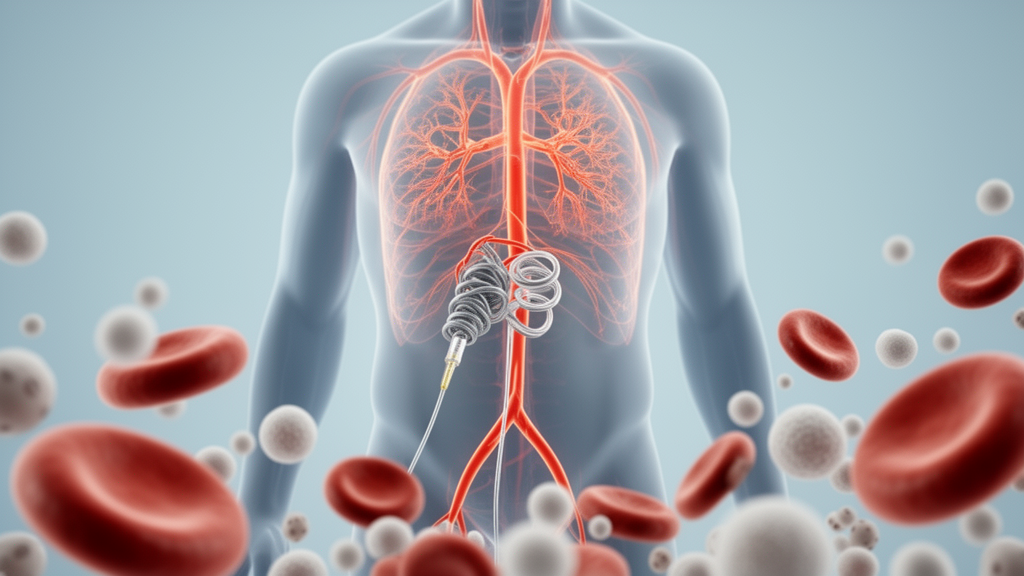
Patients with bronchiectasis whose coughing-up of blood returns months after a bronchial artery embolization may now be identifiable earlier, according to a retrospective cohort study published in BioMedical Engineering OnLine. Researchers report that four factors—the presence of non-bronchial systemic arteries, the number of lung lobes affected, the admission white blood cell count, and the neutrophil–monocyte–lymphocyte ratio—together form a prediction model for recurrence that occurs more than 30 days after the procedure.
The new study focused specifically on patients who stayed free of recurrence during the first 30 days after embolization, isolating the factors that drive longer-term relapse rather than immediate technical failure.
The research team analyzed records of patients who underwent bronchial artery embolization for bronchiectasis between June 2020 and September 2025. Of 398 patients initially screened, 284 were excluded: 225 had hemoptysis unrelated to bronchiectasis, four had technical failure in which the target artery could not be successfully embolized, three experienced recurrence within 30 days, thirteen had missing clinical data, and 39 were lost to follow-up. That left 114 patients who remained recurrence-free through the first month after treatment.
Among those 114 patients, long-term recurrence of hemoptysis occurred in 43 cases, a rate of 37.7 percent. The researchers used Spearman correlation analysis to examine relationships between variables, then applied LASSO regression to sift through candidate clinical, radiological, and inflammatory measures. The selected variables were entered into a multivariable logistic regression model fitted with Firth’s penalized maximum-likelihood estimation, a statistical approach suited to smaller samples and rare outcomes.
The analysis identified four independent risk factors. The presence of non-bronchial systemic arteries—vessels outside the bronchial circulation that can also supply the diseased lung tissue—carried an odds ratio of 2.703, with a 95 percent confidence interval of 1.033 to 7.226. Each additional affected lobe raised the odds by a factor of 1.513 (95 percent CI 1.023 to 2.280). A higher white blood cell count on admission was associated with an odds ratio of 1.314 (95 percent CI 1.072 to 1.652), and a higher neutrophil–monocyte–lymphocyte ratio on admission showed an odds ratio of 1.251 (95 percent CI 1.012 to 1.613).
The prediction model combining these four factors achieved an area under the receiver operating characteristic curve of 0.777, with a 95 percent confidence interval of 0.688 to 0.865. After bootstrap internal validation, the optimism-corrected AUC was 0.704, indicating moderate discriminatory ability that accounts for the model being fitted and evaluated on the same dataset. The authors conclude that among bronchiectasis patients recurrence-free at 30 days, these four variables are the main risk factors and that a model combining them offers improved prediction of long-term hemoptysis recurrence after embolization.
Several limitations frame the findings. The optimism-corrected performance figure reflects internal validation only; the model has not yet been tested on an external patient population. Because patients who recurred within 30 days or were lost to follow-up were excluded, the results apply specifically to the subset of patients who remain recurrence-free in the first month. As an observational study, the reported odds ratios describe associations with recurrence rather than proven causal effects, and the authors note the work is published as an early-access version that may undergo further edits before the final version of record.
Subject of Research: Risk factors for long-term recurrence of hemoptysis after bronchial artery embolization in bronchiectasis patients
Article Title: Factors associated with long-term recurrence of hemoptysis after bronchial artery embolization for bronchiectasis
Article References: Yu, C., Man, D., Liu, J., Zhou, H., Jia, Z., Xue, T., & Liu, K. (2026). Factors associated with long-term recurrence of hemoptysis after bronchial artery embolization for bronchiectasis. BioMedical Engineering OnLine. https://doi.org/10.1186/s12938-026-01639-x
Image Credits: AI Generated
DOI: 10.1186/s12938-026-01639-x
Keywords: bronchiectasis, hemoptysis, bronchial artery embolization, recurrence, prediction model, non-bronchial systemic arteries, white blood cell count, neutrophil-monocyte-lymphocyte ratio, retrospective cohort, logistic regression, interventional radiology, Factors
Cite Scienmag News
Gregory Coleman. (October 28, 2026). Blood cell ratios predict late hemoptysis return after bronchial artery embolization. Scienmag. https://scienmag.com/blood-cell-ratios-predict-late-hemoptysis-return-after-bronchial-artery-embolization/
Gregory Coleman. "Blood cell ratios predict late hemoptysis return after bronchial artery embolization." Scienmag, 28 October 2026, https://scienmag.com/blood-cell-ratios-predict-late-hemoptysis-return-after-bronchial-artery-embolization/. Accessed 28 October 2026.
Gregory Coleman. "Blood cell ratios predict late hemoptysis return after bronchial artery embolization." Scienmag. October 28, 2026. https://scienmag.com/blood-cell-ratios-predict-late-hemoptysis-return-after-bronchial-artery-embolization/