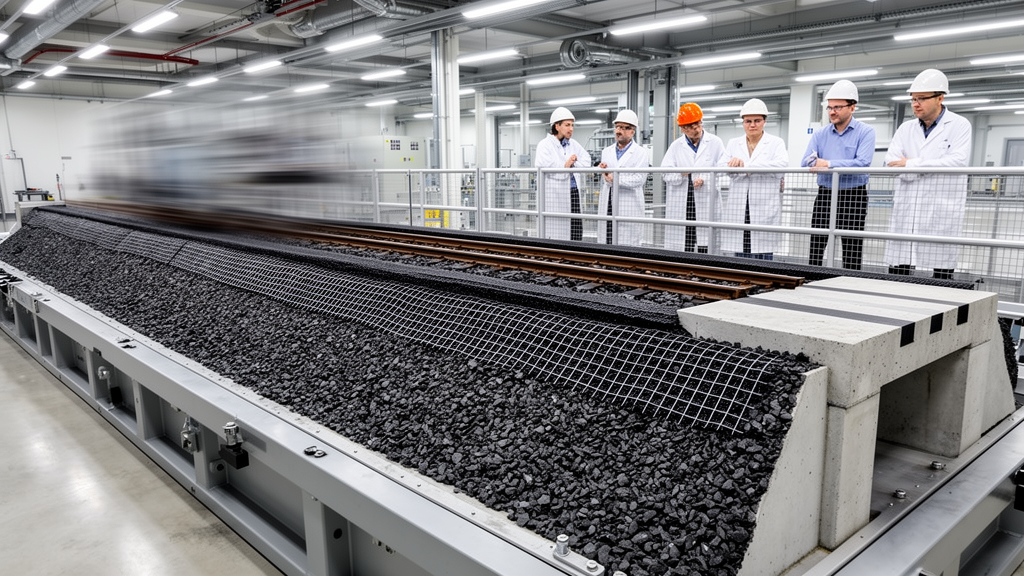
Engineers testing a new way to protect high-speed railway lines where bridges meet embankments have found that a prestressed basalt fiber geogrid can hold a model subgrade together through surprisingly violent shaking. In a 1:25 scale experiment on a shaking table at Southwest Jiaotong University, a reinforced transition section remained essentially stable through excitations of up to 0.5 g, developed significant cracks at 0.6 g, and only collapsed completely on its right slope at 0.8 g. The study, published in Advances in Bridge Engineering, is among the first to examine the dynamic response and damage evolution of a prestressed geogrid-reinforced bridge-subgrade transition under seismic loading, a topic the authors say has received far less attention than the settlement behavior of transition sections under trains.
The reinforcement method, called prestressed basalt fiber geogrid, or PBFG, combines a geogrid woven from basalt fiber with a deliberate pretensioning step. Basalt fibers have attracted attention in civil engineering for their high strength, corrosion resistance and ductility. By imposing prestress, the technique mobilizes interlocking and friction between the geogrid and the surrounding soil, which the authors report enhances seismic stability and deformation control. In the model, two layers of the geogrid were buried in the foundation soil rather than only in the embankment fill, a choice meant to constrain lateral deformation of weak ground at its source and to mimic composite foundation reinforcement schemes used in actual engineering.
The experimental platform was a single-degree-of-freedom excitation system with an effective working surface of 1.2 by 1.2 meters, a rated load capacity of 500 kilograms, and the ability to generate broadband excitation from 0.1 to 50 Hz with a peak acceleration of 1.0 g. A customized model box measuring 1.78 meters long, 0.3 meters wide and 1.17 meters high, built from a stainless steel frame and tempered glass panels, was bolted rigidly to the table. The model represented a transition section from a geologically complex region of southwestern China, where silty clay and sandy gravel layers interbed discontinuously and multiple active faults are present. The geometric scaling ratio of 25:1 corresponds to prototype dimensions of 158 by 59 by 36 meters in length, height and foundation depth, with a 20-centimeter model fill standing in for a 7.5-meter embankment.
Materials were calibrated carefully. Loess, quartz sand and graded gravel were mixed in controlled proportions to reproduce the low shear strength and high compressibility of the prototype site soils, with density, internal friction angle and cohesion verified through direct shear tests. The model fill was compacted in 0.1-meter layers to a measured compaction degree of 96 percent, deliberately above the 92 percent minimum required by design codes, a margin the team adopted to account for the small scale of the model, boundary effects and the uniformity of manual compaction. Prestress was applied in graded steps to a design value of 170 newtons through a screw-nut anchoring device, with tension monitored throughout; if loss exceeded 10 percent during filling, it was restored. The final measured prestress ranged from 162 to 168 newtons. This value was derived from a strain-equivalence principle linking the model geogrid’s tensile strength of 40 kilonewtons per meter to the prototype value of 123 kilonewtons per meter, corresponding to an equivalent prototype prestress of 21 kilonewtons per meter.
Instrumentation was extensive: four displacement sensors, fourteen acceleration sensors, seven soil pressure sensors and eighteen strain sensors, supplemented by high-resolution industrial cameras for particle image velocimetry. The loading sequence used three wave types, a sine wave, an EL Centro wave and a Wolong wave, with amplitudes stepped from 0.1 g to 0.8 g, and white noise sweeps before and after each level to track changes in dynamic properties. The published analysis focuses on the sine wave response. Displacement sensors showed that peak displacements in the slope free-surface direction grew slowly at low intensities and then accelerated, while settlement-direction displacements grew slowly through 0.5 g and increased rapidly from 0.6 to 0.8 g, with the most pronounced change at sensor D4 matching the observed collapse of the right side of the subgrade.
The acceleration results revealed a distinctive pattern. Across the full loading range, the peak acceleration amplification first increased and then decreased, reaching its maximum at 0.2 g, with a clear elevation amplification effect. Along the subgrade centerline, amplification initially decreased with elevation and then increased, a trend that became more pronounced under stronger shaking. The authors attribute this shape to competition between seismic energy dissipated by the prestressed geogrid reinforcement zone, which produces an attenuation section, and elevation amplification in the upper unreinforced soil, where impedance is lower. Within the A12 to A11 interval the growth rate of amplification was highest, while in the A6 to A7 interval, which lies within the geogrid-reinforced zone, it was lowest and even negative, suggesting the reinforcement dissipated seismic energy there and reduced the height amplification effect.
Dynamic soil pressure told a complementary story. Pressures rose continuously with shaking intensity and concentrated mainly in the subgrade foundation zone, with the maximum at the foundation base below 0.5 g. Typically, densifying soil and boundary conditions would push peak pressures toward both sides of the foundation, but in this test the peak soil pressure did not completely transfer to the sides, a behavior the authors describe as controlled migration and attribute to the reinforcement zone sharing part of the load. From 0.6 g onward, the increments at three horizontal monitoring points rose rapidly, indicating progressive evolution of peak pressures from the center of the foundation toward its sides. Geogrid strain data reinforced this picture: peak strain increased continuously with shaking, the lower layer consistently showed larger strains than the upper layer, concentrated on the right side of the foundation, and the upper layer’s peak strain eventually stabilized at approximately three-quarters of the horizontal length. The authors interpret this as the geogrid converting horizontal shear force in the soil into grid tension through interface friction and mechanical adhesion, thereby limiting lateral deformation.
Spectral and energy analyses added a spatial dimension to the damage picture. Fourier transforms of slope surface responses showed dominant frequencies near 8 Hz at both 0.2 g and 0.8 g, with significant higher-frequency responses appearing at 0.8 g that the authors link to resonance induced by structural damage. Hilbert-Huang transform analysis showed the response frequency band broadening and the peak response shifting toward low frequencies as intensity increased, with a secondary peak near 40 Hz attributed to local deformation. Total energy in the marginal spectrum increased continuously in both the centerline and slope surface directions, but the slope surface consistently carried more energy, and the right slope toe recorded the highest values of all, exceeding even the crest. Together with the displacement fields visualized by particle image velocimetry, which showed cracks propagating and coalescing at the right-slope toe at 0.8 g, the analysis identifies the central part of the subgrade and the toe of the right slope as the most vulnerable critical sections.
The authors are candid about the limits of the work. Although the fill materials were scaled at 1:25, the geogrid itself, as an industrialized product, could not be scaled down precisely in geometry or mechanical properties, and its actual tensile strength remained well above the theoretical scaled value, so the poorer ductility of basalt fiber geogrid compared with polymer alternatives could not be observed. More importantly, the test included no control conditions, no unreinforced roadbed, no non-prestressed geogrid and no conventional polymer geogrid, so the effectiveness of PBFG rests on the internal consistency of this single model test rather than a direct quantitative comparison with traditional reinforcement schemes. The authors also note that the relatively low tensile elongation of the material may lead to brittle fracture, and recommend that working strain in seismic design remain well below the ultimate strain. They call for future physical and numerical models with properly scaled geogrid materials and multiple reinforcement configurations for comparison. Within those limits, the study offers an experimental basis for seismic design of high-speed railway bridge-road transition sections using prestressed reinforcement technology, and a detailed account of how such a reinforced subgrade degrades, stage by stage, as the shaking intensifies.
Subject of Research: Seismic performance of prestressed basalt fiber geogrid-reinforced high-speed railway bridge-embankment transition zones tested on a shaking table
Article Title: Prestressed basalt fiber geogrid reinforcement for high-speed railway bridge-embankment transition zone: a shaking table test study
Article References: Wang, Z., Liang, X., Yang, C., Fu, H., & Li, X. (2026). Prestressed basalt fiber geogrid reinforcement for high-speed railway bridge-embankment transition zone: a shaking table test study. Advances in Bridge Engineering, 7(1), Article 39. https://doi.org/10.1186/s43251-026-00226-3
Image Credits: AI Generated
DOI: 10.1186/s43251-026-00226-3
Keywords: shaking table test, basalt fiber geogrid, prestressed reinforcement, high-speed railway, bridge-embankment transition, seismic response, subgrade stability, dynamic soil pressure, PIV, Hilbert-Huang transform, geogrid strain, geotechnical engineering
Cite Scienmag News
Denise Maddox. (October 27, 2026). Shaking Table Tests Reveal How Prestressed Basalt Fiber Geogrids Stabilize Railway Transitions. Scienmag. https://scienmag.com/shaking-table-tests-reveal-how-prestressed-basalt-fiber-geogrids-stabilize-railway-transitions/
Denise Maddox. "Shaking Table Tests Reveal How Prestressed Basalt Fiber Geogrids Stabilize Railway Transitions." Scienmag, 27 October 2026, https://scienmag.com/shaking-table-tests-reveal-how-prestressed-basalt-fiber-geogrids-stabilize-railway-transitions/. Accessed 28 October 2026.
Denise Maddox. "Shaking Table Tests Reveal How Prestressed Basalt Fiber Geogrids Stabilize Railway Transitions." Scienmag. October 27, 2026. https://scienmag.com/shaking-table-tests-reveal-how-prestressed-basalt-fiber-geogrids-stabilize-railway-transitions/