


More than a quarter of patients with chronic inflammatory arthritis across Latin America began immunosuppressive therapy without being screened for tuberculosis infection, according to a prospective, multicenter observational study drawing on the Pan-American League of Associations for Rheumatology (PANLAR) Registry of Rheumatic Diseases, known as PANRED. The study, published in Advances in Rheumatology, evaluated how tuberculosis infection (TBI) was screened, diagnosed, and treated in people with rheumatoid arthritis, psoriatic arthritis, and axial spondyloarthritis at the start of disease-modifying antirheumatic drugs (DMARDs) and over twelve months of follow-up.
The analysis included 590 patients receiving targeted synthetic, conventional synthetic, or biologic DMARDs. Most were women—460 participants, or 78.0%—with a mean age of 52.4 years (standard deviation 12.9). A majority, 353 patients (59.8%), were non-white, and 496 (84.1%) had rheumatoid arthritis. At baseline, 321 patients (54.4%) were using glucocorticoids, 262 (44.4%) were receiving biologic DMARDs, mostly tumor necrosis factor inhibitors, 169 (28.6%) were on targeted synthetic DMARDs, and 159 (26.9%) were on conventional synthetic DMARDs.
Screening for tuberculosis infection was performed in 430 of the 590 patients (72.9%) at baseline, meaning roughly one in four entered immunosuppressive treatment without it. Among those screened, 59 (13.7%) were diagnosed with tuberculosis infection.
Reassessment during follow-up proved far less consistent than initial testing. At twelve months, only 99 of the 430 patients who had undergone baseline screening—23.0%—received repeat screening, which identified five new tuberculosis infection cases. The low repeat-screening rate suggests that periodic reassessment, recommended for patients who remain at risk of new or reactivated infection while on immunosuppressive therapy, is not being carried out routinely in everyday practice across the region.
Two patients in the cohort (0.34%) developed active tuberculosis disease during follow-up. The researchers calculated an incidence of 339 cases per 100,000 patient-years, with a 95% confidence interval of 41 to 1,224. The very wide interval reflects the small number of observed events, so the estimate carries substantial statistical uncertainty; it should be read as a measure of occurrence in this specific cohort rather than a precise regional rate.
In that context, the gap between screening guidelines and real-world practice is notable: despite the high tuberculosis disease burden in Latin America, a substantial proportion of patients with chronic inflammatory arthritis did not undergo tuberculosis infection screening before starting immunosuppressive therapy.
The study’s design matters for interpreting these numbers. As a real-life, prospective, observational registry study, it documents what clinicians actually did across participating centers rather than testing whether any particular screening strategy improves outcomes. The cohort was limited to patients with rheumatoid arthritis, psoriatic arthritis, and axial spondyloarthritis, so the results cannot be extended to other inflammatory diseases or to pediatric populations. Because the report describes an early-access, peer-reviewed accepted version subject to further editing, some figures could shift slightly in the final version of record.
The investigators conclude that the combination of incomplete baseline screening, infrequent repeat testing, and the observed occurrence of tuberculosis disease reinforces the need for appropriate screening strategies, periodic reassessment, and ongoing clinical surveillance throughout treatment with the different classes of DMARDs. For clinicians managing inflammatory arthritis in tuberculosis-endemic settings, the registry data provide a regional benchmark showing where current practice falls short of that standard.
Subject of Research: Tuberculosis infection screening and outcomes in Latin American patients with chronic inflammatory arthritis starting DMARDs
Article Title: Epidemiology of tuberculosis infection among Latin American patients with chronic inflammatory arthritis: data from the PANLAR registry of rheumatic diseases (PANRED)
Article References: Barbosa, L. F., Soriano, E. R., Ferreira, G. A., Colugnati, F. A. B., Coutinho, L. N., Kakehasi, A. M., Guimarães, M. F. B. D. R., Souza, M. P. G. U. S., Oliveira, R. D. R. D., Fernandes, V., Cardoso, J. P., Giorgi, R. D. N., Sacilotto, N. D. C., Ochtrop, M. L. G., Cruz, V. A., Rêgo, J., Kahlow, B. S., Abreu, P. D., Pedretti, G. A., … Souza, V. A. D. (2026). Epidemiology of tuberculosis infection among Latin American patients with chronic inflammatory arthritis: data from the PANLAR registry of rheumatic diseases (PANRED). Advances in Rheumatology. https://doi.org/10.1186/s42358-026-00585-5
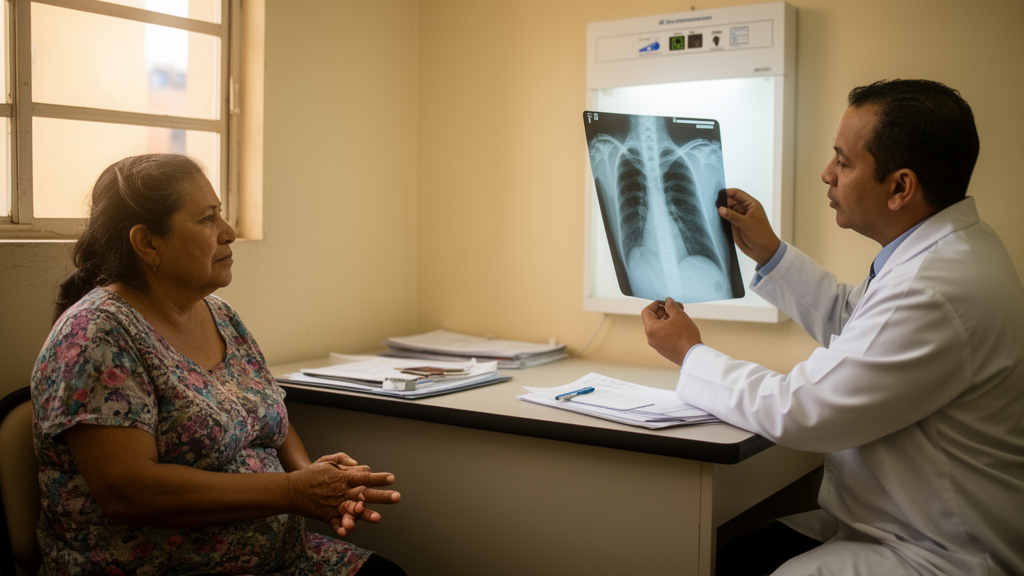
Image Credits: AI Generated
DOI: 10.1186/s42358-026-00585-5
Keywords: tuberculosis infection, chronic inflammatory arthritis, rheumatoid arthritis, DMARDs, PANLAR registry, Latin America, screening, biologic therapy, axial spondyloarthritis, psoriatic arthritis, observational study, immunosuppression
Cite Scienmag News
Ophelia Keating. (October 27, 2026). Many Latin American Arthritis Patients Skip Tuberculosis Screening Before Immunosuppressive Drugs. Scienmag. https://scienmag.com/many-latin-american-arthritis-patients-skip-tuberculosis-screening-before-immunosuppressive-drugs/
Ophelia Keating. "Many Latin American Arthritis Patients Skip Tuberculosis Screening Before Immunosuppressive Drugs." Scienmag, 27 October 2026, https://scienmag.com/many-latin-american-arthritis-patients-skip-tuberculosis-screening-before-immunosuppressive-drugs/. Accessed 27 October 2026.
Ophelia Keating. "Many Latin American Arthritis Patients Skip Tuberculosis Screening Before Immunosuppressive Drugs." Scienmag. October 27, 2026. https://scienmag.com/many-latin-american-arthritis-patients-skip-tuberculosis-screening-before-immunosuppressive-drugs/


