

Tuesday, October 27, 2026
Science
No Result
View All Result
  • Login
  • HOME
  • SCIENCE NEWS
  • CONTACT US
  • HOME
  • SCIENCE NEWS
  • CONTACT US
No Result
View All Result
Scienmag
No Result
View All Result
Home Science News Medicine

PYGO2 and MAML1 expression linked to early-stage papillary thyroid cancer

October 27, 2026
in Medicine
Nathaniel Bowman
By Nathaniel Bowman Scienmag Editorial Profile - Precision Oncology
Reading Time: 2 mins read
0
PYGO2 and MAML1 expression linked to early-stage papillary thyroid cancer

PYGO2 and MAML1 expression linked to early-stage papillary thyroid cancer

65
SHARES
587
VIEWS
Share on FacebookShare on Twitter
ADVERTISEMENT

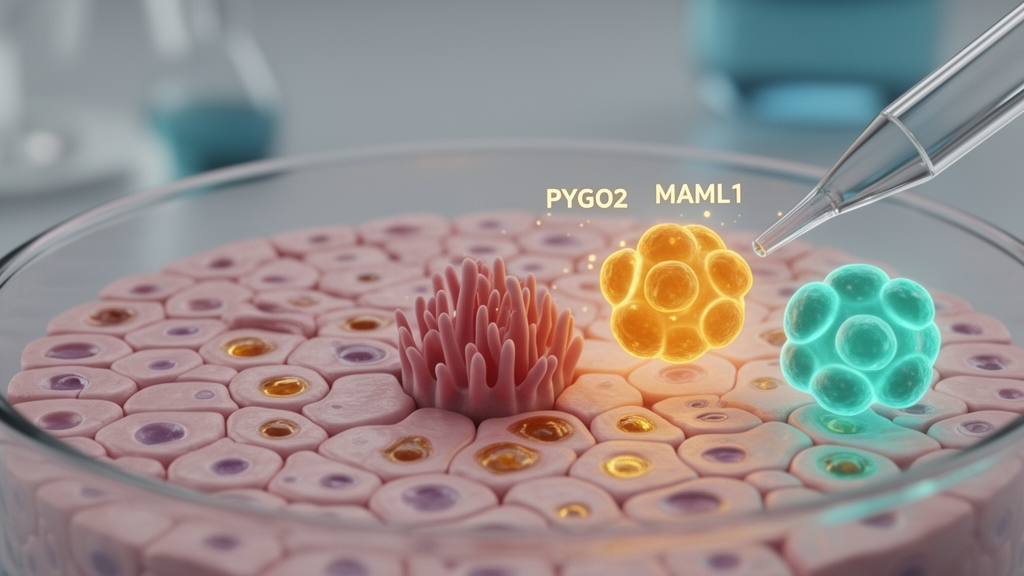
Researchers studying papillary thyroid carcinoma report that the transcriptional co-activators PYGO2 and MAML1 show expression patterns tied to early tumor stages, leading them to propose the two genes as candidate early-stage diagnostic markers for the disease.

The team collected sixty paraffin-embedded papillary thyroid carcinoma tumors along with corresponding normal tissues. Using real-time PCR, they measured mRNA levels of MAML1, a co-activator in the NOTCH signaling pathway, and PYGO2, a co-activator in the WNT pathway. Both pathways are known to regulate cell proliferation, differentiation, and tumor progression in papillary thyroid carcinoma, and the authors set out to determine whether expression of these two genes was associated with the clinicopathological characteristics of the patients.

The results showed several statistically significant associations. Early-stage tumors, classified as stage I or II, had significantly higher levels of PYGO2 expression than advanced stage III or IV tumors, with a p-value of 0.04. Tumors that had invaded beyond the thyroid gland showed significantly lower PYGO2 expression than tumors without such invasion, at p = 0.034. A parallel pattern emerged for MAML1: early-stage tumors displayed significant upregulation of MAML1 compared with advanced-stage tumors, with a p-value of 0.038.

The analysis also uncovered additional correlations. Among female patients, MAML1 expression was significantly associated with tumor focality, meaning whether the tumor was unifocal or multifocal, with a p-value of 0.025. Finally, the levels of MAML1 and PYGO2 expression showed a significant direct correlation with each other across the patient samples, reported at p = 0.013. The authors interpret this coordinated expression pattern as consistent with the two genes acting in parallel within their respective signaling pathways during tumor development.

Based on these findings, the study concludes that MAML1 and PYGO2 appear to be involved in the early stages of papillary thyroid carcinoma development and can be introduced as early-stage diagnostic markers among patients with this tumor type. The authors note that although most papillary thyroid carcinoma patients have a favorable prognosis, a considerable proportion experience tumor relapse, which motivates the search for molecular markers that clarify the mechanisms underlying tumor development. The work was published on 24 October 2026 as a peer-reviewed, accepted manuscript shared early to provide faster access, and it is citable under a permanent DOI pending the final version of record. As with any single-cohort expression study of sixty tumor samples, the reported associations will require validation in independent patient populations before any clinical use as diagnostic markers can be considered.

Subject of Research: Expression of the transcriptional co-activators PYGO2 and MAML1 in papillary thyroid carcinoma and their association with early tumor stage

Article Title: PYGO2 and MAML1 as the early stage tumor markers in papillary thyroid cancer patients

Article References: Maharati, A., Taghavinia, F., Taghehchian, N., Farrokhi, S., & Moghbeli, M. (2026). PYGO2 and MAML1 as the early stage tumor markers in papillary thyroid cancer patients. Diagnostic Pathology. https://doi.org/10.1186/s13000-026-01866-9

Image Credits: AI Generated

DOI: 10.1186/s13000-026-01866-9

Keywords: papillary thyroid carcinoma, PYGO2, MAML1, NOTCH signaling, WNT signaling, gene expression, real-time PCR, diagnostic markers, tumor stage, thyroid cancer, molecular markers, Diagnostic Pathology

Cite Scienmag News

Nathaniel Bowman. (October 27, 2026). PYGO2 and MAML1 expression linked to early-stage papillary thyroid cancer. Scienmag. https://scienmag.com/pygo2-and-maml1-expression-linked-to-early-stage-papillary-thyroid-cancer/

Nathaniel Bowman. "PYGO2 and MAML1 expression linked to early-stage papillary thyroid cancer." Scienmag, 27 October 2026, https://scienmag.com/pygo2-and-maml1-expression-linked-to-early-stage-papillary-thyroid-cancer/. Accessed 27 October 2026.

Nathaniel Bowman. "PYGO2 and MAML1 expression linked to early-stage papillary thyroid cancer." Scienmag. October 27, 2026. https://scienmag.com/pygo2-and-maml1-expression-linked-to-early-stage-papillary-thyroid-cancer/


Tags: diagnostic markersdiagnostic markers for papillary thyroid cancerdiagnostic pathologyearly detection of thyroid cancer using gene expressionearly-stage tumor detectiongender-specific gene expression patterns in thyroid cancergene expressiongene expression profiling in thyroid tumorsMAML1molecular markersmolecular markers for thyroid cancer invasionNotch signalingpapillary thyroid carcinomaPapillary thyroid carcinoma biomarkersPYGO2PYGO2 and MAML1 gene expressionreal-time PCRreal-time PCR analysis in thyroid cancerThyroid cancertumor progression biomarkers in papillary thyroid carcinomatumor stagetumor stage and gene expression correlationWNT and NOTCH signaling pathways in thyroid cancerWnt signaling
Share26Tweet16
Previous Post

Left atrial strain lower before atrial fibrillation appears after cryptogenic stroke

Next Post

Ubiquitination emerges as a central lever in diabetic heart disease

Related Posts

Left atrial strain lower before atrial fibrillation appears after cryptogenic stroke
Medicine

Left atrial strain lower before atrial fibrillation appears after cryptogenic stroke

October 27, 2026
Fragmented QRS on ECG may flag radiation heart injury in lung cancer patients
Cancer

Fragmented QRS on ECG may flag radiation heart injury in lung cancer patients

October 27, 2026
Systematic review finds wide gaps in reproductive health services for refugees in the Eastern Mediterranean
Medicine

Systematic review finds wide gaps in reproductive health services for refugees in the Eastern Mediterranean

October 27, 2026
AI body composition scans agree across MRI and CT but reveal systematic biases
Cancer

AI body composition scans agree across MRI and CT but reveal systematic biases

October 27, 2026
Opening Chronically Blocked Heart Arteries in Patients Over 80 Proves Feasible
Medicine

Opening Chronically Blocked Heart Arteries in Patients Over 80 Proves Feasible

October 27, 2026
New Fibrinogen Concentrate BT524 Stays Stable for Five Years After UV-C Virus Inactivation
Medicine

New Fibrinogen Concentrate BT524 Stays Stable for Five Years After UV-C Virus Inactivation

October 27, 2026
Next Post
Ubiquitination emerges as a central lever in diabetic heart disease

Ubiquitination emerges as a central lever in diabetic heart disease

  • Mothers who receive childcare support from maternal grandparents show more optimized

    Mothers who receive childcare support from maternal grandparents show more parental warmth, finds NTU Singapore study

    27656 shares
    Share 11059 Tweet 6912
  • University of Seville Breaks 120-Year-Old Mystery, Revises a Key Einstein Concept

    1061 shares
    Share 424 Tweet 265
  • Bee body mass, pathogens and local climate influence heat tolerance

    682 shares
    Share 273 Tweet 171
  • Researchers record first-ever images and data of a shark experiencing a boat strike

    546 shares
    Share 218 Tweet 137
  • Groundbreaking Clinical Trial Reveals Lubiprostone Enhances Kidney Function

    531 shares
    Share 212 Tweet 133
Science

Embark on a thrilling journey of discovery with Scienmag.com—your ultimate source for cutting-edge breakthroughs. Immerse yourself in a world where curiosity knows no limits and tomorrow’s possibilities become today’s reality!

RECENT NEWS

  • Rebuilding Aghdam: how a destroyed city is testing sustainable urban recovery
  • Scientists can predict low birthweights in West Africa up to a year ahead using climate data
  • Explainable AI models track EV battery health over 6G networks
  • Nurses Emerge as Key Players in Taming Targeted Cancer Therapy Side Effects

Categories

  • Agriculture
  • Anthropology
  • Archaeology
  • Athmospheric
  • Biology
  • Biotechnology
  • Blog
  • Bussines
  • Cancer
  • Chemistry
  • Climate
  • Earth Science
  • Editorial Policy
  • Marine
  • Mathematics
  • Medicine
  • Pediatry
  • Policy
  • Psychology & Psychiatry
  • Science Education
  • Science News
  • Social Science
  • Space
  • Technology and Engineering

Subscribe to Blog via Email

Success! An email was just sent to confirm your subscription. Please find the email now and click 'Confirm Follow' to start subscribing.

Join 5,151 other subscribers

© 2025 Scienmag - Science Magazine

Welcome Back!

Login to your account below

Forgotten Password?

Retrieve your password

Please enter your username or email address to reset your password.

Log In
No Result
View All Result
  • HOME
  • SCIENCE NEWS
  • CONTACT US

© 2025 Scienmag - Science Magazine