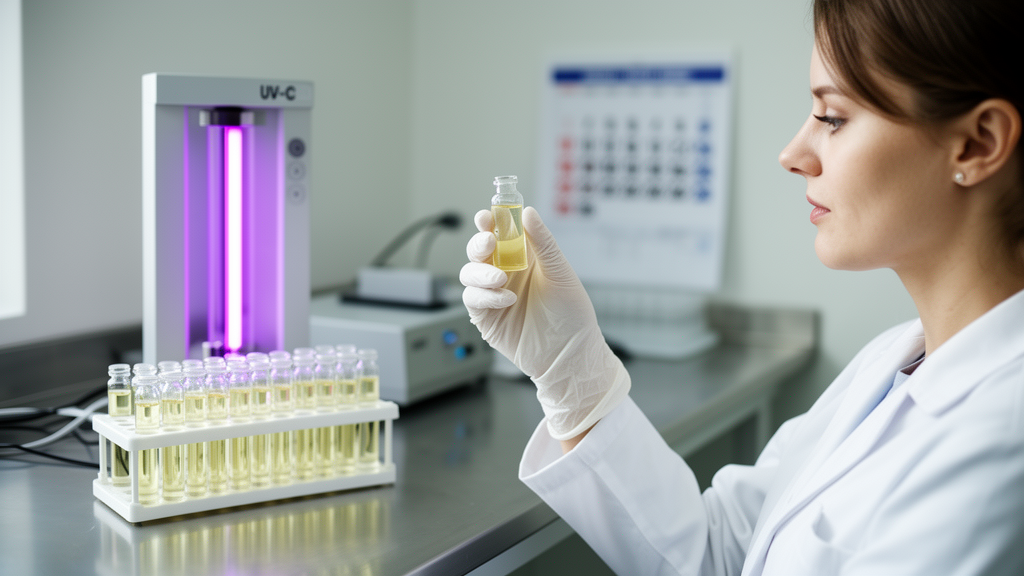
Researchers at Biotest GmbH & Co. KGaA have reported the biochemical characterization and stability testing of a new plasma-derived fibrinogen concentrate, designated BT524, that is manufactured using an innovative ultraviolet-C irradiation step for virus inactivation. Writing in the journal Drugs in R&D, the team describes a process that yields the fibrinogen concentrate and the coagulation factor VIII product Haemoctin SDH in a single shared workflow, and shows that the added irradiation step leaves the protein’s structure, activity and immunogenic profile essentially untouched. The characterization covered six batches produced at commercial scale, while the stability program followed three clinical-scale batches for 60 months.
Fibrinogen, also called clotting factor I, is a soluble plasma glycoprotein central to both primary and secondary hemostasis, including clot formation, platelet aggregation and tissue repair. The elongated 45-nanometer molecule consists of two sets of three polypeptide chains, termed Aα, Bβ and Bγ, and during coagulation thrombin cleaves it at defined N-terminal sites to generate fibrin monomers that polymerize into an insoluble fibrin scaffold with the help of calcium ions and factor XIII. Circulating fibrinogen concentrations in healthy human plasma range from 2 to 4 grams per liter, and deficiency, whether congenital or acquired, impairs blood clotting and raises the risk of bleeding.
Replacement therapy can be delivered as fibrinogen concentrate, fresh frozen plasma or cryoprecipitate, but concentrates offer distinct practical advantages: a defined and consistent fibrinogen content, rapid preparation, no need for blood-type matching, and enhanced pathogen safety through manufacturing procedures that remove or inactivate viruses and prions potentially present in human plasma. Cryoprecipitate and fresh frozen plasma, by contrast, contain variable fibrinogen levels and other procoagulants, require thawing and ABO compatibility, and carry higher risks of transfusion-related complications and pathogen transmission. Demand for plasma-derived medicines is also rising faster than plasma collection; the authors cite the Paul Ehrlich Institute’s 2023 report for Germany, where immunoglobulin consumption rose by roughly 120 percent between 2013 and 2023 while collected plasma grew by only four percent, underscoring the need for manufacturing processes that extract more products from a defined plasma volume.
The BT524 process begins with cryoprecipitate suspended in water for injection, ethanol and heparin, followed by aluminum hydroxide purification at slightly reduced pH, solvent/detergent treatment for virus inactivation, and anion exchange chromatography that separates fibrinogen from fibronectin, factor VIII and von Willebrand factor, the point at which the fibrinogen and factor VIII manufacturing routes diverge. Glycine precipitation then reduces plasma-derived impurities before the solution passes through the new UV-C irradiation step. In a dedicated UVivatec tube reactor, the protein solution flows through a helically coiled channel at a wavelength of 254 nanometers, ensuring uniform exposure; at this wavelength, nucleic acids of potentially present virus particles are damaged as adjacent pyrimidines form dimers that inhibit replication, an approach of particular interest against small non-enveloped viruses for which some established inactivation methods are less effective.
After irradiation, cation exchange chromatography removes residual von Willebrand factor, detergent and potentially present prion proteins, with quantitative prion reduction factors to be reported separately. The solution is then concentrated, formulated, filled at 1 gram of fibrinogen per vial and lyophilized to a residual moisture content of 2.0 to 4.0 percent, a window chosen so that moisture above 2.0 percent supports virus inactivation during the subsequent heat treatment while the 4.0 percent ceiling preserves product integrity. Reconstitution with 50 milliliters of water for injection yields a final fibrinogen concentration of 20 milligrams per milliliter. Preliminary virus-clearance studies with spiked in-process material showed effective reduction, including at least 4 log10 reduction for small non-enveloped Parvoviridae, with lower reduction factors for other non-enveloped and lipid-enveloped viruses that still contribute to the overall virus-safety margin.
To test whether irradiation damages the product, the researchers irradiated laboratory-scale samples of the glycine precipitation intermediate at 175, 220, 350 and 450 joules per square meter, the highest dose being 2.6 times the standard used in routine manufacturing, alongside a non-irradiated control pumped through the same system with the lamp off. Specific fibrinogen activity measured 98 percent across all doses, including the untreated control, and peptide mapping and two-dimensional difference gel electrophoresis showed no alteration of overall structure or composition at the standard dose. Assays probing innate and adaptive immune responses found no increase in neoantigenic structures at the 2.6-fold dose, since irradiated samples did not elicit stronger responses than the non-irradiated sample. At commercial scale, irradiation produced a low-level absolute aggregate increase of approximately 4 percent, with final aggregate levels between 11 and 13 percent; the authors attribute the detected species to small clusters of a few fibrinogen molecules and consider the increase acceptable given unchanged biological activity.
Biochemical characterization of the six commercial-scale batches showed a specific fibrinogen activity of 98 plus or minus 1.6 percent and 1.0 plus or minus 0.04 grams of active fibrinogen per gram of concentrate. SDS-PAGE and western blot analysis of three batches identified the fibrinogen α-, β- and γ-chains as the dominant bands, with only faint higher-molecular-weight species. Concentrations of the primary plasma protein constituents, including albumin, immunoglobulins and coagulation factors, fell below or close to their detection or quantification limits. The non-activated partial thromboplastin time was well above 80 percent of the reference control, a threshold associated in intravenous immunoglobulin practice with a reduced likelihood of thromboembolic events, although the authors note such events cannot be entirely excluded, and no proteolytic activity was detected. Sub-visible particle counts ran approximately one to two orders of magnitude below the pharmacopoeial requirements.
Stability testing followed ICH guidelines, with three clinical-scale batches, roughly half the commercial-scale capacity, stored without secondary packaging at 5 degrees Celsius plus or minus 3 degrees, at 25 degrees Celsius with 60 plus or minus 5 percent relative humidity, and at 30 degrees Celsius with 70 plus or minus 5 percent relative humidity for up to 60 months in a dark climate chamber. The product remained stable throughout, with specific fibrinogen activity never dropping below 95 percent for any batch, condition or time point. An ongoing stability study with commercial-scale material is currently under evaluation, so the five-year claim rests on the clinical-scale batches.
Reconstitution performance proved equally favorable. Across 90 determinations, three batches reconstituted by three operators on two days at room temperature using the nextaro v transfer device showed a mean reconstitution time of 2 minutes 49 seconds plus or minus 45 seconds, with only minimal foam formation, while vials cooled to 5 degrees Celsius before reconstitution took longer at 5 minutes 26 seconds plus or minus 1 minute 45 seconds. After 60 months of lyophilized storage, reconstituted samples held for 24 hours at 5 degrees Celsius or 25 degrees Celsius remained stable across all investigated characteristics, meaning the product can be prepared well in advance of administration.
The characterization sits within a broader clinical development program. In a multicenter phase I/III trial in congenital fibrinogen deficiency, 27 patients received a single 70-milligram-per-kilogram dose for pharmacokinetic and safety assessment, and 36 patients were treated across 175 bleeding episodes or surgical prophylaxis procedures, with treatment raising fibrinogen antigen levels and activity and showing a favorable safety and tolerability profile. In acquired deficiency, the randomized phase III AdFIrst trial enrolled 222 patients with major surgical bleeding and demonstrated non-inferiority of the concentrate compared with fresh frozen plasma or cryoprecipitate, along with a significant reduction in intraoperative blood loss. The authors state that BT524 is the first pharmaceutical product manufactured with this UV-C technology as an additional virus inactivation step, and suggest the approach may also prove useful for manufacturing other plasma-derived medicines.
Subject of Research: Biochemical characterization and stability of the plasma-derived fibrinogen concentrate BT524, manufactured with a UV-C virus inactivation step
Article Title: Biochemical Characterization and Stability of a New Fibrinogen Concentrate (BT524) Manufactured Using an Innovative Virus Inactivation Step
Article References: Schulte, L., Fürtig, B., Scheich, C., Kistner, S., Klaus, M., Michaelis, J. B., Sochor, F., & Maneg, O. (2026). Biochemical Characterization and Stability of a New Fibrinogen Concentrate (BT524) Manufactured Using an Innovative Virus Inactivation Step. Drugs in R&D. https://doi.org/10.1007/s40268-026-00550-z
Image Credits: AI Generated
DOI: 10.1007/s40268-026-00550-z
Keywords: fibrinogen concentrate, BT524, UV-C irradiation, virus inactivation, plasma-derived products, hemostasis, freeze-drying, protein stability, prion removal, coagulation factor VIII, bleeding disorders, drug manufacturing
Cite Scienmag News
Kristina Jarvis. (October 27, 2026). New Fibrinogen Concentrate BT524 Stays Stable for Five Years After UV-C Virus Inactivation. Scienmag. https://scienmag.com/new-fibrinogen-concentrate-bt524-stays-stable-for-five-years-after-uv-c-virus-inactivation/
Kristina Jarvis. "New Fibrinogen Concentrate BT524 Stays Stable for Five Years After UV-C Virus Inactivation." Scienmag, 27 October 2026, https://scienmag.com/new-fibrinogen-concentrate-bt524-stays-stable-for-five-years-after-uv-c-virus-inactivation/. Accessed 28 October 2026.
Kristina Jarvis. "New Fibrinogen Concentrate BT524 Stays Stable for Five Years After UV-C Virus Inactivation." Scienmag. October 27, 2026. https://scienmag.com/new-fibrinogen-concentrate-bt524-stays-stable-for-five-years-after-uv-c-virus-inactivation/