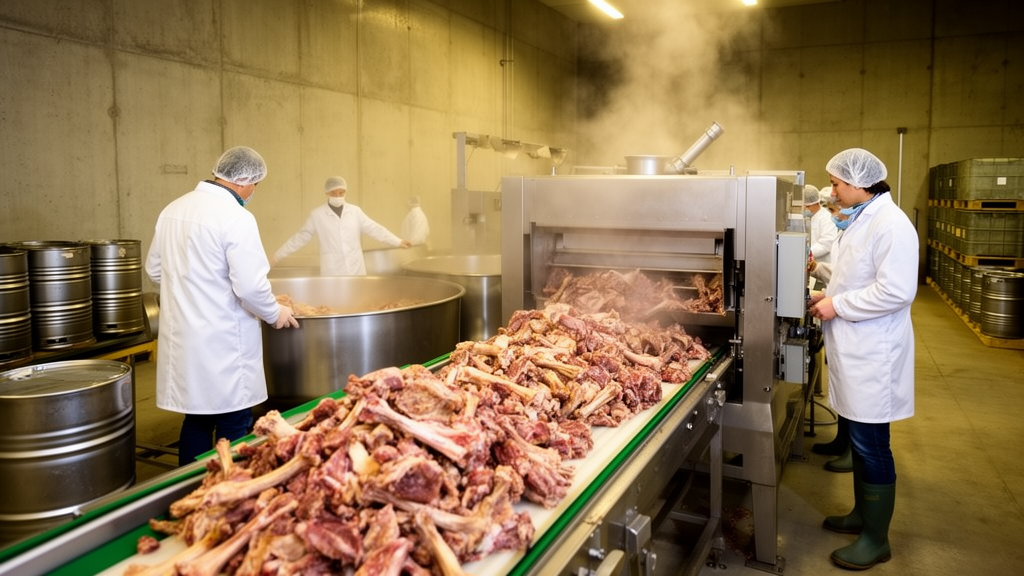
Kazakhstan’s livestock sector generates more than 800,000 tonnes of animal by-products every year, yet only a small fraction of this material is converted into anything of value, according to a narrative review published in Agriculture & Food Security. Blood, bones, skins, offal and fats that could be turned into protein hydrolysates, feed additives, bioenergy or functional food ingredients are instead discarded or used for low-value purposes, a pattern the review describes as both an environmental burden and a missed economic opportunity for a country whose meat production has been growing steadily.
The authors searched major scientific databases between January and August 2025, screened roughly 120 records at title and abstract level, and included 75 sources in the final review. They framed the analysis within a Sustainable Food Systems perspective, drawing on circular economy, bioeconomy and resource-efficiency theory to build a four-dimensional assessment covering technological capacity, regulation, economic viability, and socio-environmental drivers and barriers.
The picture that emerges is one of substantial potential constrained by structural weakness. Limited processing facilities, particularly outside major cities, mean many by-products are discarded or used only for raw skin processing and traditional animal feed. Regional disparities reinforce the pattern: areas with developed agro-industrial complexes such as Almaty and Aqmola benefit from better infrastructure, while remote regions face logistical constraints that severely limit valorisation. In the poultry sector the problem is especially acute, because feathers, offal and hatchery discards are produced in large volumes but rarely converted into higher-value outputs, owing to the absence of cost-effective recycling technologies.
Improperly managed by-products also carry environmental consequences. The review notes that they contribute to pollution, greenhouse gas emissions and public health risks, making improved utilisation both an economic and an environmental imperative. At the same time, traditional uses in national cuisine or as animal feed are no longer sufficient to absorb the volumes generated by modern meat production systems, and the common perception of by-products as disposal burdens rather than economic resources discourages investment in value-added processing.
Regulation is a central part of the problem. Kazakhstan’s framework for animal by-product management is still evolving and remains less comprehensive than the European Union’s Regulation (EC) No 1069/2009, which the authors credit with ensuring the safe and efficient utilisation of by-products across the EU. As a result, investment in technologies for by-product valorisation is limited, and markets for products such as protein hydrolysates, collagen and biogas remain underdeveloped. Viewed through a circular economy lens, the analysis concluded that Kazakhstan still operates largely within a linear, disposal-focused system, with policies designed more for waste management than for waste prevention and valorisation.
There are signs of movement. Recent government initiatives supporting stable-based animal husbandry and investment in processing infrastructure are beginning to address the gaps, and the production of poultry by-products more than tripled between 2016 and 2020, while output of canned goods and powders derived from by-products more than doubled over the same period, reflecting early effects of increased state support. The review also notes that Kazakhstan’s crop and livestock systems remain weakly integrated, so closing nutrient loops through improved by-product valorisation offers potential to reduce dependence on imported synthetic inputs and support rural livelihoods.
Domestic research has made meaningful progress in four key areas, the authors report. Enzymatic hydrolysis of secondary raw materials such as bones, woolly offal and lower-leg cuts has been shown to produce collagen-derived products suitable for functional foods, nutritional supplements and gerodietetic nutrition. Biotechnological methods using bacterial cultures and microbial enzyme preparations have enhanced the physicochemical and amino acid profiles of protein enrichers derived from collagen-rich secondary resources. Work on meat product enhancers has demonstrated that incorporating poultry by-products, including chicken crests, feet and heads, in emulsion or powdered form can improve the nutritional value, texture, antioxidant content and sensory quality of products such as sausages and cutlets. And slaughter by-products including lungs, lips, ears and esophagus have been extruded with cereal grains to produce nutrient-rich feed with improved amino acid profiles, partially substituting for imported protein inputs.
These findings share a common limitation, however: most studies operate at laboratory or pilot scale without assessing economic feasibility, regulatory compliance or pathways to industrial adoption. The review attributes this to broader structural constraints, including fragmented governance, weak industry-research linkages and limited market incentives, and notes that studies on Kazakhstan’s circular economy transition identify uneven institutional engagement, with stronger involvement from academia and weaker commitment from government bodies and financial institutions. Strengthening research-industry-government links, the authors argue, is essential to translate the country’s scientific capabilities into system-wide improvements in by-product management.
To contextualise Kazakhstan’s position, the review compared the EU, the USA, China and Japan, jurisdictions selected for their leadership in utilisation rates, regulatory diversity and relevance to Kazakhstan’s challenges. The comparison illustrates how established frameworks in the EU and USA, rapid modernisation in China and circular models in Japan address similar regulatory and infrastructure challenges, and it identifies priority adaptations for Kazakhstan: risk-based categorisation following the EU model, private rendering incentives following the US model, and modernisation investments following the Chinese model, tailored to livestock-dense regions. The authors caution that this section draws partly on policy documents and industry reports rather than peer-reviewed studies, because peer-reviewed evidence on by-product management in some countries is limited.
From this synthesis the review proposes four integrated strategies for Kazakhstan: modernising rendering infrastructure through public-private partnerships, developing bioenergy applications such as biogas and biodiesel for rural areas, expanding feed and fertiliser uses to replace imports, and implementing awareness and training programmes. Universities such as S. Seifullin Kazakh Agrotechnical University are positioned to bridge laboratory innovations, including enzymatic hydrolysis, to industry through pilot projects, while policy support such as EU-aligned regulations, investment incentives and export certification is described as essential. In its conclusions, the review recommends three priority actions: that the Ministry of Agriculture revise technical regulations to align with the EU regulation’s risk categories, improving safety, traceability and export potential; that government investment and public-private partnerships modernise rendering infrastructure in livestock-dense regions, scaling pilot projects through state grants and subsidised loans; and that tax benefits and subsidies incentivise high valorisation rates and circular bioeconomy practices, supported by annual reporting and export certification programs.
The authors are candid about the limits of their own analysis. The review was constrained by limited availability of peer-reviewed empirical studies and official data on by-product utilisation in Kazakhstan, and some analyses relied on grey literature, government reports and case studies from related regions that may lack methodological rigour or standardised reporting. Official statistics remain fragmented or inconsistent in several cases, and as a narrative review the study may be subject to selection bias. Even so, the authors argue that the narrative approach remains valuable for synthesising a fragmented and heterogeneous evidence base, and that the synthesis identifies trends, barriers and promising opportunities that can inform both policy and research agendas as Kazakhstan seeks to move its livestock sector toward more sustainable and resource-efficient management of animal by-products.
Subject of Research: Animal by-product utilization and valorization in Kazakhstan's livestock sector
Article Title: Future directions in the utilization of animal by-products: case of Kazakhstan
Article References: Baytukenova, S. B., Kostanova, A. T., & Zamaratskaia, G. (2026). Future directions in the utilization of animal by-products: case of Kazakhstan. Agriculture & Food Security, 15(1), Article 46. https://doi.org/10.1186/s40066-026-00637-5
Image Credits: AI Generated
DOI: 10.1186/s40066-026-00637-5
Keywords: animal by-products, Kazakhstan, livestock sector, circular economy, protein hydrolysates, rendering infrastructure, meat industry, bioeconomy, regulation, sustainable food systems, feed additives, waste valorization
Cite Scienmag News
Alan Morgan. (October 27, 2026). Kazakhstan Discards Most of Its 800,000 Tonnes of Annual Animal By-Products. Scienmag. https://scienmag.com/kazakhstan-discards-most-of-its-800000-tonnes-of-annual-animal-by-products/
Alan Morgan. "Kazakhstan Discards Most of Its 800,000 Tonnes of Annual Animal By-Products." Scienmag, 27 October 2026, https://scienmag.com/kazakhstan-discards-most-of-its-800000-tonnes-of-annual-animal-by-products/. Accessed 28 October 2026.
Alan Morgan. "Kazakhstan Discards Most of Its 800,000 Tonnes of Annual Animal By-Products." Scienmag. October 27, 2026. https://scienmag.com/kazakhstan-discards-most-of-its-800000-tonnes-of-annual-animal-by-products/