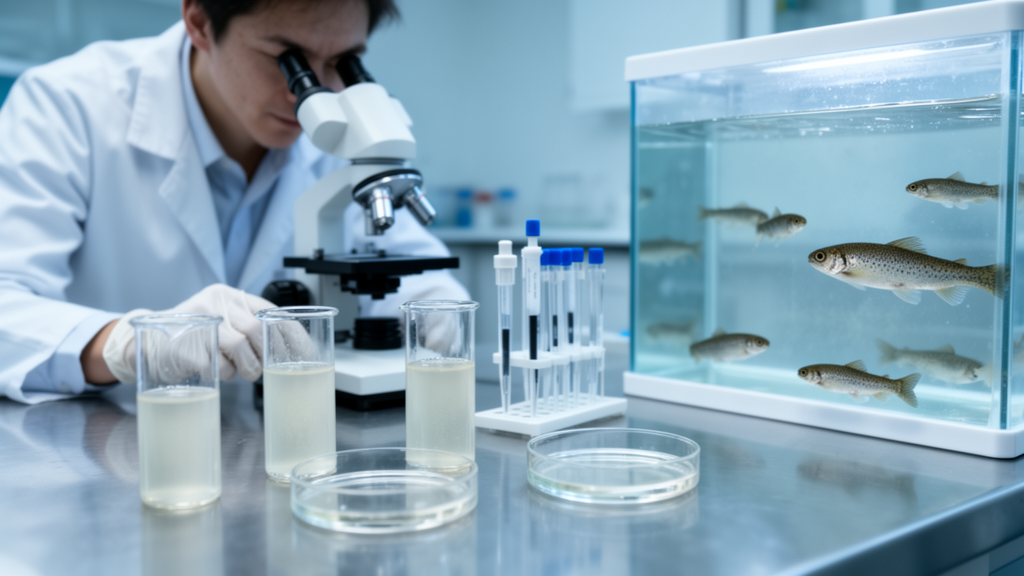
In a laboratory experiment on one of Iran’s most endangered endemic fish, five potentially toxic metals—cadmium, mercury, zinc, copper, and lead—all significantly reduced sperm motility in a concentration-dependent manner, with mercury and cadmium proving the most damaging. The study, published in Aquaculture Science and Management, examined the Sistan snowtrout (Schizothorax zarudnyi), a cyprinid fish native to the Hamoun wetland complex of eastern Iran and western Afghanistan, where it is classified as endangered. The findings offer baseline data for conservation managers working in a wetland system where monitoring studies have documented elevated levels of cadmium, lead, copper, and zinc in water and sediments.
Researchers collected sperm from six sexually mature male snowtrout captured from the Chah Nimeh reservoirs in Sistan during the February–March 2025 breeding season. The fish, averaging 41.16 centimeters in length and 660.83 grams in weight, were injected with ovaprim to synchronize spermiation, and sperm was collected twelve hours later by gentle abdominal pressure. Only samples with more than 90 percent initial motility were used, and sperm from each male served as an individual biological replicate. The samples were kept on ice and used within ten minutes of collection.
The experimental design exposed the sperm to metal chloride solutions at concentrations of 0, 0.1, 1, 10, and 100 milligrams per liter, with distilled water serving as the control. A key methodological detail is that all concentrations refer to the metal salt itself—such as cadmium chloride or mercury chloride—rather than elemental metal ion equivalents, and the reported values reflect final exposure concentrations after a one-to-one dilution of sperm with test solution. The solutions were adjusted to a pH of 7.8 and an osmolality of 5 to 15 milliosmoles per kilogram, matching typical freshwater activation media, so that observed effects could be attributed to the metal ions rather than to differences in physical chemistry.
Sperm motility was assessed under a light microscope at 400-fold magnification, with video recorded at 30 frames per second for 60 to 120 seconds starting at activation. Two independent observers blinded to treatment conditions analyzed the recordings, achieving an intraclass correlation coefficient exceeding 0.92 for all parameters. The team measured total motility duration, defined as the time from activation until 99 percent of sperm were immotile, and recorded the times at which 80, 40, and 10 percent of sperm remained motile, counting at least 100 sperm per field at each time point.
In the control group, sperm remained motile for an average of 63.12 seconds, a value consistent with previously reported figures for cyprinid fish. Cadmium and mercury were the most toxic metals tested. At 10 milligrams per liter of the salt, cadmium reduced motility duration to 10.33 seconds, an 83.6 percent reduction from control, while mercury reduced it to 16.58 seconds, a 73.7 percent reduction. At the highest concentration of 100 milligrams per liter, both cadmium and mercury caused complete and immediate sperm immobilization. Lead showed intermediate toxicity, reducing motility to 15.0 seconds at 100 milligrams per liter without causing complete immobilization, while copper reduced it to 25.0 seconds and zinc, the least toxic, reduced it to 29.53 seconds, with sperm still showing weak flagellar movement.
Based on the percentage reduction in total motility at 10 milligrams per liter, the order of toxicity was cadmium, then mercury, then lead, then copper, then zinc. The authors note that the abstract ranks mercury and cadmium as roughly equivalent in potency, while the results section places cadmium slightly ahead at that specific concentration. The temporal analysis revealed a striking pattern: sperm sensitivity to the metals increased substantially over time. During the early phase of activation, when 80 percent of sperm were still motile, differences between control and the lowest concentration of 0.1 milligrams per liter were often not statistically significant. But during the later phase, when only 40 or 10 percent of sperm remained motile, even the lowest concentrations of all five metals caused significant reductions compared to the control.
Quantitatively, at 0.1 milligrams per liter, cadmium reduced the time at which 80 percent of sperm remained motile by 25 percent, to 16.67 seconds, but reduced the time at which only 10 percent remained motile by 45 percent, to 32.62 seconds. Mercury at the same concentration cut the time to 10 percent motility to 36.33 seconds, a 38 percent reduction. Zinc was the gentlest: even at 100 milligrams per liter, 10 percent of sperm remained motile for 24.89 seconds, and at 0.1 milligrams per liter the time to 10 percent motility was only 12 percent below control. Copper and lead fell in between, with lead reducing the time to 10 percent motility by roughly 76 percent at the highest concentration and 22 percent at the lowest.
The authors caution that their study measured motility parameters only and did not directly measure the mechanistic endpoints often invoked to explain metal toxicity, such as ATP levels, reactive oxygen species production, mitochondrial function, or membrane integrity. The mechanistic explanations they discuss—mercury’s high affinity for sulfhydryl groups in proteins, cadmium’s competition with calcium for entry through voltage-gated calcium channels, lead’s interference with calcium-dependent signaling, and copper’s catalysis of oxidative radical formation—are drawn from previous literature and should be considered potential mechanisms rather than direct findings of this work. Zinc’s comparatively low toxicity is consistent with its role as an essential trace element, with toxicity emerging only at supraphysiological concentrations.
The concentrations at which significant effects were observed overlap with metal levels documented in the Hamoun wetlands. According to available monitoring data cited in the paper, metal concentrations during the dry season typically range from less than 0.001 to 0.05 milligrams per liter for cadmium and lead, and 0.01 to 0.1 milligrams per liter for zinc and copper, while agricultural runoff events during the February–March breeding season can push lead and copper above 0.5 milligrams per liter and zinc above 1.0 milligrams per liter. However, the study did not include direct field measurements of metal concentrations in the study area during the sampling period, and the authors stress that direct extrapolation of laboratory findings to field conditions should be made with caution.
Several further limitations frame the results. The in vitro exposure system does not replicate in vivo conditions, where seminal plasma components may protect sperm from metal toxicity. Each metal was tested individually, whereas environmental contamination typically involves complex mixtures. The sample size of six males was adequate for detecting statistically significant differences but may not capture natural variation, and no fertilization success assays or field validation were performed. The authors also note that the study did not measure mechanistic endpoints and did not conduct field validation. Within these constraints, the findings suggest that wild Sistan snowtrout populations may face potential risks of reproductive impairment in contaminated habitats, and the authors recommend seasonal monitoring of metals—especially mercury and cadmium—during the breeding season, careful water quality management in captive breeding programs, and future research integrating field monitoring, in vivo exposures, and assessment of fertilization success to confirm the ecological relevance of these laboratory observations.
Subject of Research: In vitro effects of five heavy metals on sperm motility of the endangered Sistan snowtrout
Article Title: Comparative effects of cadmium, mercury, zinc, copper, and lead on sperm motility parameters of the endangered sistan snowtrout (Schizothorax zarudnyi Nikolskii, 1897) (cypriniformes: cyprinidae)
Article References: Amin, G., Gharaei, A., Javad, M. H., & Roghayeh, K. (2026). Comparative effects of cadmium, mercury, zinc, copper, and lead on sperm motility parameters of the endangered sistan snowtrout (Schizothorax zarudnyi Nikolskii, 1897) (cypriniformes: cyprinidae). Aquaculture Science and Management, 3(1), Article 17. https://doi.org/10.1186/s44365-026-00044-8
Image Credits: AI Generated
DOI: 10.1186/s44365-026-00044-8
Keywords: Sistan snowtrout, Schizothorax zarudnyi, heavy metals, sperm motility, cadmium, mercury, Hamoun wetlands, reproductive toxicity, endangered species, in vitro, aquatic toxicology, Iran
Cite Scienmag News
Margaret Porter. (October 28, 2026). Five heavy metals impair sperm motility of endangered Sistan snowtrout in lab tests. Scienmag. https://scienmag.com/five-heavy-metals-impair-sperm-motility-of-endangered-sistan-snowtrout-in-lab-tests/
Margaret Porter. "Five heavy metals impair sperm motility of endangered Sistan snowtrout in lab tests." Scienmag, 28 October 2026, https://scienmag.com/five-heavy-metals-impair-sperm-motility-of-endangered-sistan-snowtrout-in-lab-tests/. Accessed 28 October 2026.
Margaret Porter. "Five heavy metals impair sperm motility of endangered Sistan snowtrout in lab tests." Scienmag. October 28, 2026. https://scienmag.com/five-heavy-metals-impair-sperm-motility-of-endangered-sistan-snowtrout-in-lab-tests/